

You’ve seen the videos. A capybara sitting in a hot tub with an orange balanced on its head. A capybara letting a bird perch on its back like it’s the most normal thing in the world. They look like the calmest animal on Earth, and somewhere in the middle of that third clip, a thought shows up: could I actually have one of these?
If you live in Michigan, the answer is probably yes.
But not for the reason every other website will tell you.
Here’s what makes Michigan strange. Most states either ban capybaras outright or hand you a permit form. Michigan does neither. There is no state permit for a pet capybara — and if you go looking for one, you’ll find that the office you’re calling doesn’t have a box to put you in. That sounds like good news. It isn’t, exactly. It means the decision gets made somewhere much closer to home: your city hall, your township office, your zoning board.
This guide walks you through what Michigan law actually says in 2026, why the permit advice you’ve read elsewhere is wrong, what it really costs (plan for at least $9,000 in year one), and what daily life with two 100-pound semi-aquatic rodents looks like when it’s fifteen degrees outside and the pool is trying to freeze.
By the end, you’ll know exactly who to call, in what order, and whether you’re honestly ready.
Let’s start with the law.
KEY TAKEAWAYS
- Capybaras are not banned in Michigan. They aren’t on the Large Carnivore Act list, and they aren’t on the state’s prohibited invasive species list.
- There is no DNR permit for a pet capybara. The Captive Game Permit that other guides point you to covers Michigan game animals only raccoon, beaver, fox, coyote and so on. A capybara is not a Michigan game animal, and the DNR says species not on that list cannot be held under that permit.
- Your local government is the real gatekeeper. With almost no state-level rule to lean on, your city or township ordinance decides whether you can legally keep one.
- If you buy out of state, MDARD requires a health certificate. Capybaras count as nonnative rodents, so a vet-signed interstate CVI comes with the animal.
- Plan for at least two. A single capybara is a welfare problem, not a pet.
- Michigan winter is the hardest part of this. Not the paperwork. The winter.
Michigan Legal Status Overview (2026 Update)
Is It Legal to Own a Capybara in Michigan?
Yes, nothing in Michigan state law bans a capybara.
That’s the honest answer, and it’s worth understanding why, because the “why” tells you where the real obstacles are.
Michigan doesn’t have one big exotic pet law. It has a handful of separate laws, each aimed at a different problem. A capybara slips through the gaps in all of them.
The Large Carnivore Act (Act 274 of 2000) bans private ownership of lions, tigers, leopards, jaguars, cougars, cheetahs, and bears. It’s aimed at animals that can kill you. A capybara is a rodent. It isn’t on the list, and it was never meant to be.
NREPA Part 413 is Michigan’s invasive species law. It lists organisms that are prohibited or restricted because they’d wreck the ecosystem if they got loose. There is a big semi-aquatic rodent on that list nutria. Capybaras aren’t. If a lawmaker had been worried about capybaras escaping into Michigan wetlands, this is the list they’d be on. They’re not on it.
MDARD’s Animal Industry Act governs importing animals into the state and bans possession of large carnivores and wolf-dog hybrids. Again, capybaras aren’t named.
So three separate doors, and a capybara walks through all three.
⚠️ QUICK ALERT “Not banned” is not the same as “you’re clear.” Keep reading. The part that stops most Michigan buyers is on the next screen.
The Permit Myth: Why Nearly Every Guide Gets This Wrong
Search “are capybaras legal in Virginia” to see a simple permit system, because Michigan’s process is famously convoluted.
That permit does not cover capybaras.
Here’s the actual text of the situation. The Captive Game Permit is issued under Part 427 of NREPA Breeders and Dealers. It exists so that people can legally hold Michigan game animals in captivity. The DNR publishes the exact list of species it covers:
Badger, bobcat, fox, raccoon, coyote, beaver, otter, muskrat, mink, squirrel, skunk, woodchuck, opossum, pheasant, bobwhite quail, Hungarian partridge, ducks, geese, and wild turkey.
And then the line that settles it: Michigan game animals not on that list may not be possessed under a Permit to Hold Game in Captivity.
A capybara is not a Michigan game animal. It isn’t native to Michigan. It isn’t hunted here. It doesn’t “closely resemble a game species” nobody is confusing a 130-pound South American rodent with a woodchuck. The permit has enclosure specs for beavers and otters and coyotes. It has none for capybaras, because the permit was never built with them in mind.
If you call the DNR Wildlife Division Permit Specialist and ask to add “capybara” to a Captive Game Permit, you will not get a permit. You’ll get a confused pause and, probably, a suggestion that you call your township.
Which is the real answer.
💡 EXPERT TIP Don’t take my word for it, and don’t take theirs. Call the DNR Wildlife Division Permit Specialist at 517-284-6210 and ask directly: “Is a capybara covered under any DNR permit?” Write down the name of the person who answers and the date. That one phone call is your best protection
So, What Does Apply to You?
Two things.
- MDARD import rules (only if the animal comes from out of state).
Almost every capybara sold in the US comes from Texas, Florida, or another southern breeder. That means your animal is crossing a state line, and that triggers MDARD.
Michigan classifies capybaras as nonnative rodents. The rule for nonnative rodents entering Michigan: the animal must arrive with an official interstate Certificate of Veterinary Inspection (CVI), completed by a USDA-accredited veterinarian in the state the animal is coming from. Michigan does not issue entry permits for nonnative rodents, so there’s no permit number to write on the certificate. The CVI travels with the animal. That’s it.
Your breeder handles most of this. Ask for it in writing before you pay.
And note the sentence MDARD attaches to that rule, because it’s the whole point of this article: check local ordinances for any further regulations that may apply.
- Your local ordinance.
This is the one that decides your case.
Your City or Township Is the Real Law
Here’s the reality most people don’t expect.
In Florida, the state says yes yes whereas California exotic pet bans operate at the state level.. In Michigan, the state barely has an opinion at all and that vacuum gets filled by whoever governs your street.
Michigan has 1,240 townships and 275 cities. Many of them have an animal ordinance written decades ago that says something like “no wild, exotic, or non-domesticated animals shall be kept within city limits.” No list. No species names. Just a broad category, and a code enforcement officer who gets to decide whether a capybara lands inside it.
Guess how that decision usually goes.
Some ordinances are more specific and set a weight limit, or ban “livestock,” or restrict any animal “not customarily kept as a household pet.” A capybara fails most of those tests on sight. Others are silent, which is genuinely good for you but you need to confirm the silence, not assume it.
There’s no state law that overrides your township here. You have no preemption argument. If your township says no, the answer is no.
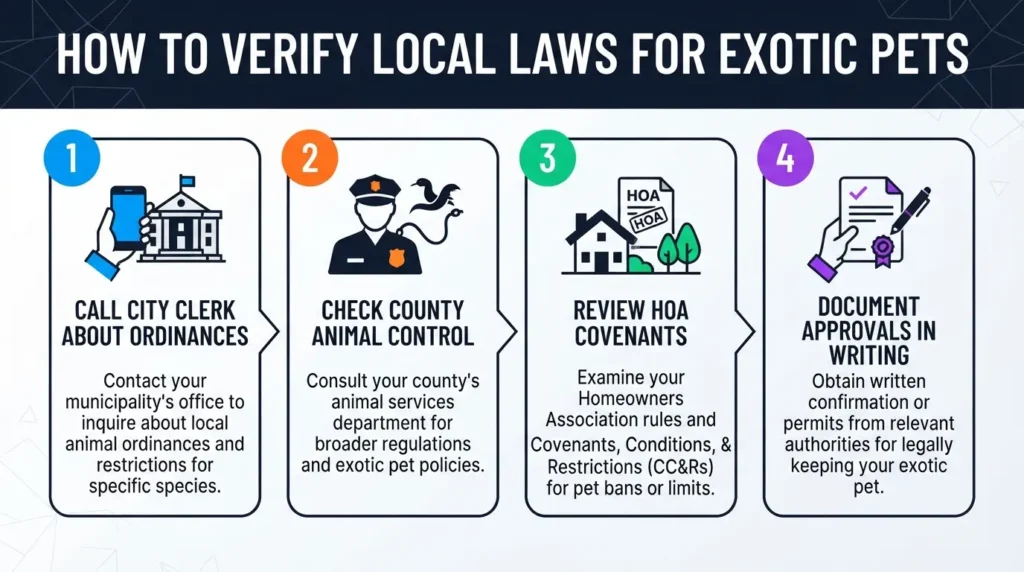
How to Check Your Local Laws (Do This First — Before Anything Else)
Step 1: Find your ordinance online.
Most Michigan municipalities publish their code through Municode, General Code, or their own site. Search the animal chapter for: exotic, wild, non-domestic, livestock, rodent, permit. Don’t search only for “capybara” almost no ordinance names them.
Step 2: Call the clerk.
City clerk or township clerk, whichever governs you. Ask plainly: “I want to keep two capybaras large South American rodents, about 100 pounds each, kept outdoors. Is that allowed under our ordinance?” Be specific about the size. Don’t say “a big guinea pig.”
Step 3: Check the county too.
Some counties layer their own animal control rules on top of city rules. The stricter one wins.
Step 4: Check your zoning.
Residential zoning may prohibit what the animal ordinance permits. Agricultural zoning is usually your friend here.
Step 5: Read your HOA covenants or lease.
An HOA is a private contract. It doesn’t care what the state allows. A single covenant banning “exotic animals” ends this, and a neighbor complaint is all it takes to trigger enforcement.
Step 6: Get it in writing.
An email from the clerk saying “our ordinance does not prohibit this” is worth more than any phone call you can’t prove happened. Save it. Print it. Keep it with your vet records.
💡 EXPERT TIP Do all six steps before you contact a breeder, put down a deposit, or buy a single fence post. Every dollar you spend before you have that written answer is a dollar you’re gambling.
What You Actually Need to Do: The Real Michigan Roadmap
Forget the permit application. Here’s the sequence that actually applies.
Step 1: Confirm your local ordinance allows it (2–4 weeks)
See above. This is your gate. Nothing else matters until it’s cleared.
Step 2: Call the DNR to confirm no state permit applies (1 day)
517-284-6210. Ask, document, move on. You’re doing this to protect yourself, not to get a form.
Step 3: Find your vet before you find your capybara (2–6 weeks)
This is harder than it sounds and it’s the step people skip. Most Michigan small-animal clinics will not see a 100-pound rodent. You need an exotic mammal vet, and you need one who’ll say yes in advance. Start with the AEMV “Find a Vet” directory and call every Michigan listing. Ask directly: “Have you treated a capybara? How many?” A vet who’s treated one capybara is worth more than a vet who’s read about them.
Step 4: Build the enclosure (2–4 months, weather dependent)
Full specs below. Build it before the animal arrives, not after. And build it before winter, because you cannot pour concrete or dig a pool in a Michigan February.
Step 5: Source from a USDA-licensed breeder (1–3 months)
Capybaras aren’t bred in Michigan in any real numbers. You’re buying out of state, which means the CVI, transport, and a long drive. Buy a pair.
Step 6: Handle the import paperwork
Your breeder’s accredited vet issues the interstate CVI. Confirm it’s done before the animal is loaded. Keep the original.
Realistic total timeline: six to nine months. Most of that is enclosure construction and finding a vet. Almost none of it is paperwork which, honestly, is the surprise here.
The True Cost: Year One and Ongoing
The viral videos never show the receipts. Here’s what a pair of capybaras actually costs in Michigan.
Expense | Year One | Annual After | Notes |
Capybaras (pair) | $3,000 – $5,000 | — | $1,500–$2,500 each. Never buy one. |
Transport from out-of-state breeder | $500 – $1,500 | — | Driving it yourself is cheaper and less stressful for the animal. |
Interstate CVI + health paperwork | $150 – $400 | — | Issued by the breeder’s accredited vet. |
Fencing & enclosure | $2,000 – $4,500 | $200 – $500 | Welded wire, posts, gate, buried dig barrier. DIY saves a lot. |
Pool & filtration | $1,500 – $3,500 | $300 – $600 | Stock tank or in-ground pond, pump, filter, plumbing, bottom drain. |
Heated winter shelter | $1,500 – $3,500 | $400 – $900 | Insulated structure plus the electric bill. This is the Michigan line item. |
Stock tank heater / de-icer | $150 – $400 | $250 – $600 | Running a heater all winter is not cheap. |
Initial veterinary care | $300 – $600 | $250 – $500 | Wellness exam, fecals, parasite treatment. |
Food, hay, vitamin C | $700 – $1,200 | $700 – $1,200 | Two adults eat a lot of hay. |
Enrichment, water testing, misc. | $200 – $400 | $150 – $300 |
|
TOTAL | $10,000 – $21,000 | $2,250 – $4,600 |
|
Budget $9,000 as an absolute floor and expect to land above it. If you’re hiring contractors instead of building yourself, use the top of every range. Urban and metro-Detroit costs run higher.
And keep an emergency fund. An exotic vet emergency for a 100-pound rodent is not a $200 visit.
Capybara Care: The Three Non-Negotiables
Capybaras are not giant guinea pigs, so learn how a capybara differs from nutria first.
That comparison is where most bad decisions start.
1. They Must Have a Friend
Problem: In the wild, capybaras live in groups of ten to twenty. They’re built for constant company they call to each other, sleep in piles, and take turns watching for danger.
Why it matters: A capybara kept alone gets chronically stressed. That’s not a mood; it’s a physiological state. It shows up as pacing, appetite loss, aggression, self-injury, and a weakened immune system. Your attention does not substitute. You are not a capybara.
Solution: Get two. A neutered male and a female, or two females. Intact males will fight. Introduce new animals slowly, in neutral space, and expect some early squabbling before they settle.
Yes, this doubles everything. That’s not a reason to keep one — it’s a reason to be sure.
💡 EXPERT TIP If your budget only stretches to one capybara, your budget doesn’t stretch to capybaras.
2. They Must Have Real Water
Problem: Capybaras are semi-aquatic .Their skin dries and cracks without regular soaking, and water is where they escape stress, cool down, mate, and yes defecate.
Why it matters: A kiddie pool is not water.
They need enough depth to fully submerge, though they cannot breathe underwater while submerged.
Without it, you get skin lesions, fungal infections, and a miserable animal.
Solution: Minimum 8 ft × 8 ft, at least 2–3 feet deep, with a gradual entry so they can walk in and out. A bottom drain saves your back. Mechanical and biological filtration — a basic pool pump will lose this fight within a week.
Never use chlorinated pool water. It irritates their skin and eyes. And no, they cannot swim in your family pool. They will contaminate it within hours.
3. They Must Eat Like Grazers
Problem: Their teeth never stop growing, and like guinea pigs, they can’t make their own vitamin C.
Why it matters: Too little hay means overgrown teeth and painful malocclusion. Too little vitamin C means scurvy swollen joints, lethargy, dull coat. Both are common. Both are entirely preventable.
Solution:
- Hay, unlimited, always. Timothy, orchard, or meadow. This is about 80% of the diet and it’s what wears their teeth down.
- Fresh vegetables daily. Romaine, kale, bell pepper, cucumber, carrots in moderation. Skip iceberg lettuce.
- A daily vitamin C supplement formulated for exotic rodents. Not optional.
- Limited high-fiber pellets guinea pig formulas, not rabbit.
- Fruit is a treat, not a food. Sugar wrecks their gut.
The Michigan Problem Nobody Warns You About: Winter
Everything above is true in Texas too. This part is ours.
Capybaras are from South America, where they share ecosystems with crocodiles in natural river habitats.
. Their whole design assumes warm water and no snow. Michigan gives them neither for about five months a year.
Here’s the reality:
Their pool will try to freeze. A frozen pool isn’t just unusable it’s a hazard. You’ll need a livestock stock-tank heater or de-icer, sized for your volume, running through the cold months. Insulated covers help. Your December electric bill will notice.
Freezing air is dangerous, not just uncomfortable. Prolonged exposure to below-freezing temperatures can kill a capybara. “They have thick fur” is not a plan. They need a heated, insulated shelter they can access at will big enough for two adults to lie down and turn around, dry, ventilated, and warm.
Their skin gets worse in winter, not better. Dry indoor air plus less swimming equals cracking. Winter is when skin problems show up.
Solution: Treat the heated shelter as core infrastructure, not an add-on. An insulated barn stall, a converted shed with a heat source, or a purpose-built structure inside the enclosure. Plan it with the enclosure, in the same build, in the same budget.
If you can’t afford to heat it all winter, every winter, for ten to twelve years this isn’t the pet.
Myths vs. Reality
Myth 1: They’re low-maintenance.
Reality: Daily pool management, daily feeding, weekly deep cleans, constant fence checks, and a winter routine. This is closer to keeping livestock than keeping a dog.
Myth 2: One capybara will be happy if I love it enough.
Reality: No. Covered above. This one isn’t debatable.
Myth 3: They can live indoors like a dog.
Reality: They aren’t house-trainable in any meaningful sense, and they defecate in water. An indoor capybara is a demolition project with a plumbing problem.
Myth 4: They’re fine in the cold look at those coats.
Reality: They’re tropical animals. Michigan winter can kill them.
Myth 5: Any vet can treat one.
Reality: Most Michigan vets will decline. Find yours before you need one, not during an emergency at 11pm.
Myth 6: A DNR permit makes it legal anywhere in Michigan.
Reality: There is no DNR permit for capybaras, and even if there were, it wouldn’t override your township ordinance. Local law is the law here.
Sourcing: Breeders and Rescues
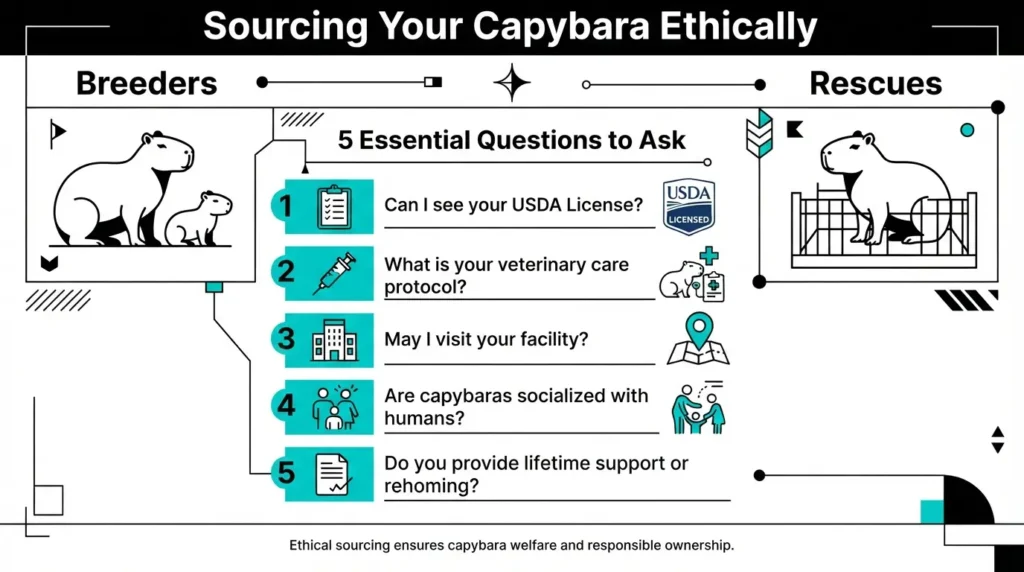
There are very few capybara breeders in Michigan. You’re almost certainly buying out of state.
Questions to ask any breeder:
- Are you USDA-licensed? (Required if they’re selling across state lines.)
- Can I visit and see the parents?
- Will you provide the interstate CVI?
- What have the babies been fed, and are they weaned?
- Can you give me references from past buyers?
Red flags: won’t let you visit, happy to sell you a single animal without asking a single question, no health records, pressure to pay a deposit fast, prices well below market.
A breeder who tries to talk you out of it is probably a good breeder.
Rescues occasionally have capybaras surrendered by owners who got in over their head which happens more than the internet suggests. Adoption costs less and you’re helping an animal that needs it. The trade-off is an unknown history and possibly an adult with established habits. Worth a look, and worth being honest with yourself about whether you can handle it.
Real Problems, Real Solutions
Challenge: The pool turns green and foul in three days.
They defecate in the water. It’s normal and it’s not going to stop. Install a high-capacity pond filter with UV sterilization and a bottom drain. Partial water changes weekly, full scrub monthly. Some owners set up a smaller, easy-to-dump “second pool” that gets used more heavily and cleaned daily.
Challenge: The fence.
Capybaras dig and they push. Use 4-foot welded wire, buried 12–18 inches or fitted with an L-footer skirt. Walk the perimeter weekly. A hot wire at the base helps, if installed safely.
Challenge: Squabbling pair.
Give them options multiple shelters, multiple feeding spots, more than one way into the pool. Most conflict is about competition for a single resource. Neuter males if you’re not breeding.
Challenge: You want to take a vacation.
There is no kennel for this. Train a friend or family member months in advance, and have them do a full weekend solo before you leave. Some exotic vet clinics board. Ask early.
Frequently Asked Questions
Do I need a permit to own a capybara in Michigan?
Not from the DNR no state permit covers pet capybaras. If you import one from another state, MDARD requires an interstate health certificate (CVI) from a USDA-accredited vet. Your city or township may require its own permit or may ban them entirely. Check locally first.
Are capybaras legal in my specific Michigan city?
That’s the only question that really matters, and only your clerk can answer it. Call them. Get it in writing.
Can I own just one if I spend a lot of time with it?
No. They’re obligately social. One capybara is a stressed capybara.
Do capybaras get along with dogs?
Sometimes. It’s risky. A dog’s play can seriously injure a capybara, and a startled capybara can bite hard. Never unsupervised, ever.
How long do they live?
Ten to twelve years with good care. Plan for a decade of winters.
Do they smell?
The animals themselves don’t, much. The pool absolutely will if you neglect it.
Can they swim in my swimming pool?
No. Chlorine damages their skin and eyes, and they’ll contaminate it immediately.
What if my capybara escapes?
Call local animal control and the DNR right away. A loose 100-pound rodent is a traffic hazard and a public safety issue, and it will not survive long on its own here.
What if I move to another state?
Research the destination before you commit. California, Colorado, and several other states ban them outright. You may not be able to take them with you and rehoming a bonded pair is hard.
Final Thoughts
Michigan is one of the easier states to legally own a capybara and one of the harder states to actually keep one.
The paperwork is thin. There’s no permit to chase, no inspection to pass, no fee to pay the state. That surprises people, and it’s genuinely the least of your problems.
The hard part is the winter, the water, the second animal you didn’t budget for, the vet you can’t find, and the township clerk who’s never had this question before. Get those five things right and you can give a pair of capybaras a good life here.
Get them wrong and you’ll be trying to rehome two large rodents in February. It happens more than you’d think.
If you’ve read this far and you’re still excited — good. Start with the phone call to your clerk.
Am I Ready? Self-Assessment
Answer honestly. Count your yeses.
☐ I have at least 250 sq ft of outdoor space I can fence and dedicate permanently.
☐ I can spend $9,000+ in year one without straining.
☐ I’m getting two, not one.
☐ I have written confirmation from my city/township/HOA that this is allowed.
☐ I’ve found an exotic vet within driving distance who has treated capybaras.
☐ I can do daily pool management and weekly deep cleaning, in January.
☐ I have a real, budgeted plan for a heated winter shelter.
☐ I accept they live outdoors, not on my couch.
☐ I’m committed for 10–12 years.
☐ I have a reliable hay supply and a vitamin C source.
9–10 yes: You’ve done the work. Start with the clerk’s office.
6–8 yes: You have real gaps. Close them before you spend anything.
0–5 yes: Not now. Visit a capybara at a licensed facility, volunteer, and revisit in a year.