
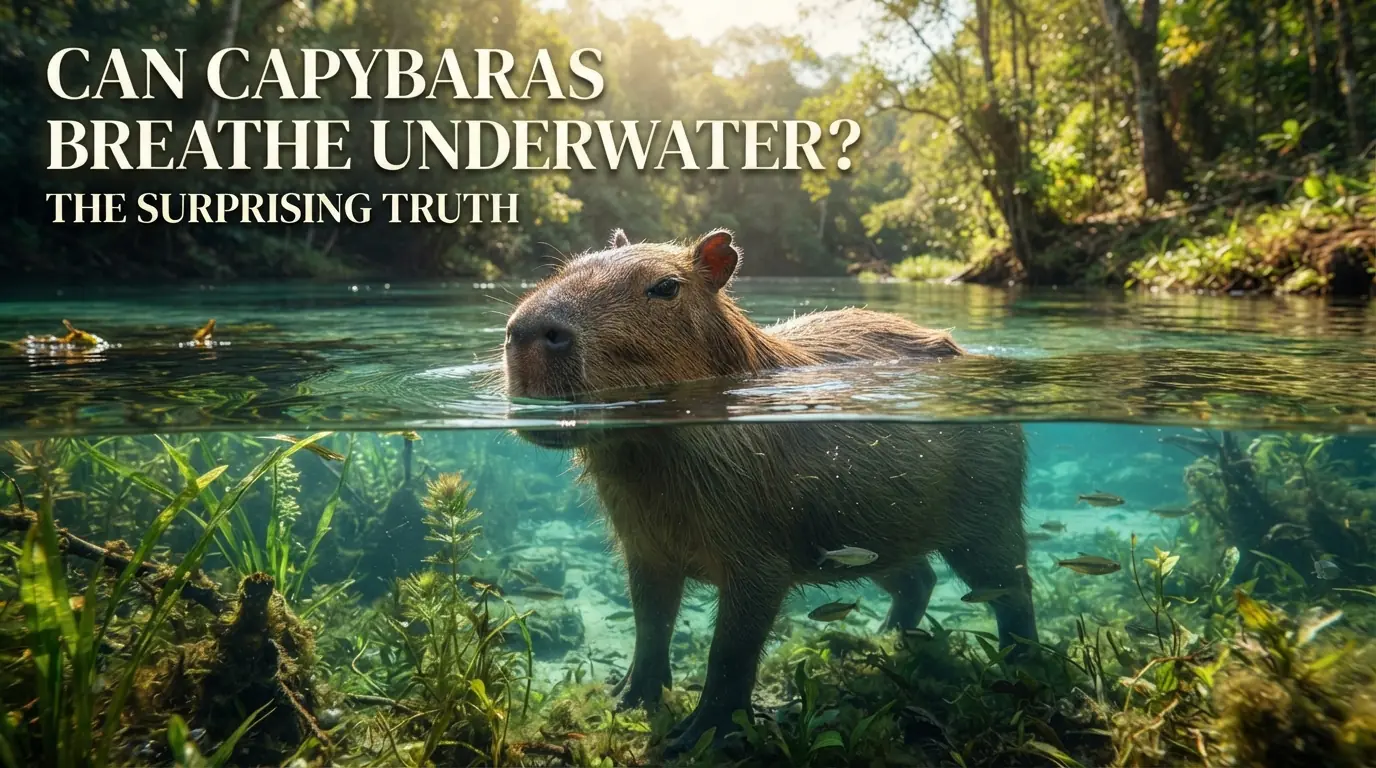
Picture a rodent the size of a large dog slipping into a murky river and simply vanishing. No splash. No struggle. Just a smooth brown back sliding under the surface, gone for minutes at a time. It sounds like something a fish would do. It isn’t. It’s a capybara, the world’s largest rodent, and its underwater talents are strange enough to start arguments in comment sections.
So here’s the question everyone asks: can a capybara actually breathe underwater? The short answer is no. But the long answer is far more interesting, because what looks like breathing underwater is really a stack of adaptations most land animals could never pull off. People assume these gentle giants must have gills, or some amphibian trick up their sleeve. The truth is stranger, and a lot more impressive.
In this guide, you’ll find out exactly how long a capybara can hold its breath, the physiology that makes it possible, and how it stacks up against beavers, otters, and hippos. We’ll bust the myths that refuse to die, follow a capybara through the moments underwater actually matters, and by the end you’ll look at that lazy riverside lounger a little differently.
So take a breath, you’ll need it, and let’s dive in.
Try This: Somewhere in the breath-holding section below, you’ll hit a “Hold Your Breath” challenge. Start a timer, seal your lips, and see how you measure up against a capybara’s five-minute record. Fair warning: you probably won’t win.
The Quick Answer: No, Capybaras Can’t Breathe Underwater
Let’s settle it before we go deeper. No, capybaras cannot breathe underwater. They’re mammals, plain and simple, closer kin to a guinea pig than to any fish, and they breathe air through lungs just like we do. There are no gills hiding under that fur, and no oxygen-absorbing skin. Every capybara you’ve ever seen submerged was holding its breath, nothing more.
What makes that so easy to misread is how long they can stay under. Here’s the quick version:
- Capybaras are mammals, not fish or amphibians. They have lungs and must surface to breathe.
- They can’t pull oxygen from water. No gills, no skin-based breathing.
- They can hold their breath for up to five minutes, though two to three minutes is more typical during ordinary swimming and grazing.
- They seal their nostrils and fold down their ears before going under.
- Their heart rate drops sharply once submerged, stretching their oxygen supply.
- They’re genuinely good swimmers, moving at roughly 8 km/h (about 5 mph).
Source note: The San Diego Zoo and other wildlife authorities put the capybara’s maximum breath-hold at around five minutes.
That five-minute figure is the headline. Now let’s look at the body built to earn it.
Anatomical Superpowers: How Capybaras Are Built for Water
A capybara doesn’t breathe underwater, but almost everything about its body is quietly engineered for life in and around it. Head to tail, it reads like a checklist for a semi-aquatic specialist.
Webbed Feet and Streamlined Body
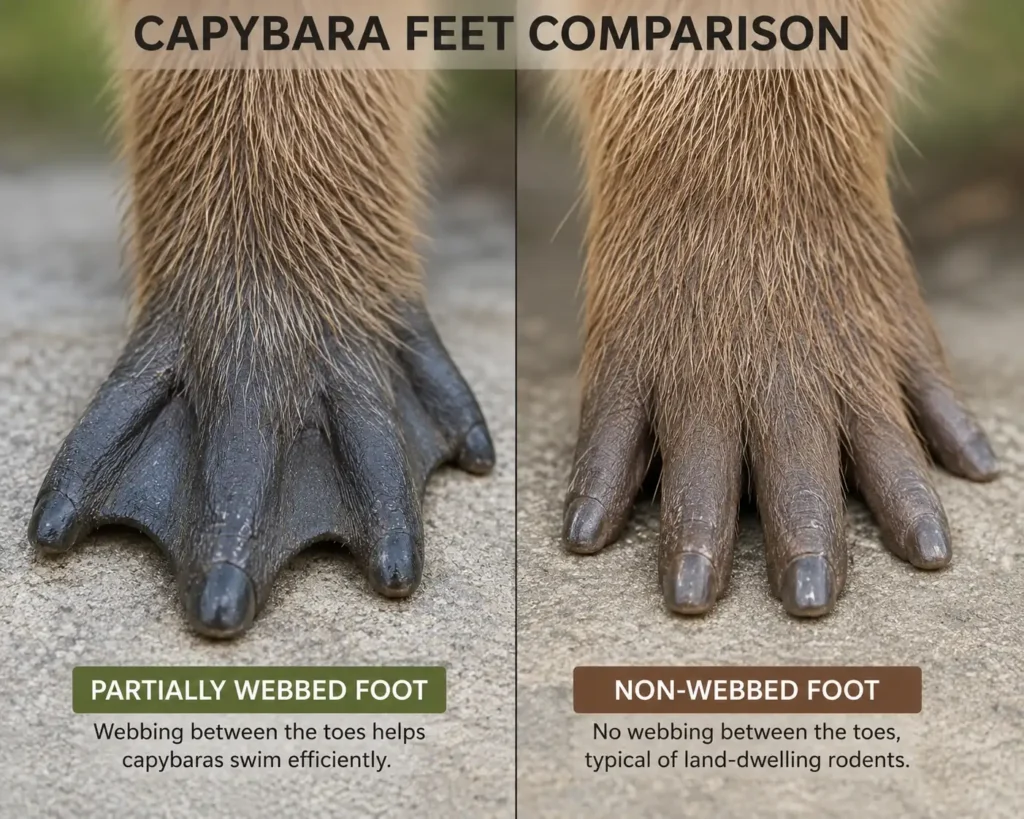
Start at the feet. Capybaras have partially webbed toes, little sails of skin that turn each paw into a soft paddle. It’s not the full flipper you’d find on an otter, but it’s enough to push a heavy body through water with surprising ease.
The body helps too. That barrel-shaped torso looks ungainly on land, yet in water it becomes an asset, rounded and smooth, cutting drag as the animal glides. Their legs sit short and wide, which does little for grace on a riverbank but everything for stability in soft, sucking mud.
High-Set Sensory Organs: Periscope Vision
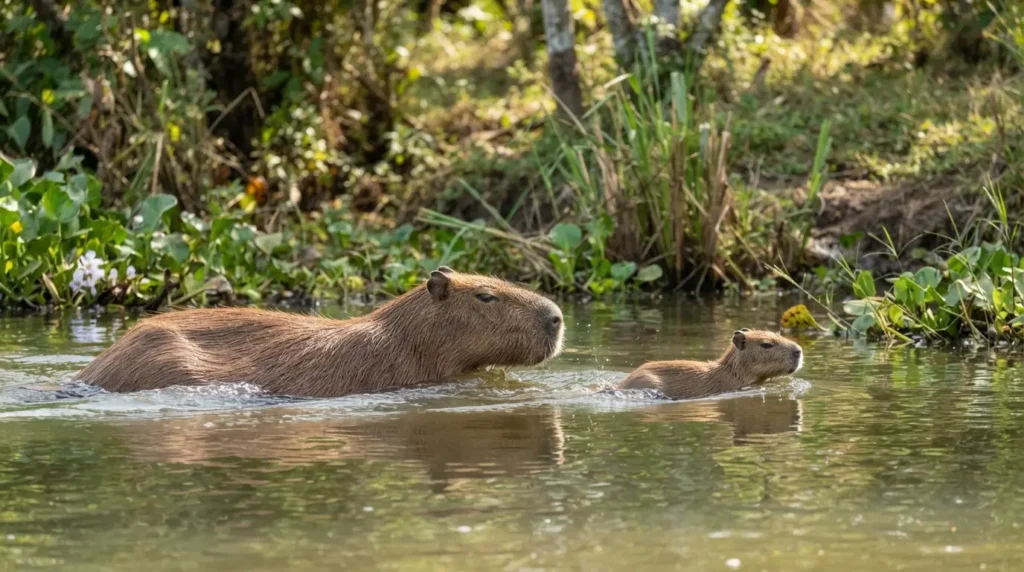
Now look at the head. A capybara’s eyes, ears, and nostrils are all pushed up to the very top of the skull. That single design choice lets it do something remarkable: float almost entirely underwater while still seeing, hearing, and breathing. Only a thin strip of face breaks the surface.
Biologists call this a periscope arrangement, and it’s the same trick hippos and crocodiles use, though the popular capybara and crocodile relationship story is largely misunderstood. Three unrelated animals, one identical solution, a textbook case of convergent evolution, where separate lineages stumble onto the same answer to the same problem.
Expert Tip: Visit a zoo with a capybara pool and watch how they rest in the water. You’ll see the body disappear while the eyes and nostrils hover just above the waterline, like a submarine at periscope depth.
Nostril and Ear Valves: Nature’s Scuba Gear
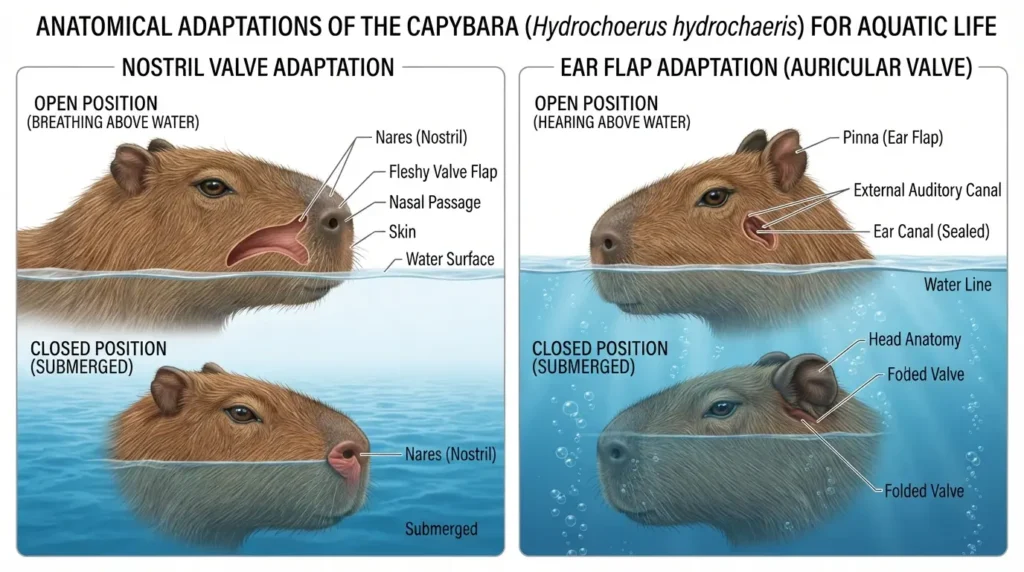
Here’s where it gets clever. When a capybara goes under, it can voluntarily close its nostrils and ears, sealing them with muscle and small flaps of skin. Water stays out of the airway and the ear canal, no matter how long the dive lasts.
That seal is good enough to eat with. A submerged capybara can crop and chew aquatic plants without swallowing a drop, nostrils clamped shut the entire time.
Dense, Water-Repellent Fur
Their coat is the odd one out. It’s coarse and sparse rather than plush, and it won’t win any awards for waterproofing. What it does well is dry fast in the tropical sun, and a layer of fat beneath the skin adds a little buoyancy and insulation in cool water.
This is where capybaras part ways with the true water specialists. A beaver or an otter carries a thick, dense undercoat that traps air and seals out cold. A capybara doesn’t bother. Its skin is thick and tough instead, built to shrug off scrapes from reeds and rocks rather than to keep every drop at bay. It’s the coat of an animal that floats and grazes in warm water, not one that dives through freezing rivers.
A body built for water is only half the story. The real magic happens on the inside.
The Science of Breath-Holding: The Mammalian Diving Reflex
When a capybara slips beneath the surface, it isn’t holding its breath out of panic. It’s running a finely tuned survival program that every mammal carries. Capybaras just run it better than most.
What Is the Mammalian Diving Reflex?
The mammalian diving reflex is an ancient piece of wiring shared by every mammal on Earth, including you. Dunk your face in cold water and your body starts rationing oxygen automatically. The reflex kicks off three responses at once: bradycardia (a slowed heart rate), peripheral vasoconstriction (blood flow pulling back from the limbs and skin), and splenic contraction (the spleen squeezing out a fresh reserve of oxygen-rich red blood cells).
In capybaras, this reflex is turned up. It lets a land-based herbivore stay under far longer than a comparable animal that never goes near water.
How Capybaras Conserve Oxygen
Think of it as onboard rationing. Once a capybara submerges, blood flow reroutes toward the organs that can’t wait, the brain and the heart, while muscles and skin are told to make do with less. The heart slows to burn through oxygen more gradually.
They also carry a bigger fuel tank in their muscles. Myoglobin, the protein that stores oxygen in muscle tissue, tends to run higher in semi-aquatic animals than in their strictly terrestrial cousins, giving a diving capybara a small private reserve to draw on.
Expert Tip: Want the real science? Search scholarly databases for terms like “capybara bradycardia” or the species name, Hydrochoerus hydrochaeris, alongside “diving response.”
The Heart-Rate Drop: From 100 Beats a Minute Down
The heart is the star of the show. The diving reflex can slow a submerged mammal’s heartbeat dramatically, in the most extreme divers dropping it to a small fraction of the resting rate, and even a simple splash of water on the face is enough to start the process. For the capybara, that sharp slowdown is exactly what buys those extra underwater minutes.
A slower heart means a calmer, stiller animal. And a still animal is a hidden one, which brings us to why any of this matters.
Hold Your Breath Challenge: Here’s your moment. Start a timer and hold your breath now. Most people tap out somewhere between 30 and 60 seconds. A capybara can stay down for five minutes, roughly five to ten times longer, without a hint of stress. How’d you do?
Comparing Capybara Physiology to Other Divers
Let’s be fair: a capybara is no seal. It can’t touch the breath-holds of true marine mammals, and its lungs aren’t unusually large. What’s impressive is the efficiency.
For a grazing rodent that spends most of its life on land, the ability to throttle its heart rate down this far is genuinely rare, a key difference any capybara vs nutria guide would highlight.
Evolutionary angle: This is convergent evolution at work again. The capybara’s diving reflex echoes adaptations in beavers, otters, and other water-lovers it isn’t closely related to at all, separate branches of the mammal family tree arriving at the same underwater toolkit.
Numbers are easier to appreciate side by side. So let’s line the capybara up against its fellow swimmers.
Capybara vs. Other Semi-Aquatic Mammals: A Breath-Holding Showdown
How does the capybara really stack up? The table below puts breath-hold times, swimming speeds, and signature adaptations next to one another. You’ll notice the capybara isn’t the champion in any single column, its edge is the combination of stealth and staying power.
Animal | Max Breath-Hold Time | Swimming Speed (km/h) | Key Adaptations |
Capybara | Up to 5 minutes | ~8 | Partially webbed feet, sealable nostrils and ears, strong diving reflex, high-set eyes/ears/nostrils |
Beaver | Up to 15 minutes | ~5 | Large lungs, valved nostrils and ears, dense waterproof fur, paddle tail for steering |
Otter | Up to 8 minutes | ~12 | Streamlined body, webbed feet, high lung capacity, thick insulating fur |
Hippo | Up to 5 minutes | ~8 | Nostril valves, dense bones for bottom-walking, can surface to breathe while asleep |
Note: Breath-hold times and swim speeds vary by species and individual; the figures above reflect commonly cited estimates and are worth confirming against sources like the San Diego Zoo or peer-reviewed studies.
What the Numbers Mean: Stealth vs. Speed
The beaver’s fifteen minutes looks unbeatable, but there’s a catch: beavers often rack up those long holds while sitting still in a lodge, not while actively dodging danger. A capybara spends its five minutes doing something harder, actively hiding and evading.
Otters are faster in a straight line, no contest. But speed isn’t the capybara’s game. Its move is to sink without a sound and go motionless among the reeds, vanishing rather than outrunning.
Hippos match the capybara’s breath-hold almost exactly, but they answer threats with aggression. A capybara does the opposite. Its whole strategy is to slip away, not to stand and fight.
Underwater Ninja angle: If you scored these animals on stealth alone, the capybara would rate near the top. Few animals its size can submerge without a ripple and simply disappear.
Why Capybaras Don’t Need to Hold Their Breath as Long as Beavers
It comes down to where they live. Capybaras roam open wetlands and grasslands with easy escape routes onto land, so they rarely need a marathon dive. Beavers are tied to their lodges, whose entrances sit underwater, so a longer breath-hold is part of the daily commute.
For a capybara, defense is a team sport, many watchful eyes in the herd, then a fast dash into the water. Five minutes is simply more than enough. The predators that hunt them, jaguars and caimans mostly, won’t loiter underwater forever waiting for a rodent to resurface.
Why Capybaras Go Underwater: Survival, Foraging, and Play
So when does all this underwater ability actually get used? Follow a capybara through an ordinary day and the water turns out to be its office, its pantry, its hiding place, and its playground.
Predator Evasion: The Five-Minute Disappearing Act
Threaten a capybara, whether it’s a jaguar on the bank or a caiman in the shallows, and its first instinct is water. It bolts in and drops below the surface. Hidden among aquatic plants, it can hold there with nothing showing but the tips of its nostrils, if that. More often than not, staying silent and unmoving for a few minutes simply outlasts a predator’s patience.
Expert Tip: Search out underwater footage of capybaras online. Watching one melt into the vegetation shows exactly how they turn a wetland into cover.
Underwater Foraging: Grazing on Aquatic Plants
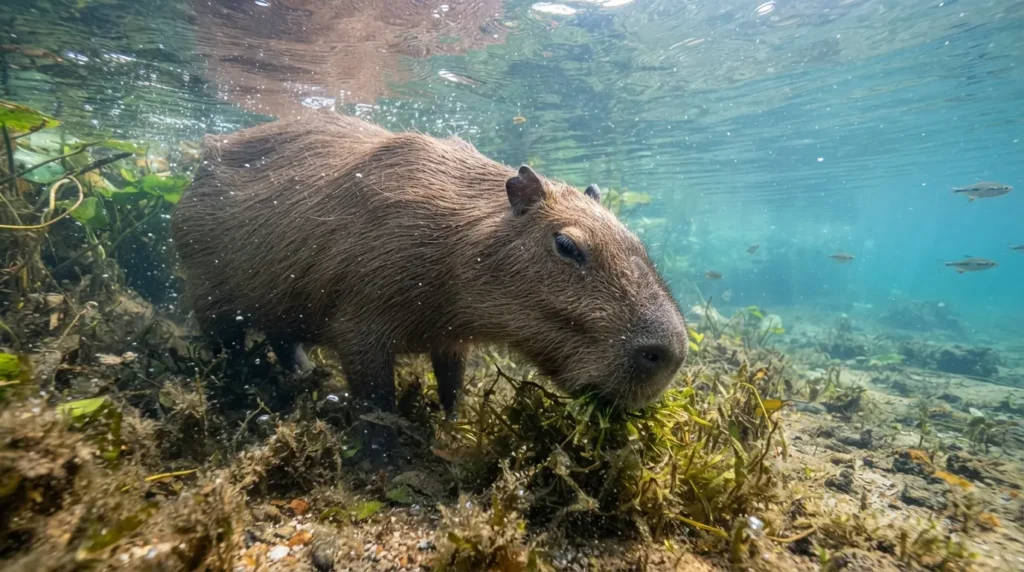
Capybaras are pure herbivores, and plenty of their menu grows underwater. They’ll dive to reach submerged plants, snipping stems with those big front incisors. Thanks to the nostril seal, they can hold a mouthful and chew below the surface without popping up for every bite. Dinner and cover in one.
Resting and Sleeping: Do Capybaras Sleep Underwater?
Here’s a common mix-up. Capybaras do not sleep fully submerged. They rest on land or in the shallows with their heads comfortably above water. What they will do is doze while floating, nostrils and eyes riding just above the waterline. There are scattered anecdotal reports of captive capybaras napping underwater, but that’s the exception, not the rule, and those stories are worth treating with a grain of salt.
Social Play: Underwater Tag and Hide-and-Seek
Capybaras are deeply social, and a lot of that sociability plays out in the water. They chase, wrestle, and splash around, and the young ones especially seem to practice diving and breath-holding through sheer play, quietly building the survival skills they’ll lean on later. Observers have described something that looks a lot like underwater tag, one capybara diving and the rest piling in after it.
Expert Tip: Follow wildlife photographers who specialize in capybaras. Their feeds are the best window into these playful, splashy moments.
Myths and Misconceptions: Separating Fact from Fiction
The internet loves a capybara, and it loves a good myth even more. Let’s clear a few up.
Myth: Capybaras Can Breathe Underwater
The fact: they can’t. Capybaras have lungs and must surface for air; what looks like underwater breathing is just an unusually long breath-hold. The myth sticks around because they stay under so long, and so calmly, that people assume something fishier is going on. It isn’t. No rodent on Earth has gills.
Myth: Capybaras Are Slow Swimmers
The fact: they’re quicker than they look. That lumbering walk on land is misleading. In water a capybara moves at around 8 km/h, faster than most people can swim. Those webbed feet and that streamlined body let it put on a real burst of speed when something’s chasing it.
Myth: Baby Capybaras Can’t Swim
The fact: capybara pups are precocial, born ready to go. They can swim and dive within hours of being born, which is exactly what survival in a predator-heavy wetland demands. Mothers coax their young into the water early, and the whole herd pitches in to keep them safe.
Myth: Capybaras Are Related to Fish or Amphibians
The fact: capybaras are rodents, full stop, close relatives of guinea pigs and rock cavies. Their watery lifestyle is convergent evolution, not a family connection to anything aquatic. The confusion is understandable given how at home they look in a river, but their family tree sits firmly among the rodents.
Frequently Asked Questions About Capybaras and Water
Can Baby Capybaras Swim Immediately?
Yes. Capybara pups arrive fully furred, eyes open, and able to swim and dive within hours of birth. That early mobility is a survival necessity in wetlands full of predators.
How Deep Can Capybaras Dive?
Usually not far. Most dives are into shallow water around 1 to 2 meters (3 to 6 feet) deep. They can go deeper if they need to, but they favor shallows where the surface is always an easy push away.
Do Capybaras Sleep Underwater?
No. They rest on land or in shallow water with their heads above the surface, and may doze while floating, but they always come up to breathe. They can’t sleep fully submerged.
How Do Capybaras Avoid Predators Underwater?
With a mix of stealth and endurance, sinking silently, holding still among plants, and staying under long enough to outwait predators that either lose interest or need to surface themselves.
Are Capybaras Faster Swimmers Than Otters?
No. Otters are the quicker swimmers, reaching speeds around 12 km/h. Capybaras cruise closer to 8 km/h and rely on stealth and stamina rather than raw speed.
Product Recommendation: Want to watch them in action? The San Diego Zoo’s capybara live cam lets you see them swim and hang out in real time.
Conclusion: The Underwater Ninja of the Wetlands
Capybaras can’t breathe underwater, but honestly, they don’t need to. Between webbed feet, sealable nostrils and ears, periscope eyes, and a diving reflex tuned well past what most land mammals manage, they’ve turned breath-holding into an art form. Five minutes under is enough to duck a jaguar, graze a riverbed, or win a game of tag, all without taking a single breath.
So next time you spot a capybara loafing by the water, calm and unbothered, remember what’s hiding under that mellow surface: a silent, breath-holding ninja of the wetlands.
Keep exploring: For more, browse the guides at Capybara World or Capybara Talks, and share your favorite capybara fact with someone. Spreading accurate, jaw-dropping knowledge about these underrated rodents is half the fun.