
Imagine an animal that can live nearly twice as long in a zoo as it does in its natural habitat. That’s the reality for the capybara, the world’s largest rodent, and its lifespan is really a tale of two different worlds.
You’ve probably seen capybaras lounging in hot springs or calmly sharing a riverbank with birds, dogs, and the occasional confused capuchin monkey, and there are plenty more fascinating capybara facts to discover. But how long do these semi-aquatic giants actually live? But how long do these semi-aquatic giants actually live? The answer isn’t a single number. It’s a story shaped by predators, diet, genetics, and human care.
This guide breaks down capybara lifespan using the same standard researchers use: the AnAge longevity database, field studies out of South America, and zoo records from accredited institutions. By the end, you’ll know exactly why capybaras live longer under human care, what cuts their lives short in the wild, and how to support a long, healthy life if you’re considering one as a pet. We’ll also cover the oldest capybara ever recorded and what conservation means for the species’ future. Let’s get into the life and longevity of Hydrochoerus hydrochaeris.
Average Lifespan in the Wild
The Numbers: 7–10 Years, But With a Catch
The typical wild capybara lives between 7 and 10 years. That number is accurate, and it’s also misleading if you stop there.
Here’s the catch: life expectancy at birth is just over one year. Not seven. Not ten. One. That figure comes from a field study cited in the AnAge database, the standard reference researchers use for verified longevity records across species.
The gap between those two numbers tells the real story. Juvenile mortality is so steep that it drags the average lifespan down to barely a year, even though plenty of individual capybaras live a full decade. Once a capybara survives its first year, its odds improve fast. The oldest females in that same field study reached 6 years, the oldest males 7, and other field estimates and anecdotal sightings push the ceiling closer to 10.
In the wild, most capybaras never see their first birthday. That single sentence explains more about capybara lifespan than any average ever could.
Why So Many Don’t Make It: The Juvenile Gauntlet
A capybara pup faces a gauntlet in its first year that thins the herd fast.
- Predation pressure. aguars, anacondas, caimans, and large birds of prey all target young capybaras, though the capybara crocodile relationship isn’t always predatory. A single caiman working a shrinking waterhole during the dry season can take out most of a litter in one season.. A single caiman working a shrinking waterhole during the dry season can take out most of a litter in one season.
- Disease and parasites. Wetlands are crowded, wet, and warm, exactly the conditions parasitic infections and waterborne disease need to spread through a group fast.
- Habitat instability. Seasonal flooding can separate a pup from its mother in seconds. Drought does the opposite: it forces everyone into the same shrinking pool, which raises competition and predator encounters at once.
Most sources gloss over this and just print “7 to 10 years” as if every capybara gets an equal shot at it. They don’t. The number is an average for survivors, not a guarantee for newborns.
Regional Variations in Wild Lifespan
Not every wetland is equally dangerous. Capybaras in protected areas with lower jaguar density, some pockets of the Pantanal, for instance, tend to live longer on average than populations in higher-predation zones.
The IUCN Red List capybara entry lists the species as Least Concern overall, but that broad status hides real regional pressure. Human hunting reduces average lifespan in some areas even where natural predators are scarce, and that pressure isn’t evenly distributed across the species’ range.
Why So Many Don’t Make It: The Juvenile Gauntlet
A capybara pup faces a gauntlet in its first year that thins the herd fast.
- Predation pressure. Jaguars, anacondas, caimans, and large birds of prey all target young capybaras. A single caiman working a shrinking waterhole during the dry season can take out most of a litter in one season.
- Disease and parasites. Wetlands are crowded, wet, and warm, exactly the conditions parasitic infections and waterborne disease need to spread through a group fast.
- Habitat instability. Seasonal flooding can separate a pup from its mother in seconds. Drought does the opposite: it forces everyone into the same shrinking pool, which raises competition and predator encounters at once.
Most sources gloss over this and just print “7 to 10 years” as if every capybara gets an equal shot at it. They don’t. The number is an average for survivors, not a guarantee for newborns.
Regional Variations in Wild Lifespan
Not every wetland is equally dangerous. Capybaras in protected areas with lower jaguar density, some pockets of the Pantanal, for instance, tend to live longer on average than populations in higher-predation zones.
The IUCN Red List capybara entry lists the species as Least Concern overall, but that broad status hides real regional pressure. Human hunting reduces average lifespan in some areas even where natural predators are scarce, and that pressure isn’t evenly distributed across the species’ range.
Average Lifespan in Captivity
The Extended Timeline: 10–15 Years and Beyond
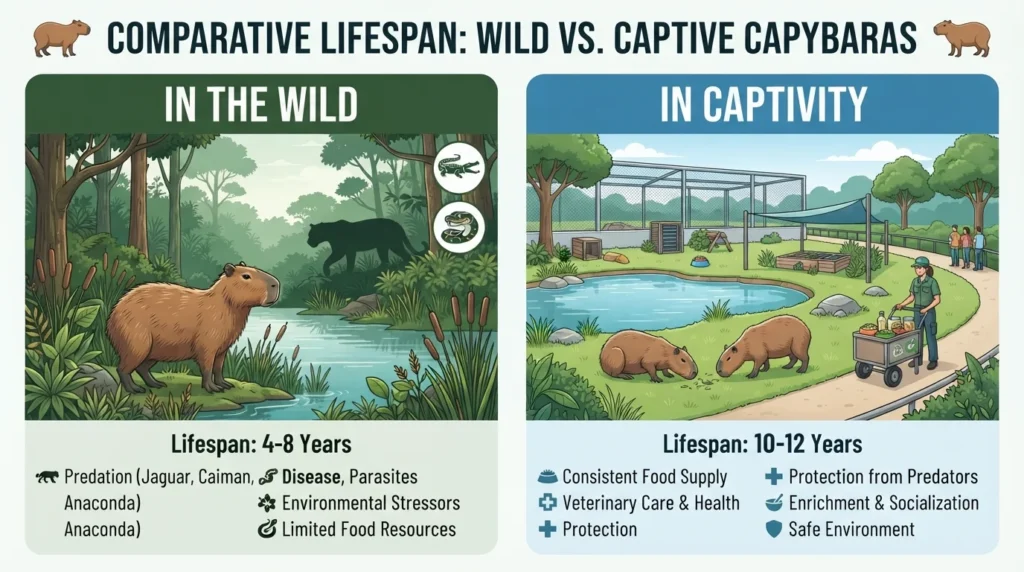
In zoos and responsible private care, capybaras routinely reach 10 to 15 years. The maximum verified age on record is 15.1 years, again from the AnAge database, which functions as the gold standard for maximum longevity claims across species.
That’s not a small bump. It’s close to a doubling of what most wild capybaras ever reach. Remove the predators, stabilize the food supply, and add veterinary care, and you remove almost every factor that kills a wild capybara young.
What “Captivity” Really Means: Zoos vs. Private Homes
“Captivity” isn’t one condition. It’s a spectrum, and where a capybara lands on it matters more than the label itself.
- Zoo environments. Accredited institutions like the San Diego Zoo Wildlife Alliance run professionally managed diets, large enclosures with real pools, and regular health monitoring. These conditions produce the highest captive lifespans on record.
- Private ownership. This is where the range widens. A well-informed private owner can match zoo-level longevity. An unprepared one, wrong diet, no pool, no vet access, can end up closer to the wild average, which defeats the entire point of keeping one as a pet.
The quality of care is everything here. “Captivity” by itself guarantees nothing.
The Role of Veterinary Care and Nutrition
Two things do most of the heavy lifting in extending captive lifespan: consistent nutrition and preventative vet care.
Annual check-ups with an exotic animal veterinarian catch dental disease, arthritis, and early obesity before they become life-shortening problems. A balanced diet, mostly grass hay, some fresh vegetables, fruit kept as an occasional treat, prevents the diabetes and joint issues that shorten so many captive lifespans. The Spruce Pets capybara care guide covers the practical side of this in more depth if you’re planning a diet from scratch.
Factors Affecting Lifespan
In the Wild: A Constant Battle for Survival
Predation: the number one threat. Jaguars, anacondas, caimans, ocelots, and harpy eagles all hunt capybaras, and young animals are the easiest targets. The capybara’s semi-aquatic lifestyle cuts both ways here: water is an escape route from land predators, but it’s also home turf for caimans and anacondas; their underwater breath-holding ability helps them evade threats. Diving into the river to dodge a jaguar can mean swimming straight toward something worse.
Disease and parasitism. Trypanosomiasis, leptospirosis, and internal parasites like Echinococcus all circulate through wild populations. Group living, which helps with predator vigilance, works against capybaras here. Dense populations spread disease faster than solitary animals ever would. The book Capybara: Biology, Use and Conservation of an Exceptional Neotropical Species covers this disease ecology in far more depth than any single article can.
Habitat quality and food availability. Wetland health decides how much grass and aquatic vegetation is actually available. Drought forces capybaras to crowd around shrinking water sources, which raises both competition and stress. This connects directly to the conservation section later: degraded habitat doesn’t just reduce capybara numbers, it lowers average lifespan for the ones that remain.
Social structure and stress. Capybaras live in groups of 10 to 20. That social structure is mostly protective, more eyes watching for predators, but it comes with a cost. Dominance hierarchies mean some individuals get less access to food and mates, which can shorten their lives even without a single predator involved. Isolation is worse: it causes chronic stress that weakens the immune system.
In Captivity: Control and Care
Diet and nutrition. A proper capybara diet mirrors what a capybara would eat in the wild: high-fiber, low-calorie, with constant access to hay. A reasonable daily breakdown looks something like 80% grass hay, 15% leafy greens, and 5% treats. Overfeeding is the most common mistake owners make, and it leads to obesity, diabetes, and fatty liver disease, none of which show up in a young capybara but all of which shorten its life later.
Enclosure design and enrichment. A large, secure outdoor space with a real pool isn’t optional. Swimming supports joint health and helps prevent the obesity that plagues under-exercised captive capybaras. Enrichment, logs to gnaw, tunnels, puzzle feeders, reduces boredom-driven stress. The San Diego Zoo Wildlife Alliance’s published enclosure standards are a solid reference point if you’re designing space from scratch.
Veterinary care and preventative medicine. Capybara teeth grow continuously, so proper capybara dental care is essential, and annual exams catch arthritis, dental malocclusion, and skin conditions early enough to genuinely add years to a capybara’s life. Annual exams catch arthritis, dental malocclusion, and skin conditions early, and early detection here genuinely adds years to a capybara’s life.
Social needs. Capybaras are highly social animals, and keeping at least two together measurably reduces stress and stereotypic behaviors, the repetitive, anxious movements animals develop in isolation; learning their capybara sounds and meanings can further improve their care. Adopting a bonded pair from a rescue or reputable sanctuary is preferable to buying through the exotic pet trade, and it usually means the animals are already socialized to each other.Adopting a bonded pair from a rescue or reputable sanctuary is preferable to buying through the exotic pet trade, and it usually means the animals are already socialized to each other.
Life Stages of a Capybara
Birth and the First Weeks: Precocial But Vulnerable
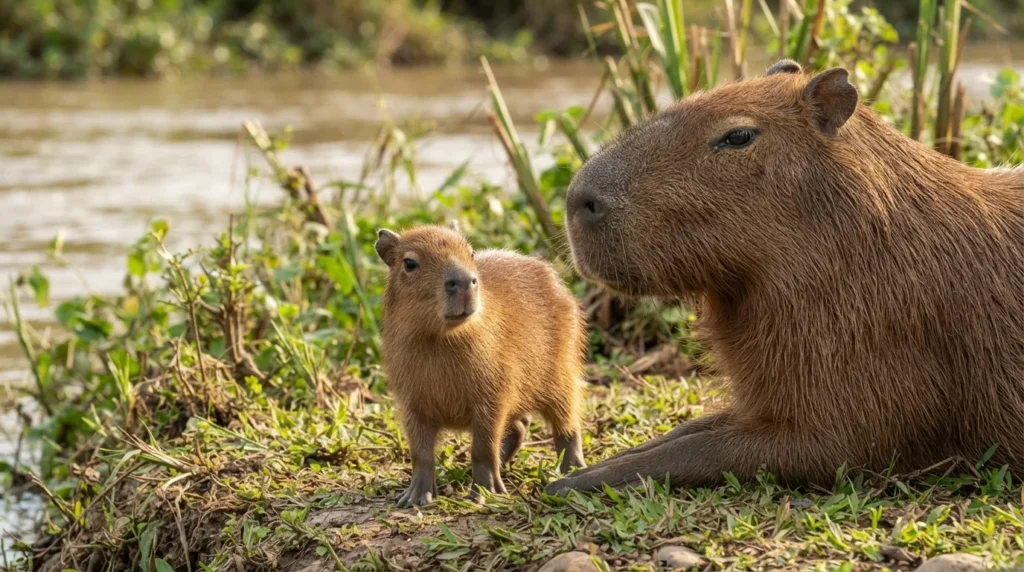
Capybaras are precocial. That means a pup is born fully furred, eyes already open, and able to walk within hours of birth, nothing like the blind, helpless newborns of most rodents.
A litter runs 2 to 8 pups, each weighing around 1.5 kg at birth. They nurse for roughly 16 weeks but start nibbling grass within days, well before weaning is anywhere near complete.
Juvenile Phase: Learning to Survive
From weaning to about a year old, juveniles stick close to the group, learning to forage and read predator warning signs from the adults around them.
This is the highest-mortality window in a capybara’s entire life. Remember that life expectancy at birth of just over one year? This phase is where that number gets made. Only a fraction of any litter makes it through to adulthood.
Adulthood: Prime Years
Sexual maturity arrives at 12 to 18 months, with full adult size reached by 18 months. Adults weigh 35 to 66 kg and are most active at dawn and dusk, avoiding the heat of midday and the deeper dark when nocturnal predators hunt hardest.
In the wild, this is the phase where a capybara pulls its weight for the group, standing vigilance, breeding, and helping raise the next generation of pups through their own dangerous first year.
Senior Years: Signs of Aging
Around 7 to 10 years in the wild, or past 10 in captivity, capybaras start to show real signs of age:
- Worn-down or overgrown teeth, making it harder to eat
- Reduced mobility and stiffness, often early arthritis
- Coat changes: thinning, graying, or patchy fur
- Decreased activity and less social interaction with the group
For pet owners, these signs are a cue, not a crisis. Step up veterinary monitoring and adjust the environment, ramps instead of steps, softer bedding, easier pool access, to match what an aging body actually needs.

Wild vs. Captivity Lifespan Comparison
Factor | Wild | Captivity |
Average lifespan | 7–10 years (for those surviving infancy) | 10–15 years |
Maximum recorded lifespan | ~10 years | 15.1 years |
Life expectancy at birth | Just over 1 year | High; most pups survive |
Primary mortality causes | Predation, disease, habitat loss, hunting | Age-related disease (arthritis, dental issues), obesity |
Diet | Grasses, aquatic plants, seasonal fruit | Controlled hay, vegetables, limited fruit |
Habitat quality | Variable; drought, flood, human encroachment | Stable, enriched, with pool access |
Social structure | Groups of 10–20, with hierarchy-driven stress | Pairs or small groups, low stress when managed well |
Veterinary care | None | Annual check-ups, preventative care |
Predation risk | High (jaguars, anacondas, caimans) | None |
Quality-of-life indicators | Constant vigilance, high stress | Low stress, consistent food, medical attention |
The Oldest Recorded Capybara
The longest-lived capybara on record reached 15.1 years in captivity, documented in the AnAge database, the same curated longevity reference used throughout this guide. It’s a database built specifically to hold up verified maximum-age claims across species, so this figure isn’t an internet rumor. It’s the closest thing to a scientific record book capybara longevity has.
Public details on this specific individual are thin. But the surrounding research points clearly enough at what got it there: a stress-free enclosure, expert veterinary oversight, a properly balanced diet, and almost certainly a compatible social group rather than solitary housing.
Picture what those 15 years actually looked like. A pup born fully furred and walking within hours, surviving a juvenile window that kills most of its wild peers, growing into an adult that never had to watch the water for a caiman, and finally aging out gradually, worn teeth, a slower pace, a thinner coat, in an enclosure built around its comfort rather than its survival. That’s what 15.1 years of optimal care buys a capybara that the wild almost never does.
How to Support a Long, Healthy Life for Pet Capybaras
Is a Capybara the Right Pet for You?
Capybaras are not low-maintenance pets. They need serious space, a real pool, a specialized diet, and social companionship, not a hamster cage and a water bowl.
Before acquiring one, talk to an exotic animal veterinarian and check your local regulations. Capybaras are illegal to keep as pets in many areas, and that’s worth confirming before you fall in love with the idea. The Spruce Pets care guide is a useful reality check on the full scope of commitment involved.
Diet and Nutrition: The Foundation of Longevity
A solid daily feeding plan looks roughly like this:
- Unlimited grass hay (timothy or orchard grass)
- Fresh leafy greens: romaine, kale, dandelion greens
- A limited amount of high-fiber pellets formulated for large rodents
- Occasional treats: small pieces of carrot, apple, or sweet potato
Avoid overfeeding. Obesity is one of the leading causes of premature death in captive capybaras, and it creeps up slowly enough that owners often don’t notice until joint problems or diabetes are already underway. Monitor weight monthly, not just when something looks off.
Enclosure and Enrichment: Building a Capybara Paradise
Plan for a minimum of 12 by 12 meters of secure outdoor space for a pair. Capybaras dig and climb more than people expect, so fencing needs to account for both.
The pool matters as much as the fence. Aim for at least 1 meter of depth, with a gradual entry point and a real filtration system, not a kiddie pool that turns green by the second week. Add enrichment on top of that: logs for gnawing, tunnels, floating toys, and puzzle feeders to keep an intelligent, social animal from getting bored.
Social Needs: Never Keep a Capybara Alone
Capybaras are highly social, and solitary confinement leads to depression, chronic stress, and a measurably shortened lifespan. This isn’t a nice-to-have. It’s closer to a medical requirement.
Adopt a bonded pair from a rescue or sanctuary whenever possible. Introducing two unfamiliar adult capybaras to each other can be genuinely difficult, and starting with an already-bonded pair sidesteps that entirely.
Veterinary Care Schedule
Build a routine around annual wellness exams that include dental checks and blood work, vaccinations discussed with your vet based on regional disease risk, and regular fecal exams for parasite control.
Find a vet with actual capybara experience before you bring one home. Not every exotic animal vet is familiar with a capybara’s specific dental and digestive needs, and that gap can matter in an emergency.
Conservation and Its Impact on Wild Lifespan
Habitat Preservation: The Key to Wild Longevity
Capybaras depend entirely on wetlands, grasslands, and riparian zones. Deforestation, agricultural expansion, and urban development fragment these habitats, and fragmentation raises stress and mortality even in populations that aren’t directly hunted.
The IUCN lists capybaras as Least Concern overall, but that species-wide status masks real local pressure. Capybara: Biology, Use and Conservation of an Exceptional Neotropical Species documents this habitat-loss impact in far more regional detail than a top-line conservation status ever could.
Hunting and Human Pressures
In some regions, capybaras are hunted for meat and leather. That pressure can skew population age structures and pull down average lifespan even where the species overall isn’t at risk. Regulated hunting can be sustainable, but illegal poaching remains a real problem in parts of the range.
Supporting certified sustainable products and responsible ecotourism, rather than unregulated wildlife trade, is one of the more direct ways an average reader can affect this from a distance.
The Role of Protected Areas and Ecotourism
National parks and reserves, Pantanal Matogrossense National Park among them, give capybaras a real shot at living out a natural lifespan without the hunting and habitat pressure found elsewhere. Ecotourism built around these areas generates revenue that funds further conservation, which creates a genuinely positive feedback loop rather than just a feel-good label.
Climate Change and Future Challenges
Altered rainfall patterns and more frequent extreme weather threaten the wetland ecosystems capybaras depend on. Capybaras are adaptable animals, more adaptable than most large mammals their size, which gives them some resilience here. But adaptability has limits, and long-term habitat loss could still drag down average wild lifespan even for a species not currently considered at risk.
Conclusion and Key Takeaways
Wild capybaras face a gauntlet of predators, disease, and habitat pressure that rarely lets them past 10 years, and often ends far sooner. Capybaras in managed care, given the right diet, enclosure, and veterinary attention, can reach 15 years or more. That’s the entire story in two sentences, and everything above just fills in why.
The key factors repeat throughout: predation pressure, diet quality, veterinary care, and social structure. The 15.1-year record isn’t a fluke. It’s a demonstration of what optimal care can actually achieve when every one of those factors lines up.
If you’re considering a capybara as a pet, the responsibility is real and it’s significant. But with the right knowledge, going in, you can give one a genuinely long, fulfilling life. If you care about wild populations instead, the throughline is simpler still: protecting wetlands is protecting the capybara’s future.
If this deep dive was useful, share it with fellow animal enthusiasts, and consider supporting a capybara conservation initiative where you can. Every wetland saved is a few more years for the capybaras living in it.

Carly Fiorina
Exotic Pet Research Specialist/Capybara Owner
Hi, I’m Carly, and I’m the heart behind CapybaraTalks.com. My journey with capybaras began when I met my first pet, and I was instantly fascinated by her calm, social, and endlessly curious nature. Capybaras are gentle, playful, and love to swim and explore—each one has a unique personality that makes them such special companions.