

Imagine a newborn that weighs less than a loaf of bread, arrives with its eyes wide open, has a full set of cheek teeth already in place, and is standing on all four legs before its first hour is up.
That is a baby capybara. And it is not an exception to the rule for rodents — it is a complete rejection of it.
Most people meet capybaras through a viral clip: a row of pups riding on their mother’s back across a pond, or a herd soaking in a hot spring with an orange balanced on someone’s head. What those clips do not show is the system underneath. A capybara pup survives its first year through communal nursing, a herd-wide alarm network, a vocabulary of purrs and whistles, and a group structure so essential that herds below a certain size fail to raise young at all.
This guide follows that pup from its first minute to its eighteenth month, from 1,500 grams to roughly 40 kilograms, and covers many fascinating capybara facts along the way.You will learn how the entire herd shares the work of raising each baby, what pups eat before their digestive system can handle grass, how they avoid caimans from day one, what happens when a mother rejects her newborn, and how growing up in a zoo changes the whole trajectory.
Let’s start with what to call them.
What Is a Baby Capybara Called?
A baby capybara is called a pup.Not a kit, not a cub, not a kitten. Pup is the standard term used by zoos, keepers, and wildlife biologists, and it is the same word applied to baby guinea pigs and baby rats. That is not a coincidence capybaras sit in the order Rodentia, family Caviidae, the same family as guinea pigs and rock cavies. They are, genuinely, giant cousins of the guinea pig, which is why our capybara vs. guinea pig comparison turns up so many surprising overlaps.
A group of pups born together is a litter. And here is where the family resemblance stops being cute and starts being biologically interesting.
Precocial: Born Ready for the World
Most rodents you can name mice, rats, hamsters, squirrels are altricial. Their babies arrive naked, blind, deaf, and completely immobile, and they spend their first two weeks in a nest doing very little except growing.
Capybaras are precocial. The word means “early ripening,” and it describes a newborn that arrives close to finished. A capybara pup is born:
- Fully furred, in the same reddish-brown coat the adults wear
- With its eyes open from the first moment
- With all of its cheek teeth already erupted and, according to research cited by the San Diego Zoo Wildlife Alliance, already showing signs of wear
- Able to stand, walk, and follow the herd within hours
That last detail about the teeth is worth sitting with. A capybara pup is not born preparing to eat grass eventually. It is born with the equipment to start grazing more or less immediately.
The reason is the habitat. Capybaras live in South American wetlands where jaguars work the treeline, caimans work the shallows, and anacondas work the water in between. A pup that spent three weeks blind and immobile in a nest would not be a capybara pup. It would be a meal. Evolution had exactly one option here, and it took it.
How Capybara Pups Compare to Other Rodent Babies
|
Rodent Species |
Birth State |
Eyes at Birth |
Fur at Birth |
Mobility at Birth |
|
Capybara |
Precocial |
Open |
Full coat |
Stands, walks, and swims within hours; follows the herd |
|
Guinea Pig |
Precocial |
Open |
Full coat |
Stands and walks within hours |
|
Beaver |
Precocial |
Open |
Full coat |
Can swim within 24 hours, but stays inside the lodge for about a month |
|
House Mouse |
Altricial |
Closed |
Naked |
Helpless and immobile |
|
Brown Rat |
Altricial |
Closed |
Naked |
Helpless and immobile |
One clarification on that beaver row, because it gets reported inconsistently. Beaver kits are genuinely precocial born furred, eyes open, capable of swimming within a day. But they are physically confined to the lodge for roughly the first month, partly because they are so buoyant they struggle to dive down through the underwater exit tunnel. A capybara pup, by contrast, is out in the open with the herd from day one. Same classification, very different first month.

Birth and the First Hours
Gestation and Litter Size
Capybara gestation runs about 150 days, roughly five months. Litters are typically four to five pups, though the full documented range runs from one to eight depending on the mother’s age, condition, and the state of the habitat.
Females usually produce one litter a year, with a second possible when conditions are good. Breeding happens year-round but peaks at the start of the wet season, when grass is about to become abundant which is exactly when a lactating female needs it most.
Births usually happen on land, in dense vegetation or a sheltered spot near water.
Expert tip: Planning a zoo visit to see pups? Go early in the morning or late afternoon. Capybaras are most active in the cooler hours and spend the middle of the day resting or sitting in water.
The Birth Itself
Capybara mothers do not disappear to give birth. Unlike many mammals that seek total isolation, a capybara female typically stays within range of her herd, with the dominant male somewhere nearby on watch.
Pups are delivered one at a time. The mother cleans each newborn immediately and consumes the amniotic sac and placenta, a behavior that removes the scent cues a caiman or jaguar could otherwise follow straight to a group of defenseless newborns.
The First Hour
Within sixty minutes of being born, a capybara pup will usually have:
- Stood up. Wobbling at first, coordinated within minutes.
- Started walking, staying tight to its mother’s side.
- Found the milk. A capybara female’s teats sit along her flanks rather than underneath her body, which means a pup can nurse while she is standing, walking, or wading. For a species that has to keep moving, that anatomy matters.
- Started talking. Pups produce a soft purring whistle almost from birth, and the mother answers with a low rumble. That call-and-response is the first thread of a communication system the pup will rely on for the rest of its life.
Expert tip: Watch for pups riding on their mother’s back while she swims. It is a normal, frequently observed behavior, and in the wild it is what keeps a very young pup out of reach of whatever is below the surface.
Birth and the First Hours
Gestation and Litter Size
Capybara gestation runs about 150 days, roughly five months. Litters are typically four to five pups, though the full documented range runs from one to eight depending on the mother’s age, condition, and the state of the habitat.
Females usually produce one litter a year, with a second possible when conditions are good. Breeding happens year-round but peaks at the start of the wet season, when grass is about to become abundant which is exactly when a lactating female needs it most.
Births usually happen on land, in dense vegetation or a sheltered spot near water.
Expert tip: Planning a zoo visit to see pups? Go early in the morning or late afternoon. Capybaras are most active in the cooler hours and spend the middle of the day resting or sitting in water.
The Birth Itself
Capybara mothers do not disappear to give birth. Unlike many mammals that seek total isolation, a capybara female typically stays within range of her herd, with the dominant male somewhere nearby on watch.
Pups are delivered one at a time. The mother cleans each newborn immediately and consumes the amniotic sac and placenta, a behavior that removes the scent cues a caiman or jaguar could otherwise follow straight to a group of defenseless newborns.
The First Hour
Within sixty minutes of being born, a capybara pup will usually have:
- Stood up. Wobbling at first, coordinated within minutes.
- Started walking, staying tight to its mother’s side.
- Found the milk. A capybara female’s teats sit along her flanks rather than underneath her body, which means a pup can nurse while she is standing, walking, or wading. For a species that has to keep moving, that anatomy matters.
- Started talking. Pups produce a soft purring whistle almost from birth, and the mother answers with a low rumble. That call-and-response is the first thread of a communication system the pup will rely on for the rest of its life.
Expert tip: Watch for pups riding on their mother’s back while she swims. It is a normal, frequently observed behavior, and in the wild it is what keeps a very young pup out of reach of whatever is below the surface.
Physical Development Timeline: From 1,500 Grams to 40 Kilograms
Here is the full arc, stage by stage. If you want the adult end of this story in more detail, our capybara size guide covers where all this growth eventually lands.
Birth to One Week
- Birth weight: approximately 1,500 grams (3.3 lbs). Zoo records sometimes report slightly higher; the San Diego Zoo weighed a 2015 litter at 3.5 to 4 pounds each.
- Day 1: Standing, walking, and nursing within hours. The pup stays within a few feet of its mother almost constantly.
- Days 2–3: First mouthfuls of grass. Nursing is still doing nearly all the nutritional work, but the sampling starts almost immediately.
- Days 4–7: Swimming improves fast. Pups enter shallow water alongside the mother and climb onto her back when they tire or when the water gets deeper than they can handle.
Weeks 2–4: Early Grazing and Social Integration
By the second week, pups are grazing actively alongside the herd while still nursing frequently. They begin interacting with the other pups — the first version of the nursery group. Their vocal range expands, with distinct calls for hunger, contact, and distress.
Weeks 4–8: The Nursery Group Solidifies
Now the pups move as a unit. The nursery group is a genuine social structure, not a loose collection of babies, and it is supervised collectively by the herd’s adult females. Allonursing nursing from females other than their own mother — becomes routine rather than occasional. Grass takes a bigger share of the diet each week.
Weeks 8–16: Weaning
Weaning completes at around 16 weeks, about four months, and it is gradual rather than abrupt. By the end of it, pups are competent grazers with the gut microbes needed to break down tough cellulose, a capability they acquire in a way we will get to shortly.
They are fully embedded in herd life by this point, though the bond with their own mother stays noticeably closer than with other adults.
Months 4–12: Juvenile Growth
Growth accelerates. Young capybaras put on weight steadily through this stretch and learn the complicated parts of herd life by watching: dominance interactions, who defers to whom, what an alarm bark means, how to read the water.
Young males start play-sparring. At this age it is practice, not competition.
This is also, statistically, the most dangerous period of a capybara’s entire life a point covered in depth in our guide to capybara lifespan in the wild versus captivity.
Months 12–18: Approaching Adulthood
By 18 months a pup has become a subadult of roughly 40 kilograms (88 lbs) , a nearly 27-fold increase from birth weight.
Sexual maturity splits sharply by sex:
- Females: as early as 7 to 12 months
- Males: later, typically 15 to 24 months
Yearlings begin dispersing from their birth herd around this stage, with young males far more likely to leave than females. Females often stay for life.
The Capybara Nursery: How the Entire Herd Raises Each Pup
This is the part most articles skip, and it is the most remarkable thing about capybara parenting.
What a Nursery Group Actually Is
Every pup in a herd belongs to a collective. Depending on how many females bred that season, that can be a handful of pups or fifteen or more. They graze together, rest together, and move together as a unit through the herd.
And they feed together from whichever adult female happens to be available.
Allonursing: Communal Nursing in Practice
Allonursing means a female nursing offspring that are not biologically hers. In many species this is rare or accidental. In capybara herds it is the default.
The mechanics are simple and slightly comic. The pups move through the group as a small mob, nudging at resting females until one of them stands up and lets them feed. Most comply. Then the group moves on to the next one.
That system does two things at once. It spreads the enormous energy cost of lactation across multiple adults, and it means no pup goes hungry just because its own mother is grazing, wallowing, or watching for predators somewhere else.
Expert tip: If you see a pup nursing from a female that is clearly not its mother, nothing has gone wrong. That is the system working exactly as designed.
The Four-Adult Threshold
Here is the finding that reframes everything above.
Capybara groups with fewer than four adults consistently fail to rear any young at all. Not “raise fewer young.” Not “have lower success rates.” Fail.
Below that threshold, the nursery system simply collapses. There are not enough lactating females to sustain allonursing, and there are not enough adult eyes to maintain the vigilance that keeps pups alive between grazing sessions. Group association is not a nice feature of capybara life — it is a hard requirement for reproduction.
This is why you almost never encounter capybaras in pairs or trios in the wild. Their entire reproductive strategy is built on a minimum crowd.
It is also, incidentally, the strongest single argument against the idea of a solitary pet capybara. Whatever else these animals are, they are not built to be alone.
The Dominant Male’s Role
The dominant male does the security work.
He patrols the group’s perimeter and scans continuously — treeline, water’s edge, sky. When he detects a threat, he produces a sharp alarm bark that redirects the entire herd toward water in seconds. And he frequently positions himself between the threat and the retreating group, which raises his own exposure considerably while the pups get clear.
What Baby Capybaras Eat: From Milk to Grass
The First Days
For the first few days, milk does nearly all the work. Capybara milk is rich in fat and protein, which is what a precocial newborn’s growth rate demands. Pups nurse often sometimes hourly during daylight and the side-mounted teats mean the mother does not have to stop what she is doing.
Grass Within Days
Pups begin nibbling grass within their first week, starting the journey toward the adult capybara diet. That is not just curiosity. It is the first step in building a digestive system.
Because here is the problem: a newborn capybara cannot actually digest grass. Cellulose requires a specific community of microbes to break down, and pups are born without them.
Coprophagy: How Pups Build a Gut
The solution is coprophagy eating the feces of adult herd members.
It sounds unpleasant. It is also one of the more elegant adaptations in herbivore biology. By consuming adult droppings, a pup transfers a working population of bacteria, protozoa, and fungi directly into its own digestive tract. Those microbes then do the fermentation work that lets the pup extract nutrition from tough grasses.
Adult capybaras continue the behavior for the same reason. Without it, no capybara at any age could survive on the diet it evolved to eat.
The Weaning Transition
Weaning is a ratio shift, not a switch. Over roughly 16 weeks, milk steadily gives way to grass until grass is doing all the work. Even after weaning finishes, the mother-pup bond persists, and the young capybara continues grazing alongside her.
Expert tip: Pups eat grass within days but keep nursing for up to 16 weeks. Early grazing is not a sign that a pup is ready for separation.
Predators and Survival: How Capybara Pups Stay Alive
The Threat List
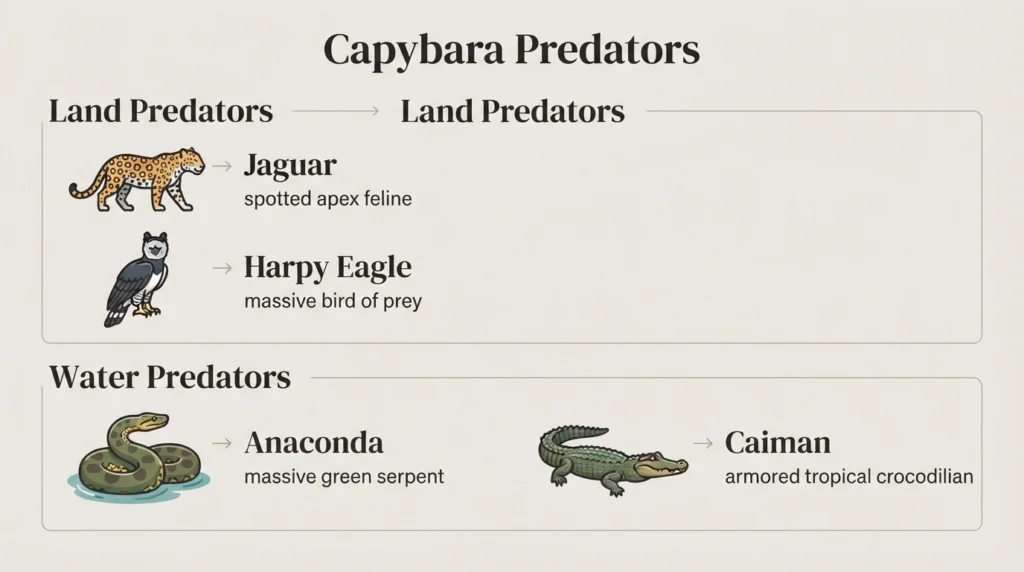
A capybara pup is prey for essentially everything in the wetland:
- From the water: caimans and green anacondas, which can take a pup from the water’s edge or from shallow swimming areas
- From the land: jaguars, pumas, ocelots, bush dogs, foxes, and feral dogs
- From above: harpy eagles, caracaras, and other birds of prey, which target pups that stray from the group
Strategy 1: Stay Shallow
Pups avoid deep water instinctively, but as they grow, their capybara swimming abilities become impressive. They stay in water that barely covers their legs, or they ride on an adult’s back when the herd crosses anything deeper.
What makes this interesting is that it appears to be innate rather than learned. Captive-born pups with no predator experience whatsoever still show the same preference for shallow water. Nobody teaches a capybara pup that caimans exist. It arrives already knowing where not to swim.
Strategy 2: Collective Vigilance
The herd operates as a distributed sensor network. Capybaras have eyes, ears, and nostrils set high on the skull, the same arrangement you see in hippos which lets an adult stay almost entirely submerged while still monitoring the surface.
Any adult that detects a threat barks. The whole group responds instantly, either bolting for water or freezing in place, a response that relies on their capybara running speed. Pups learn the appropriate response by doing it alongside everyone else.
Strategy 3: The Danger of the Edges
The most vulnerable capybaras are not the youngest ones. They are the young males who have just dispersed from their birth herd.
A solitary animal loses everything the group provided: the extra eyes, the alarm network, and the confusion effect that makes it hard for a predator to lock onto any single individual in a moving crowd. This is why dispersal is such a high-mortality event, and why many young males work hard to join an established herd rather than tough it out alone.
What the Survival Data Actually Shows
We should be honest here, because a lot of sites are not.
Precise survival rates for wild capybara pups are hard to come by. Long-term field research in remote wetlands is expensive and difficult, and the figures you see quoted online commonly in the range of 30 to 50 percent surviving to one year are estimates drawn from limited regional data, not a settled scientific consensus.
What the research does support clearly: mortality is heaviest in the first months, predation is the leading cause, and life expectancy at birth in the wild is barely over a single year even though adults who make it through routinely reach seven to ten.
Anyone quoting you an exact survival percentage with confidence is quoting a number nobody has firmly established.
Predators and Survival: How Capybara Pups Stay Alive
The Threat List
A capybara pup is prey for essentially everything in the wetland:
- From the water: caimans and green anacondas, which can take a pup from the water’s edge or from shallow swimming areas
- From the land: jaguars, pumas, ocelots, bush dogs, foxes, and feral dogs
- From above: harpy eagles, caracaras, and other birds of prey, which target pups that stray from the group
Strategy 1: Stay Shallow
Pups avoid deep water instinctively. They stay in water that barely covers their legs, or they ride on an adult’s back when the herd crosses anything deeper.
What makes this interesting is that it appears to be innate rather than learned. Captive-born pups with no predator experience whatsoever still show the same preference for shallow water. Nobody teaches a capybara pup that caimans exist. It arrives already knowing where not to swim.
Strategy 2: Collective Vigilance
The herd operates as a distributed sensor network. Capybaras have eyes, ears, and nostrils set high on the skull, the same arrangement you see in hippos which lets an adult stay almost entirely submerged while still monitoring the surface.
Any adult that detects a threat barks. The whole group responds instantly, either bolting for water or freezing in place depending on what the threat is. Pups learn the appropriate response by doing it alongside everyone else.
Strategy 3: The Danger of the Edges
The most vulnerable capybaras are not the youngest ones. They are the young males who have just dispersed from their birth herd.
A solitary animal loses everything the group provided: the extra eyes, the alarm network, and the confusion effect that makes it hard for a predator to lock onto any single individual in a moving crowd. This is why dispersal is such a high-mortality event, and why many young males work hard to join an established herd rather than tough it out alone.
What the Survival Data Actually Shows
We should be honest here, because a lot of sites are not.
Precise survival rates for wild capybara pups are hard to come by. Long-term field research in remote wetlands is expensive and difficult, and the figures you see quoted online commonly in the range of 30 to 50 percent surviving to one year are estimates drawn from limited regional data, not a settled scientific consensus.
What the research does support clearly: mortality is heaviest in the first months, predation is the leading cause, and life expectancy at birth in the wild is barely over a single year even though adults who make it through routinely reach seven to ten.
Anyone quoting you an exact survival percentage with confidence is quoting a number nobody has firmly established.
Capybara Pup Vocalizations: What the Sounds Mean
Capybara pups start “talking” from day one, and each sound has a job: the purring whistle is their constant contact call that keeps mom and pup connected in tall grass without ever seeing each other, squeaks and whines signal hunger or real distress, and the explosive alarm bark warns the whole herd of danger a call pups learn just by watching adults react. Pups even fine-tune their calls over time based on feedback from adults, which is also why hand-raised capybaras can end up sounding a little “off.”Read the full breakdown of capybara pup vocalizations.
Wild vs. Captive Development: What Changes
Remove predators and guarantee food, and you have removed nearly everything that shapes a wild pup’s first year.
Wild pups allocate a significant share of their energy budget to vigilance and stress responses. Captive pups do not have to, and it shows in their growth curves and their survival rates.
Comparative Milestones
|
Developmental Milestone |
Wild Pups |
Captive Pups |
|
Birth weight |
~1,500 g (3.3 lbs) |
~1,500 g; zoo litters sometimes recorded at 3.5–4 lbs |
|
Weaning age |
~16 weeks; may extend if forage is scarce |
~16 weeks, on more consistent nutrition |
|
Survival to one year |
Low; estimates vary widely by region and predator density |
Substantially higher in accredited institutions |
|
Age at dispersal |
~12–18 months, males first |
Managed by breeding programs; effectively human-directed |
|
Typical litter size |
4–5 pups |
4–5 pups |
|
Growth rate |
Variable; slowed by drought and food scarcity |
Faster and steadier on reliable feed |
|
Predator exposure |
Constant; shapes behavior and stress physiology |
None; reduced fear responses are common |
A note on that survival row: we have deliberately not printed a hard percentage for wild pups. The figures circulating online are estimates from limited field data, and presenting them as established fact would be misleading.
Behavioral Differences
Captive-born pups habituate to humans and novel objects in a way wild pups never do. That is not a defect it is the predictable outcome of growing up somewhere predators do not exist and humans arrive with food.
What is more interesting is what does not change. Captive pups still form nursery groups. They still allonurse. They still produce the full vocal repertoire, and they still avoid deep water. Those behaviors are not learned responses to predation pressure. They are hardwired, and they show up regardless of environment.
Health and Veterinary Care
Captive pups get vaccinations, parasite control, and regular check-ups. Wild pups face parasites, infections, and injuries with no intervention at all. That gap alone accounts for a meaningful share of the difference in survival.
A Day in the Life of a Capybara Pup
When i spent my whole day with my cute capy , this is exactly how we spent togehter
Dawn, around 5 a.m. First light on the wetland. The herd stirs from its resting spot on a slightly raised bank and begins moving toward the grazing ground. The pup rises with its mother and folds into the nursery group. It works at the tender shoots, never more than a few feet from her, its purring whistle running underneath everything like background noise. The dominant male stands apart, facing the treeline.
Mid-morning, 7 to 11 a.m. The heat builds and the herd drifts toward water. The pup wades in until the water touches its belly and stops there. Older juveniles are swimming in the deeper channel. It watches them and does not follow. When hunger arrives it nudges its mother’s flank and she stands to let it feed, both of them ankle-deep. A few meters away, another pup is nursing from a different female entirely. Nobody finds this remarkable.
Midday, 11 a.m. to 3 p.m. The worst of the heat pushes everyone into shade or half-submerged rest. The pup dozes against its mother’s side, waking every few minutes to reposition or nuzzle. Other pups play-grapple nearby clumsy, low-stakes rehearsals for dominance contests years away. The male has not lowered his head.
Late afternoon, 3 to 6 p.m. Cooler now, and the herd emerges for the second major grazing session. The pup ranges further than it has all day. Three feet. Five. Then the alarm bark cracks across the clearing and it is back at its mother’s flank before it has decided to move.
A caiman has surfaced in the deep channel. The herd freezes, then withdraws to shallower water in a slow, coordinated drift. Nothing happens. The caiman submerges. Grazing resumes.
Dusk, 6 to 8 p.m. The dangerous hour — predators active, light failing. The herd moves to the night resting area, a sheltered spot with clear sightlines. The pup nurses once more and settles in against its mother.
Night. The herd rests, but not deeply. Adults doze in shifts. Somewhere off in the dark, a jaguar coughs, and the dominant male’s head comes up. The group stirs and settles again, not close enough to run.
The pup sleeps through it, warm against its mother’s side, growing toward the year it will have to handle all of this without her.
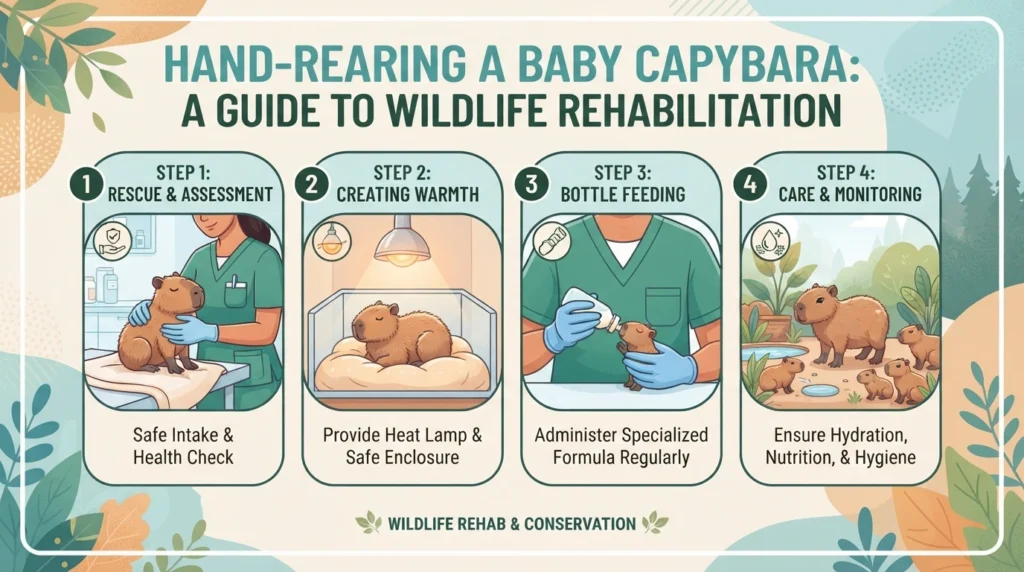
Orphaned and Hand-Reared: What Happens When a Mother Rejects Her Pup
Why Rejection Happens
Sometimes a capybara mother refuses a newborn outright no nursing, pushing it away, occasionally showing aggression toward it.
This almost always involves a pup that is weak, premature, underweight, or visibly compromised.
It reads as cruelty. It is not. A female has a finite energy budget and a litter of four or five to get through the most dangerous period of their lives. Directing that energy toward offspring with a realistic chance of surviving is the behavior that gets the most of her genes into the next generation. Nearly every mammal mother on Earth does some version of this calculation.
Expert tip: If you see this at a zoo or read about it online, understand what you are looking at. Rejection of a non-viable newborn is normal, adaptive behavior not a failure of mothering.
The Lexus Story
The best-documented case belongs to a capybara named Lexus, at Sodegaura Zoo in Japan.
Lexus was born prematurely in a litter of five and could not stand or walk. His mother, Marie by all accounts an attentive and capable mother to her other pups rejected him, which under the circumstances was the expected response.
The zoo’s founder took him home and hand-reared him. Lexus survived. He grew up in a family house alongside the household dog, Kenji.
And that is where the story gets genuinely instructive. Lexus developed vocalizations that no other capybara makes sounds widely believed to be his attempt to reproduce Kenji’s greeting behavior. He learned to communicate like the animal he grew up with.
At around six months, the zoo attempted to reintegrate him with the capybara herd.
It did not work. Lexus has never lived as part of a herd. He lives today in a large grassy field adjacent to the enclosure holding the herd he was born into, thriving by every measure of health and clearly fond of human company but socially, permanently outside the group. His two sisters live in the herd. His two brothers went to other zoos as breeding males.
Hand-rearing saved his life. It also cost him something that could not be given back.
Frequently Asked Questions About Baby Capybaras
Can you keep a baby capybara as a pet?
Legal in some jurisdictions, restricted or banned in many others and even where it is permitted, reputable wildlife organizations advise against it.
The reason is the four-adult threshold and everything downstream of it. Capybaras are obligate social animals. A single capybara living alone experiences chronic stress, and the research on group size makes clear that isolation runs against something fundamental in the species. Add a mandatory swimming pool, a specialized high-fiber diet, an exotic vet, and the challenge of potty training a capybara, and the commitment is far beyond what most homes can meet.
If you are still weighing it, start with the legal question in your own state — our guide to capybara ownership in North Carolina shows how much the rules vary and how many people discover the restrictions too late.
How long do baby capybaras stay with their mother?
Pups nurse for up to 16 weeks and stay closely bonded for several months after weaning. Most remain with their birth herd for at least a year. Young males typically disperse between 12 and 18 months; females frequently stay for life.
Do baby capybaras have teeth at birth?
Yes, all of their cheek teeth are already erupted at birth, with signs of wear present from the start. Like all rodents, their incisors and cheek teeth grow continuously and are worn down by constant grazing on abrasive vegetation.
How much does a baby capybara weigh?
About 1,500 grams (3.3 lbs) at birth. Some zoo-recorded litters come in slightly heavier at 3.5 to 4 pounds. By 18 months, that becomes roughly 40 kilograms.
What sounds do baby capybaras make?
Four main ones: a purring whistle to stay in contact with the mother and herd, an insistent squeak to solicit nursing, a sharp whine signaling distress, and as they get older the alarm bark that sends the whole group toward water.
Why do capybara mothers reject their babies?
Almost always because the pup is premature, weak, or non-viable. It is an adaptive resource-allocation behavior, not a behavioral failure. In managed care, keepers can intervene and hand-rear the pup, though full social reintegration is not guaranteed.
How can I see baby capybaras in person?
Check AZA-accredited zoos with capybara habitats — San Diego Zoo and Palm Beach Zoo both run breeding programs and post birth announcements on their social channels. Visit early morning or late afternoon, when pups are most active.
The Takeaway
A capybara pup goes from 1,500 grams to roughly 40 kilograms in eighteen months. It arrives furred, sighted, toothed, and mobile, because a wetland full of caimans and jaguars offers no other viable option.
But the physical adaptations are only half of it. What actually keeps a pup alive is the herd: the nursery group, the females who nurse whichever pup shows up, the dominant male patrolling the perimeter, and the constant thread of purrs and whistles holding the whole thing together. Strip that down below four adults and the entire system stops functioning, no matter how well-developed the newborns are.
That is the real story of a baby capybara. Not a solitary animal that happens to be social a social system that happens to produce individual animals.
If you found this useful, share it with someone who has been sending you capybara videos. And if you want to go deeper, our wild vs. captive lifespan guide picks up exactly where this one leaves off.
Further Reading and Sources
- San Diego Zoo Wildlife Alliance Capybara Fact Sheet free, regularly updated, and the source for the gestation, birth weight, weaning, sexual maturity, and four-adult-threshold figures used throughout this article.
- Animal Diversity Web (University of Michigan) capybara entry — peer-reviewed academic detail on capybara biology.
- Capybara: A Natural History of the World’s Largest Rodent by Rexford D. Lord the standard reference work on the species.
- PBS Nature capybara fact sheet accessible overview with documentary footage of wild family groups.

Carly Fiorina
Exotic Pet Research Specialist/Capybara Owner
Hi, I’m Carly, and I’m the heart behind CapybaraTalks.com. My journey with capybaras began when I met my first pet, and I was instantly fascinated by her calm, social, and endlessly curious nature. Capybaras are gentle, playful, and love to swim and explore each one has a unique personality that makes them such special companions.