
Could you lift a capybara? Most adults can’t. That single fact tells you almost everything you need to know about this animal, and most people get it wrong anyway.
The capybara is the world’s largest rodent. Everyone knows that much. But “largest rodent” doesn’t mean much until you see real numbers next to things you already know, a dog, a suitcase, your own height. Size matters here for real reasons too. It shapes how a capybara moves, how it survives, and, if you’re ever thinking about caring for one, how big a pen and pool you’d actually need.
By the end of this guide, you’ll be able to picture a capybara as clearly as you picture a Labrador Retriever. We’ll cover exact height, length, and weight, how a two-pound pup turns into a hundred-pound adult, how the numbers compare to everyday objects, and what actually decides how big any single capybara gets. Grab a tape measure if you want to follow along. Several of the tips below let you mark out a capybara’s size right on your own floor.
The numbers in this guide come from zoo records, wildlife field studies, and databases like Animal Diversity Web, PBS Nature, and published research out of Brazil and Venezuela. Capybaras have been measured, weighed, and studied for decades, so the story here is well documented.
Capybara Size at a Glance
- Height at the shoulder: 20–24 inches (50–60 cm). About the height of a medium-sized dog’s back.
- Body length (head to rump): 42–53 inches (106–134 cm). Longer than a standard guitar case.
- Weight: 77–146 pounds (35–66 kg). Close to a large Labrador Retriever, but stockier.
- Tail: Capybaras barely have one. It’s tiny and almost invisible, so their length is always measured from nose to rump.
Detailed Dimensions Breakdown
Height at the Shoulder: How Tall Does a Capybara Stand?
Twenty to twenty-four inches. That’s the typical range, measured at the top of the shoulder blades while the animal stands on all fours.
Here’s why that number is easy to misjudge: a capybara’s height alone doesn’t tell you much. Combine that shoulder height with a wide, barrel-shaped body, and the animal fills far more space than the number suggests. A Beagle or a Cocker Spaniel stands about that same height at the shoulder. Neither one is anywhere close to a capybara in bulk.
Expert tip: Grab a tape measure and mark 24 inches up a wall. That’s the top of a large capybara’s back. Now picture that height stretching out over four feet of length. That’s the real footprint of the animal.
Body Length: From Nose to Rump
Forty-two to fifty-three inches, measured in a straight line from the tip of the nose to the base of the tail, following the curve of the back.
Want something to compare it to? A standard acoustic guitar case runs about 42 to 48 inches. A large checked suitcase is closer to 30 inches. So a capybara is longer than your suitcase, and just about even with your guitar case.
Expert tip: Mark out 54 inches (4.5 feet) on the floor with tape. That’s a large adult capybara’s length. It takes up more floor space than most people expect.
Weight: The Heft of a Capybara
Seventy-seven to a hundred and forty-six pounds. That’s the full adult range, and females often land at the higher end.
A few things push that number up or down. Diet matters. Season matters too, wild capybaras can lose 10 to 15 percent of their body weight during the dry season, when food is harder to find. And whether an animal lives in the wild or in captivity makes a real difference, since captive capybaras almost always have steady access to food.
For comparison, a healthy adult Labrador Retriever weighs 55 to 80 pounds. A capybara can weigh nearly twice that, packed into a shorter, much denser body.
Expert tip: If you’re ever planning space for a capybara, that weight is the whole story. It needs sturdy fencing and a pool built to hold real weight. A flimsy kiddie pool won’t survive the season.
Size Comparison Table
Animal / Object | Average Weight | Average Length | Height at Shoulder | Notes |
Capybara | 77–146 lb (35–66 kg) | 42–53 in (106–134 cm) | 20–24 in (50–60 cm) | World’s largest rodent; stocky, semi-aquatic |
Beaver | 35–70 lb (16–32 kg) | 30–40 in (76–102 cm) | 12–15 in (30–38 cm) | Second-largest rodent, but much smaller overall |
Labrador Retriever | 55–80 lb (25–36 kg) | 36–42 in (91–107 cm) | 21–24 in (53–61 cm) | Close in shoulder height, far leaner build |
Average Adult Human | 137 lb (62 kg) global average | 64 in (163 cm) standing height | N/A (stands upright) | Shorter than a person, but can outweigh one |
Acoustic Guitar Case (empty) | 10–15 lb (4.5–7 kg) | 42–48 in (107–122 cm) | 4–6 in (10–15 cm) | Nearly the same length as a capybara |
Large Checked Suitcase (empty) | 10–12 lb (4.5–5.5 kg) | 28–32 in (71–81 cm) | 18–22 in (46–56 cm) | Shorter in length, close in height when standing |
Growth Stages: From Birth to Adult
Birth to Weaning (0–8 Weeks)
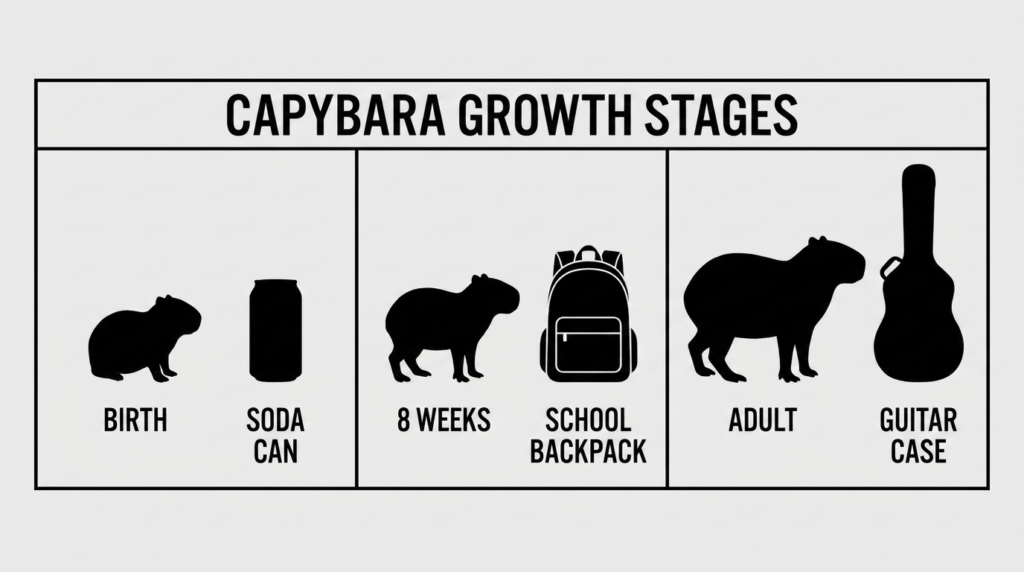
A capybara pup is born ready for the world. It arrives fully furred, eyes already open, and can walk within hours of being born. Birth weight sits between 2 and 4 pounds (0.9–1.8 kg).
Pups nurse for around 8 weeks, but they start nibbling grass within the first week. Growth is fast from day one.
By 4 weeks, a pup may have doubled its birth weight. By 8 weeks, when nursing typically ends, it can weigh 10 to 15 pounds (4.5–6.8 kg).
Expert tip: A newborn capybara is about the size of a guinea pig. Don’t let that fool you. It can reach 88 pounds by 18 weeks.
Juvenile Growth Spurts (2–6 Months)
Between 2 and 4 months, growth hits its fastest point. Under good conditions, a young capybara can gain 5 to 10 pounds a week.
By 4 to 6 months, weight typically reaches 50 to 70 pounds (23–32 kg), and body length can already pass 3 feet.
Capybaras reach sexual maturity around 12 to 18 months old, but the bulk keeps building for another year after that.
Adolescence to Full Size (6–18 Months)
Growth slows after 6 months, but it doesn’t stop. By 12 months, most capybaras have reached 80 to 90 percent of their adult weight.
Between 12 and 18 months, the skeleton finishes growing. Muscle and fat can still add a bit more over time, depending on diet.
Full adult size usually arrives by 18 months. Females often end up a little heavier than males.
Capybara Growth Milestones Table
Age | Weight | Length (approx.) | Notes |
Birth | 2–4 lb (0.9–1.8 kg) | 8–12 in (20–30 cm) | Born fully developed; can walk and swim right away |
4 weeks | 5–8 lb (2.3–3.6 kg) | 14–18 in (35–45 cm) | Starts grazing on grass; still nursing |
8 weeks (weaning) | 10–15 lb (4.5–6.8 kg) | 18–24 in (45–60 cm) | Fully weaned; fast growth ahead |
18 weeks | 70–88 lb (32–40 kg) | 30–36 in (76–91 cm) | Close to adult height; still filling out |
12 months | 90–120 lb (41–54 kg) | 38–46 in (96–117 cm) | Nearing adult weight |
18 months (adult) | 110–146 lb (50–66 kg) | 42–53 in (106–134 cm) | Full size; females may be heavier |
Sexual Dimorphism: Male vs. Female Size
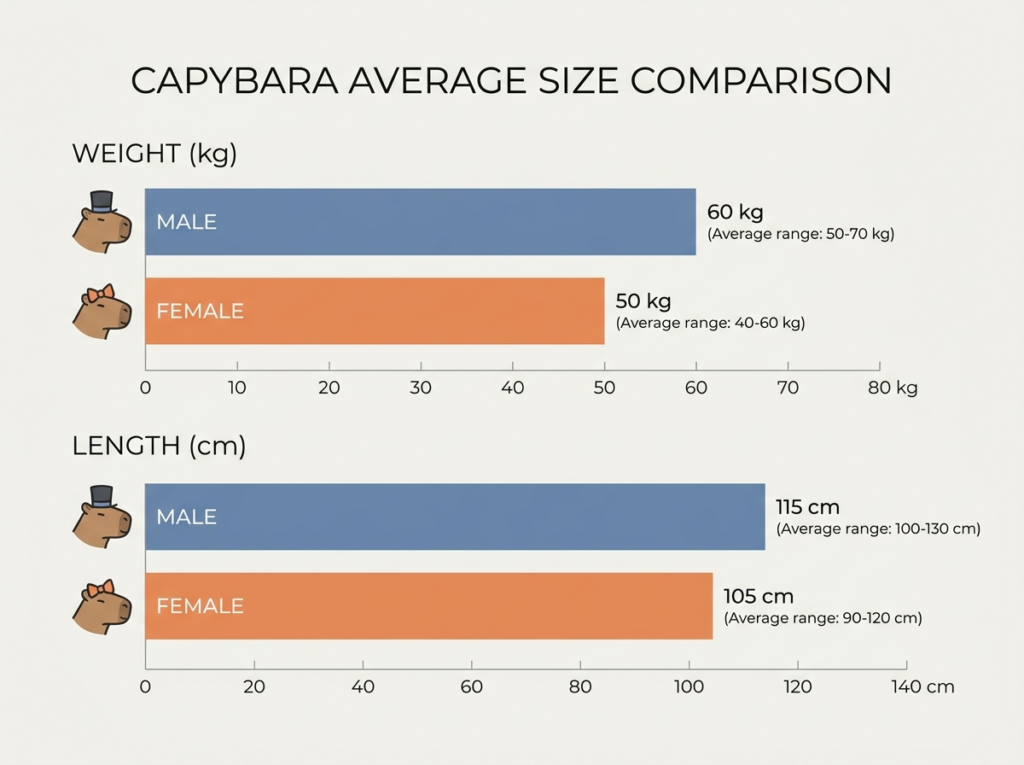
Here’s something unusual about capybaras: the females are typically the bigger ones. In most mammals, it’s the other way around.
A field study of capybaras in São Paulo, Brazil, put real numbers on this. Adult males averaged about 119 pounds (54 kg). Adult females averaged about 137 pounds (62 kg), noticeably heavier. Length differences between the sexes are much smaller, and less consistent, than the weight gap.
Why would females run larger? The leading idea is simple: bigger females can carry and nurse bigger litters. Extra size means extra energy reserves for that job.
Males aren’t left without a signature feature, though. Adult males carry a raised, bare gland on the snout used for marking territory. It’s an easy way to spot a male from a distance, even when weight alone doesn’t tell you much.
Expert tip: Watching a group of capybaras? Don’t assume the biggest one is the male. It’s often the opposite. Look for the raised gland on the snout instead, that’s your male.
Greater vs. Lesser Capybara: Size Differences
There are two capybara species, not one. The greater capybara (Hydrochoerus hydrochaeris) is the one in nearly every photo and video you’ve seen. The lesser capybara (Hydrochoerus isthmius) is smaller in every dimension, and far less known.
Scientists once treated the lesser capybara as just a smaller variety of the greater capybara. Genetic research later confirmed it deserves its own species name.
Where you find each one also differs. Greater capybaras range across most of South America, east of the Andes mountains. Lesser capybaras live in a smaller area: Panama, Colombia, and Venezuela, west of the Andes.
So if you ever spot a small capybara in Central America or northern Colombia, it’s probably not a baby. It’s likely a full-grown lesser capybara.
Species Size Comparison Table
Species | Average Weight | Average Length | Height at Shoulder | Geographic Range |
Greater Capybara | 77–146 lb (35–66 kg) | 42–53 in (106–134 cm) | 20–24 in (50–60 cm) | Most of South America, east of the Andes |
Lesser Capybara | 35–62 lb (16–28 kg) | 30–40 in (76–102 cm) | 16–20 in (40–50 cm) | Panama, Colombia, Venezuela, west of the Andes |
The lesser capybara is less studied than its bigger cousin, so these numbers carry a bit more uncertainty. Still, the size gap between the two species is large and consistent across every source that has measured them.
Record Sizes and Exceptional Individuals
The heaviest verified capybara on record weighed around 200 pounds (91 kg), a female found near São Paulo, Brazil. That record has held up across multiple studies for decades and is one of the most consistently cited figures in capybara research.
Body length records tend to top out close to 53 inches (134 cm), matching the upper end of the normal adult range rather than some dramatic outlier.
Captive capybaras, with steady food and no need to search for meals, often land at the heavier end of the range. Wild capybaras rarely pass 150 pounds; food is harder to come by, and there’s more work involved in finding it.
Expert tip: Be careful with size claims you see online. A number without a source, whether from a video caption or a random blog, isn’t worth much. Zoos, universities, and published wildlife studies are the sources worth trusting.
Factors That Influence Capybara Size
Diet and Nutrition
In the wild, capybaras eat grasses, water plants, and the occasional piece of fruit. That diet is high in fiber and low in calories, which means they have to eat constantly, up to 8 pounds of plants a day.
More food, and better food, means faster growth and a bigger adult. In captivity, though, a diet too heavy in protein or carbs can pack on unhealthy weight rather than healthy size.
Expert tip: A wild capybara’s weight shifts with the seasons. During the dry season, when food is scarce, it can lose 10 to 15 percent of its body weight.
Habitat Quality
Capybaras are semi-aquatic, they need water as much as land. A large territory with real access to water lets them swim, cool off, and escape predators. Cramped space or poor water access can slow growth and add stress.
Climate plays a role too. Warm, wet places with greenery year-round tend to grow bigger capybaras. In tougher habitats, capybaras usually run smaller.
Genetics
Just like dogs, some capybara family lines naturally grow larger than others. In the wild, bigger size can help with defending against predators and staying warm in water, so it’s often favored over time.
The greater capybara’s larger overall size compared to the lesser capybara is written into its genes. Within either species, though, individual capybaras still vary quite a bit.
Captivity vs. Wild Conditions
Captive capybaras are often heavier. Steady food and regular vet care will do that. But without enough room to move, that extra weight can turn unhealthy fast.
Wild capybaras stay leaner and more muscular. Constant movement and unpredictable food supply keep their size in a kind of natural balance between eating well and staying safe from predators.
Expert tip: Planning to care for a capybara? Aim for lean and muscular through good food and plenty of room to move, not just the highest number on a scale.
Visualizing Capybara Size: Tools and Resources
Interactive Size Simulator Concept
Picture a simple online tool. You type in your height. The screen then shows a life-sized capybara silhouette standing right next to a figure your size, both placed on a grid marked out in feet and inches.
You’d see exactly how far up your body its shoulder reaches. You could switch between a side view and a view from above, to see how much floor space it actually takes up.
That’s the real value here: it turns a number like “20 to 24 inches” into something you can actually feel. A parent could show a child, right on screen, exactly how big this animal really is next to them.
Downloadable Capybara Size Chart
A printable size chart is one of the simplest ways to make all of this stick. Picture one page with:
- A life-sized outline of a capybara’s footprint, so you can trace it yourself.
- A side-view silhouette with the key measurements labeled.
- A comparison chart showing the capybara next to a guitar case, a Labrador, and a person.
- The growth milestone table from earlier in this guide.
A chart like that works well in a classroom, as a planning reference before bringing home an animal, or simply as something for a curious kid to color in.
Our Research and Methodology
Author Expertise: This guide was researched and reviewed with reference to published wildlife studies and zoo fact sheets on capybaras, and it draws on established field research from Brazil and Venezuela on capybara body size and growth.
Data Collection Methods: The numbers here come from a mix of sources: peer-reviewed wildlife research, zoo records, and databases such as Animal Diversity Web and PBS Nature. Measurements follow standard methods used in the field, shoulder height measured at the highest point of the shoulder blades, body length measured from nose to the base of the tail, and weight recorded on a calibrated scale.
Commitment to Accuracy and Updates: This guide will be reviewed and updated as new research, records, or zoo data become available. If you’ve come across a verified size record we haven’t included, let us know in the comments.
Conclusion
Capybaras are the largest rodents alive, and now you have the real numbers to prove it: 20 to 24 inches at the shoulder, over 4 feet long, and a weight that can top 140 pounds. A 2-pound pup reaches that full size in about 18 months. Females typically end up heavier than males. And the lesser capybara, a smaller, separate species, lives an entirely different range than its bigger cousin.
Whether you’re reading this out of pure curiosity, for a school project, or because you’re planning space for a pet, the real dimensions change how you see this animal. It stops being an internet meme and starts being what it actually is: a genuinely large, genuinely heavy animal that happens to be extremely calm about the whole thing.
Expert tip: If you ever get the chance to stand near a capybara enclosure, do it. Compare your own height to its shoulder. Photos never quite capture the real scale, seeing it in person does.
Download the size chart, mark out 4.5 feet on your floor, or just share this guide with someone who still thinks a capybara is guinea-pig sized. And if you’ve seen one in person, tell us about it in the comments, we’d love to hear how it compared to what you expected.

Carly
Exotic Pet Research Specialist
Hi, I’m Carly, and I’m the heart behind CapybaraTalks.com. My journey with capybaras began when I met my first pet, and I was instantly fascinated by her calm, social, and endlessly curious nature. Capybaras are gentle, playful, and love to swim and explore—each one has a unique personality that makes them such special companions.
1 thought on “Capybara Size Guide: How Big Do Capybaras Get?”