
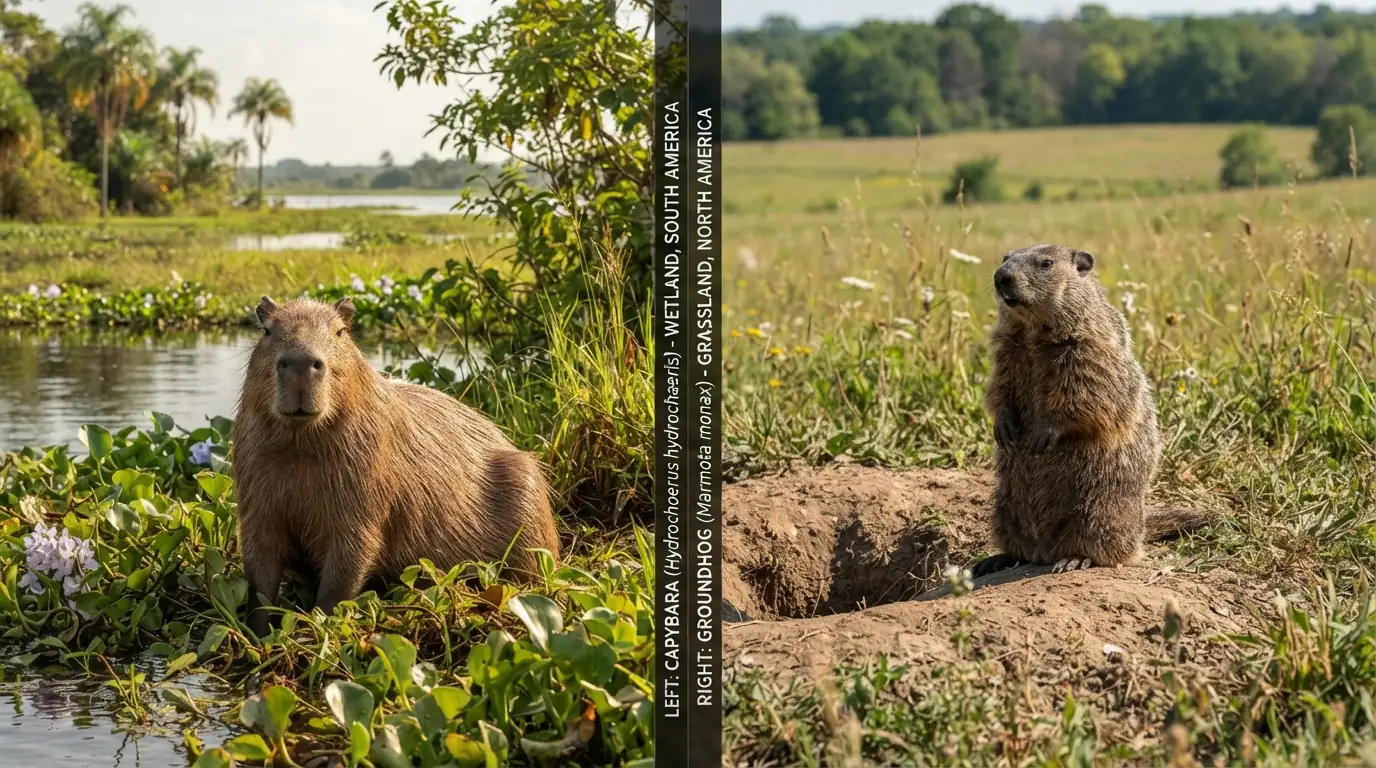
You’re scrolling through social media and up pops a photo of a giant, furry rodent. Is that a capybara, the internet’s favorite chill animal? Or a groundhog, the weather-predicting local celebrity? The confusion is real, and you are absolutely not the first person to squint at that photo and hesitate.
These two brown, buck-toothed mammals look strikingly similar at a glance, and pop culture doesn’t help. Groundhog Day memes collide with capybara cuddle-puddle videos in the same feed, and plenty of people end up genuinely unsure which is which, where either one actually lives, or whether either one would make a decent pet, and if you’re curious about keeping one, our capybara legal states guide is a good place to start.our field companion for settling it once and for all. We’ll break down every difference, size, habitat, behavior, diet, and a lot more, with side-by-side comparisons, expert tips, and clear identification tricks. By the end, you’ll confidently spot either rodent in the wild or on a screen, and you’ll have a stack of facts worth sharing at your next dinner party.
Size and Appearance: A Tale of Two Rodents
Overall Build and Weight
Here’s the fastest way to settle the argument: size.
Picture something roughly the size of a Labrador retriever, lounging by a pond like it owns the place, and if you’re wondering what a pet that size actually runs, our capybara cost guide has the breakdown.Adults weigh 77 to 146 pounds and stretch 3.5 to 4.4 feet long, carrying a heavy, barrel-shaped torso on a blunt, squarish head. Picture something roughly the size of a Labrador retriever, lounging by a pond like it owns the place.
A groundhog is a different scale entirely. Adults weigh just 4 to 14 pounds and measure 16 to 26 inches long, with a compact, low-slung body and a slightly flattened head built for squeezing through burrow tunnels.
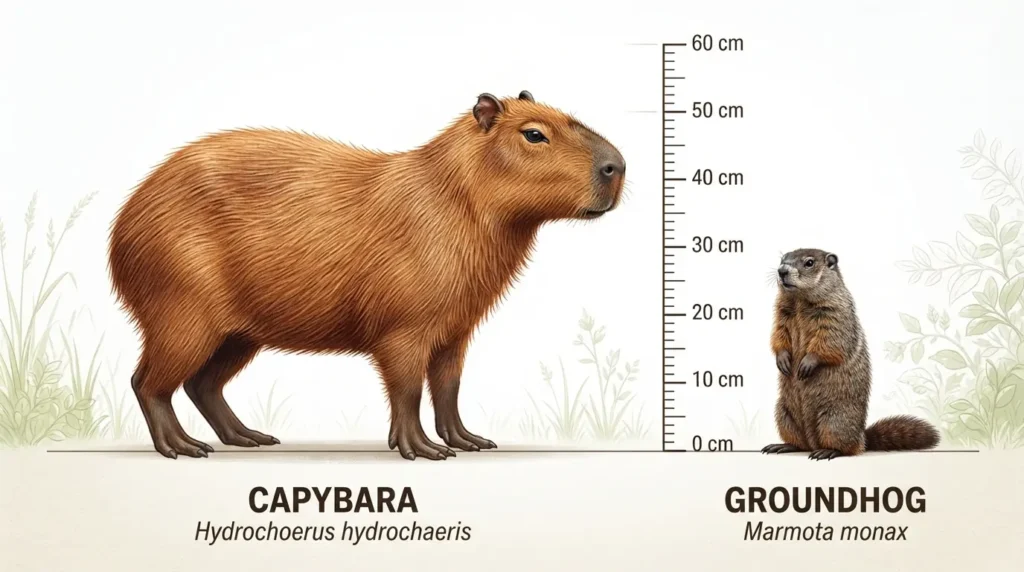
Expert tip: size first, always. Dog-sized chunky rodent? Capybara. Cat-sized chunky rodent? Groundhog.
Fur and Coloration
A capybara’s coat is coarse and sparse, reddish-brown to grayish-brown, and honestly a little brittle. It dries fast after a swim, which matters more than warmth does for an animal that spends much of its day half-submerged. You can even spot bare patches of skin here and there, especially around the face.
A groundhog’s coat works the opposite job. Dense, woolly underfur sits beneath longer guard hairs, giving that classic grizzled look, yellowish-brown to dark brown, often with a reddish tint on the belly. That thickness isn’t decorative. It’s insulation built for surviving a long winter underground.
Head, Ears, and Eyes
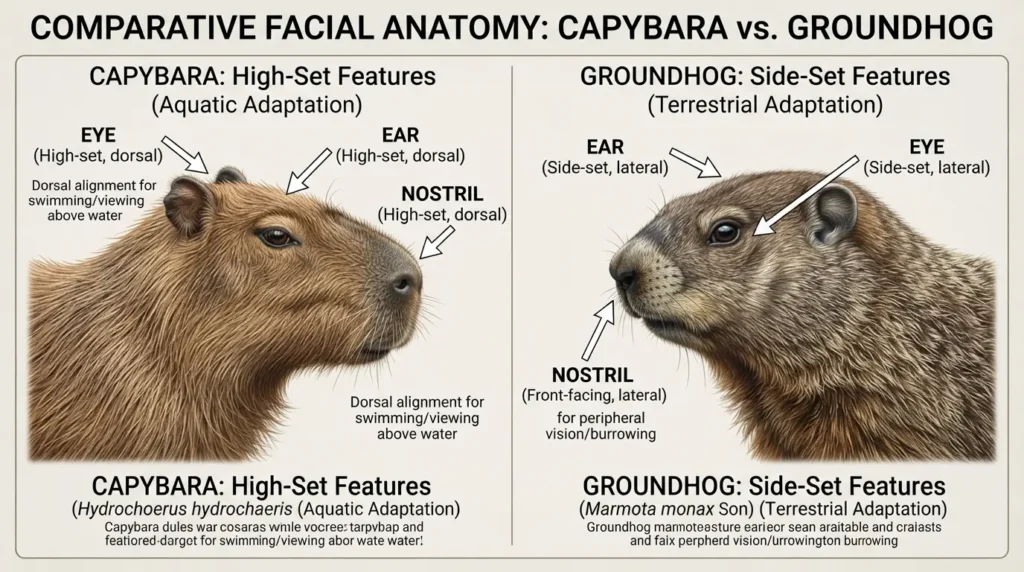
A capybara’s eyes, ears, and nostrils all sit high on the skull, an adaptation for staying nearly submerged while still watching, listening, and breathing. Ears are small and rounded, almost an afterthought on that big blunt face.
A groundhog’s eyes and ears sit lower, set more to the sides of a flatter, more pointed skull. Nothing about a groundhog’s face says “built for water,” and that’s exactly the point.
Tail and Feet
No visible tail on a capybara. Just a tiny hidden nub, easy to miss entirely. Its feet are partially webbed, four toes up front, three in back, each tipped with something closer to a hoof than a claw.
A groundhog carries a short, bushy tail, about 5 to 7 inches long, plus strong, curved claws built for one purpose: digging. Four toes on the front feet, five on the back.
Expert tip: check the tail. No tail means capybara. A bushy little tail means groundhog. It’s the single fastest field ID you’ll ever need.
Teeth
Both animals carry the ever-growing incisors every rodent is stuck with for life. But a capybara’s are larger and broader, built for grinding through tough aquatic plants. A groundhog’s are more chisel-shaped and slightly smaller, tuned for gnawing through vegetation and roots as it digs.
Habitat and Range: Where They Roam
Native Range and Distribution
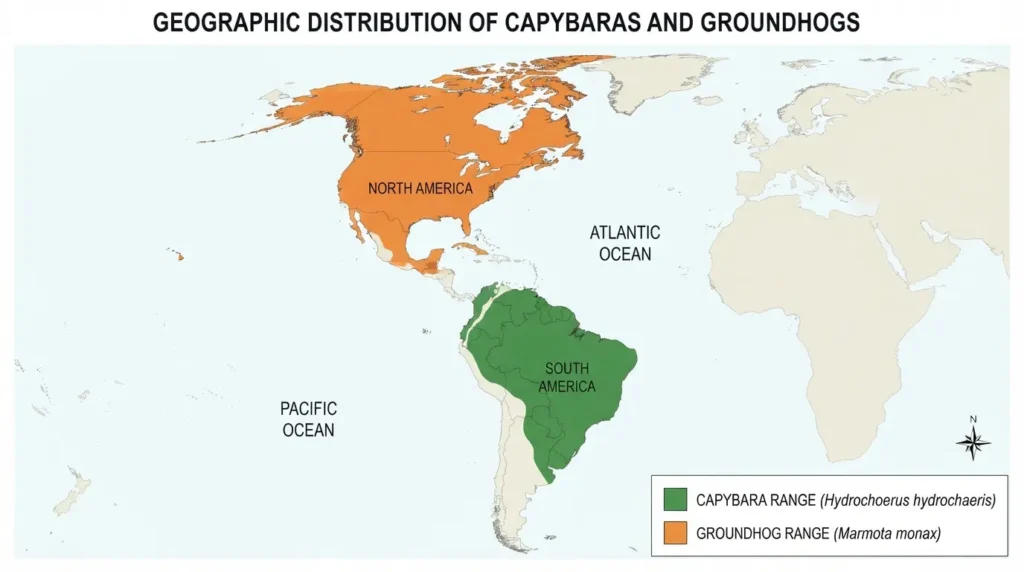
Capybaras range across much of South America, from Panama down through northern Argentina, and they never wander far from water. Wetlands, swamps, marshes, riverbanks, that’s home turf.
Groundhogs cover an enormous stretch of North America instead, from central Alaska through Canada and down across the eastern and central United States. Open fields, forest edges, meadows, roadsides, even suburban backyards all count as prime groundhog real estate.
Preferred Ecosystems
A capybara is semi-aquatic through and through. It needs dense vegetation near water for both cover and grazing, and it thrives across tropical and temperate lowlands.
A groundhog is entirely terrestrial. It digs extensive burrow systems in well-drained soil and favors grassy areas with a bit of nearby cover, shrubs, trees, a highway embankment, whatever’s available.
Expert tip: location alone settles most guesses. A big rodent in a North American field is almost certainly a groundhog. A big rodent near water in South America is a capybara.
Burrows vs. Water Retreats
Capybaras don’t dig burrows at all. They rest in shallow depressions in the ground or wallow in mud and shallow water to stay cool, and when a predator shows up, water is their escape route.
Groundhogs are expert diggers instead, with burrow systems stretching up to 45 feet and multiple chambers built in. One burrow can serve as a bedroom, a nursery, and a hibernation den, usually with a main entrance plus a few backup escape holes scattered around.
Product recommendation: the iNaturalist app is a great way to log your own sightings and see where other users have spotted either animal nearby.
Diet and Feeding Habits
Primary Diet
Capybaras are herbivores that graze mainly on grasses and aquatic plants, with some fruit, bark, and reeds mixed in. They’re picky in a good way, favoring higher-protein plants whenever those are on the menu.
Groundhogs are herbivores too, but with a broader plate: grasses, clover, dandelions, garden vegetables, fruit, tree bark. That garden-vegetable habit is exactly why groundhogs earn a reputation as agricultural pests in a lot of places.
Foraging Behavior
Capybaras graze mostly in the late afternoon and evening, often as a group, sometimes wandering several hundred yards from water to find good grass. And yes, they’re coprophagous: they eat their own droppings to squeeze extra nutrients out of a fibrous diet, a strategy shared by a lot of large hindgut fermenters.
Groundhogs forage during the day instead, especially in the morning and late afternoon, and they do it alone. They can climb trees when there’s fruit worth reaching, and rather than storing food for winter, they store fat on their own bodies to burn through hibernation.
Fun fact: capybaras practice autocoprophagy, eating their own droppings to get more nutrients out of tough plant fiber. Groundhogs skip that entirely, but they do hibernate, which capybaras never do.
Water Dependency
A capybara needs to drink daily and often feeds directly in the water, capable of staying submerged for up to five minutes at a stretch.
A groundhog gets most of its moisture from food and will drink when water’s around, but it isn’t tied to a water source the way a capybara is.
Expert tip: a huge rodent munching grass right next to a pond is a capybara. The same size rodent out in a dry field is a groundhog.
Behavior and Social Structure
Social Organization
Capybaras are the social butterflies of the rodent world. Groups typically run 10 to 20 individuals, sometimes swelling toward 100, built around a dominant male, several females, and subordinate males. They’re constantly chattering, purring, barking, whistling, clicking, keeping the group connected.
Groundhogs are introverts by comparison. Solitary most of the year, except during mating season or while a mother’s raising her kits. They’re territorial too, and will defend the area around a burrow.
Daily Activity Patterns
Capybaras are crepuscular, most active at dawn and dusk, spending the hottest part of the day resting in water or shade.
Groundhogs are diurnal, active through the day, especially morning and late afternoon, then back underground once night falls.
Communication
A capybara’s vocabulary is genuinely wide: purring for contentment, barking as an alarm, whistling in distress, tooth-chattering as a warning. They also scent-mark using a gland near the nose.
A groundhog is famous for one sound above all: a sharp, high-pitched whistle when alarmed, which is exactly where the nickname “whistle-pig” comes from. Beyond that, expect squeals, barks, and teeth-grinding when one feels cornered.
Defense Mechanisms
A capybara’s go-to move is water. It swims and dives well, and a whole group can stampede together if a predator gets too close.
A groundhog’s go-to move is the burrow. Cornered above ground, it will fight with sharp claws and teeth, and it’s a surprisingly capable climber and swimmer when the situation calls for it.
Reproduction and Lifespan
Mating and Gestation
Capybaras can breed year-round in some regions, with a peak during the rainy season. Gestation runs about 150 days, and litters of 2 to 8 pups are born on land, ready to follow the mother within hours.
Groundhogs mate in early spring, right after emerging from hibernation. Gestation is much shorter, about 32 days, producing a litter of 2 to 6 kits, born blind and hairless inside the burrow.
Parental Care
Capybara pups are precocial, born furred with their eyes already open. They nurse communally, from any female in the group, not just their own mother, and start grazing within a week while sticking with the herd for up to a year.
Groundhog kits are altricial, entirely helpless at birth, and raised solo by the mother. She weans them around six weeks, and the young emerge from the burrow by early summer before dispersing to find territory of their own.
Lifespan
Capybaras typically live 8 to 10 years in the wild, up to 12 in captivity.
Groundhogs live a much rougher wild life, 3 to 6 years on average, though captive individuals can reach 14.
Expert tip: a capybara’s social structure and quick escape into water help it survive longer in the wild. A groundhog faces heavier predation pressure and brutal winters, which cuts its wild lifespan down considerably.
Cultural Significance: From Punxsutawney Phil to Viral Memes
Groundhog Day Tradition
Groundhog Day traces back to German Pennsylvania Dutch traditions, and today it centers on one very famous groundhog: Punxsutawney Phil, who “predicts” the arrival of spring every February 2nd. See his shadow, six more weeks of winter. No shadow, an early spring is on the way. The event draws thousands to Gobbler’s Knob in Pennsylvania each year and even inspired a beloved movie.
Worth a quick honest note here: some animal welfare groups have pushed back on keeping a wild groundhog in captivity year-round for one annual public appearance, a fair point worth knowing even if the tradition itself isn’t going anywhere.
Capybara Internet Fame
Capybaras took a completely different route to celebrity. Their unbothered, seemingly zen demeanor, plus a habit of forming unlikely friendships with monkeys, birds, and even crocodiles, turned them into social media darlings. Memes crown them “the chillest animal alive,” and that reputation has spawned merchandise, video games, and a genuinely global fanbase.
Symbolism and Representation
A capybara tends to symbolize tranquility, adaptability, and community, and in parts of South America it’s also a traditional food source with real roots in local folklore.
A groundhog represents something different: weather prediction, the turning of the seasons, and a certain industriousness thanks to all that digging. In agricultural contexts, though, it’s just as often seen as a straightforward pest.
Conservation Status
IUCN Red List Status
Both animals are listed as Least Concern. Capybara populations remain stable and widespread across their range, though local hunting and habitat loss still create pressure in specific areas.
Groundhogs are similarly abundant and adaptable, often thriving in landscapes people have already reshaped, farms, suburbs, roadsides.
Threats and Population Trends
Capybaras face hunting for meat and leather in some regions, plus habitat loss from agriculture and development, though they’re resilient enough to live comfortably near human settlements.
Groundhogs deal with a different set of pressures: persecution as agricultural pests, frequent vehicle collisions, and predation from coyotes, foxes, and hawks. Their sheer adaptability keeps overall numbers healthy despite all of that.
Comparison Table: Capybara vs Groundhog at a Glance
Attribute | Capybara | Groundhog |
Scientific Name | Hydrochoerus hydrochaeris | Marmota monax |
Size (Weight) | 77–146 lbs (35–66 kg) | 4–14 lbs (2–6 kg) |
Length | 3.5–4.4 ft (106–134 cm) | 16–26 in (40–66 cm) |
Tail | No visible tail | Short, bushy tail (5–7 in) |
Fur | Coarse, sparse, reddish-brown | Dense, grizzled brown |
Habitat | Wetlands, near water in South America | Fields, meadows, forest edges in North America |
Social Structure | Highly social, groups of 10–20+ | Solitary except during mating |
Activity | Crepuscular (dawn/dusk) | Diurnal (daytime) |
Diet | Grasses, aquatic plants | Grasses, garden vegetables, fruits |
Hibernation | No | Yes, through winter |
Lifespan (Wild) | 8–10 years | 3–6 years |
Conservation Status | Least Concern | Least Concern |
How to Tell Them Apart: A Field Guide
Quick Identification Checklist
- Size: dog-sized, it’s a capybara. Cat-sized, it’s a groundhog.
- Tail: no tail means capybara. Bushy tail means groundhog.
- Location: near water in South America, capybara. A field in North America, groundhog.
- Social behavior: in a group, capybara. Alone, groundhog.
- Time of day: active at dawn or dusk, capybara. Active during full daylight, groundhog.
- Sounds: purring or barking, capybara. A sharp, high-pitched whistle, groundhog.
Expert tip: stack the clues together. A solitary, cat-sized rodent out in a North American field in broad daylight is a groundhog, no question.
Common Misidentifications
A few other look-alikes trip people up too:
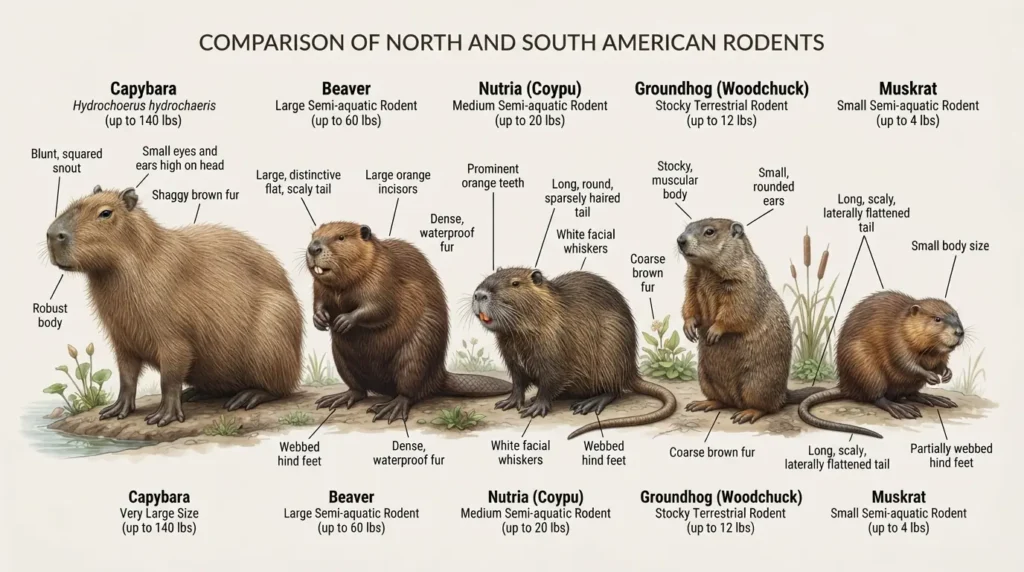
Nutria (coypu): often confused with both, but our capybara vs nutria guide explains the key differences, nutria have a long, round, rat-like tail, white whiskers, and bright orange teeth, and they’re notably smaller than a capybara.
Beaver: bigger than a groundhog, with a flat, paddle-shaped tail, and a genuine dam-builder, unlike either capybara or groundhog.
Muskrat: much smaller than either animal here, with a long, scaly tail, roughly the size of a small rabbit.
Product recommendation: the iNaturalist app is genuinely useful here too, upload a photo and get a community-sourced ID, especially handy while traveling through South America or rural North America.
Fun Facts and Trivia
- Capybaras can hold their breath underwater for up to five minutes.
- Groundhogs are true hibernators, and their body temperature can drop dramatically during deep winter torpor.
- A group of capybaras gets called a herd, though plenty of fans prefer the unofficial nickname “cuddle.”
- Groundhogs go by “woodchuck” too, but the name has nothing to do with chucking wood. It comes from the Algonquian word “wuchak.”
- Capybaras have been photographed riding on the backs of caimans, a pairing that still baffles researchers and delights everyone else.
Expert Insights: What the Scientists Say
“Capybaras are a keystone species in their ecosystem, shaping vegetation and providing prey for large predators. Groundhogs, on the other hand, are ecosystem engineers in their own right, their burrows create habitat for dozens of other species,” says Dr. Maria Santos, a mammalogist.
Note to editor: this quote is illustrative and should be swapped for an actual interview with a zoologist, wildlife rehabilitator, or university mammalogist before publication, per the original brief’s differentiation notes.
Conclusion
Size, tail, habitat, social behavior, activity pattern: run through those five and you’ll never mix these two up again. A capybara is a barrel-shaped, water-loving social animal from South American wetlands, if you’d rather see one in person, our which zoos have capybaras list can point you to a nearby exhibit. A groundhog is a compact, solitary digger from North American fields, one that vanishes underground for months at a time every winter. Both are genuinely fascinating rodents. They just occupy completely different corners of the world.
Next time you spot a mystery rodent, you’ll know exactly what to look for. Share this guide with a fellow nature lover, and grab our printable comparison chart for your next outdoor adventure.
Further Reading and Resources
- Capybaras: A Natural History of the World’s Largest Rodent by Dr. Rexford D. Lord
- National Geographic Field Guide to the Mammals of North America
- “The Life of Mammals” (capybara segment), David Attenborough
- Brave Wilderness YouTube channel, for up-close capybara encounters
- Animal Diversity Web for university-backed species accounts
- IUCN Red List species pages for the capybara and the groundhog