
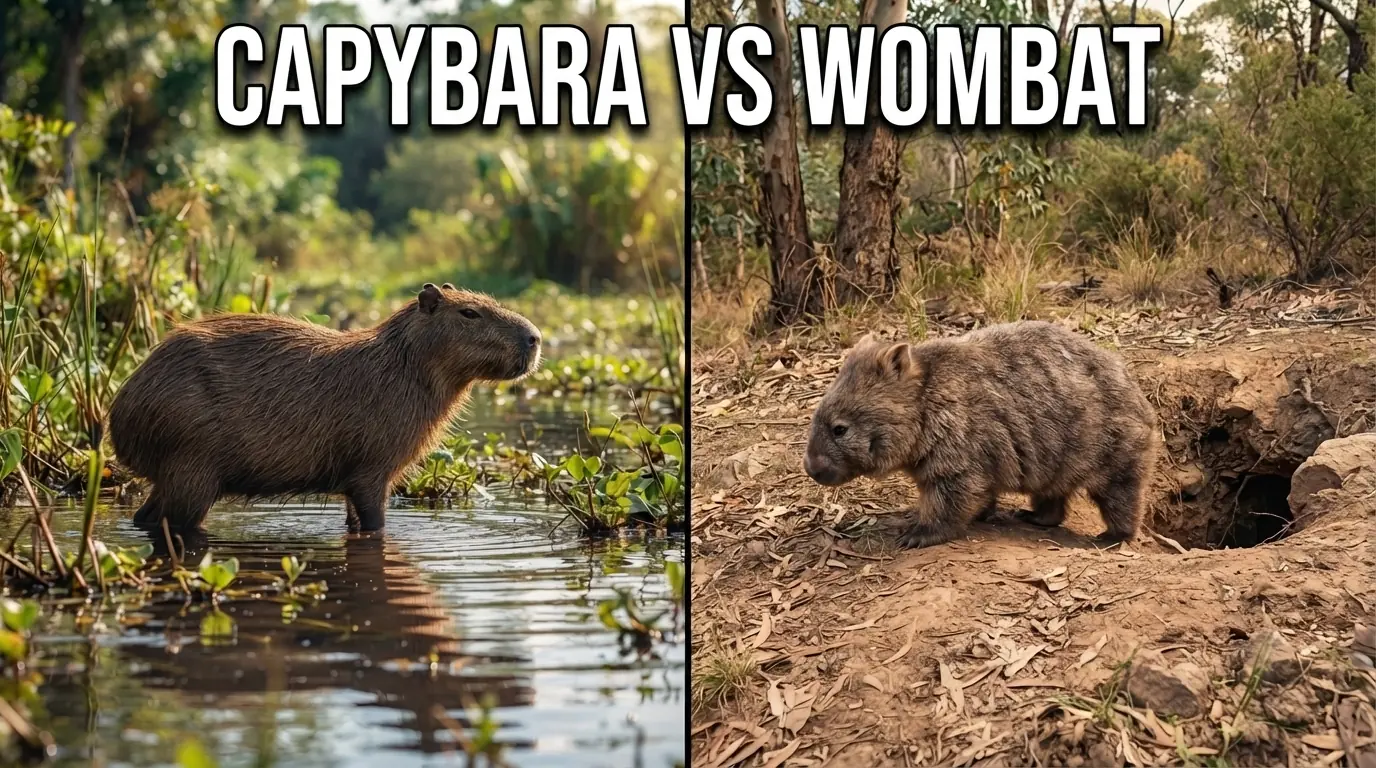
Imagine an animal that can hold its breath for five minutes underwater. Now imagine another animal, on the opposite side of the planet, that produces perfect little cubes of poop. One is the world’s largest rodent. The other is a burrowing marsupial with a pouch that opens backward. Both have become internet darlings, showing up in viral clips and comment sections full of exclamation points. But how much do you actually know about capybaras and wombats, once you get past the memes?
This isn’t a list of fun facts strung together. We’re putting these two mammals side by side, from their evolutionary roots to their daily habits, from their conservation status to the reality of what it would actually take to keep one as a pet. By the end, you’ll be able to explain to anyone why a capybara is a rodent and a wombat is a marsupial, which one needs a swimming pool, and which one can demolish a backyard fence in an afternoon. You’ll also know how to support their conservation and where to see each of them ethically, whether that’s a wetland in Brazil or a nature reserve in Tasmania.
Ready to meet your new favorite mammal? Let’s get into it.
Taxonomy and Classification: Rodent vs. Marsupial
The Fundamental Biological Divide
Here’s the first thing to get straight, because it changes everything that follows: a capybara and a wombat are not distant cousins. They’re not cousins at all.
The capybara (Hydrochoerus hydrochaeris) belongs to the family Caviidae, the same rodent family that includes guinea pigs and rock cavies, and is often compared to the nutria, a similar semi-aquatic rodent. Like every rodent, it has a single pair of continuously growing incisors, top and bottom, built for a lifetime of gnawing.
The wombat, meanwhile, most commonly Vombatus ursinus, belongs to the family Vombatidae. Wombats are marsupials. That word carries real biological weight: marsupials give birth to tiny, underdeveloped young that finish their growth inside a pouch, nursing and maturing there for months. A wombat is, genetically speaking, far closer to a koala than to any rodent on Earth.
There are three living wombat species: the bare-nosed (or common) wombat, the southern hairy-nosed wombat, and the critically endangered northern hairy-nosed wombat, according to the Australian Museum and current IUCN Red List records.
Evolutionary History: A Tale of Two Continents
Capybaras evolved in South America, part of a much larger radiation of caviomorph rodents whose ancestors are thought to have rafted across from Africa tens of millions of years ago. From there, that lineage diversified into everything from chinchillas to the capybara itself, the largest rodent that has ever lived successfully into the modern era.
Wombats tell a completely different origin story. They’re part of the ancient Gondwanan marsupial lineage, the same broad family tree that produced kangaroos and koalas, shaped by tens of millions of years of isolation on the Australian continent. Their ancestors were digging specialists, adapting slowly to Australia’s shifting mix of arid plains and temperate forest.
Expert tip: despite the superficial resemblance, the stocky body, the short legs, the near-invisible tail, capybaras and wombats last shared a common ancestor over 100 million years ago, back before the earliest true rodents or marsupials existed in anything like their current form. Every similarity you notice between them is convergent evolution, two unrelated lineages independently arriving at similar solutions to similar problems.
Physical Characteristics: Built for Water vs. Built for Digging
Size and Weight: Who’s Bigger?
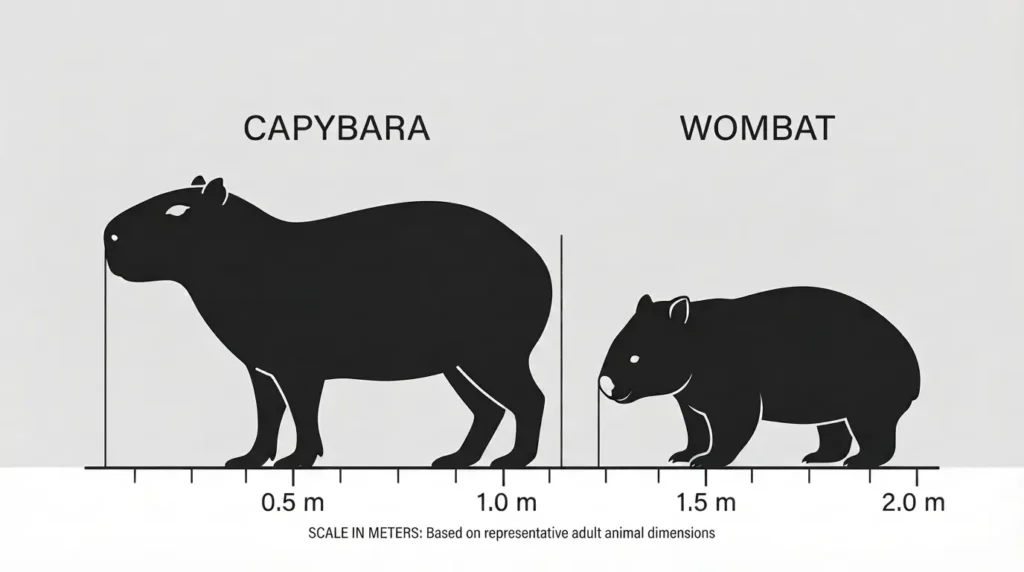
Put them side by side and the capybara wins on almost every measurement. Adults stand roughly 50 to 60 cm at the shoulder, run 106 to 134 cm in length, and weigh anywhere from 35 to 66 kg. That makes the capybara the largest living rodent on the planet, full stop.
The bare-nosed wombat measures 70 to 120 cm long and weighs 20 to 35 kg, with the southern hairy-nosed wombat running slightly smaller still. But raw size doesn’t tell the whole story. Wombats are compact and dense, built low to the ground with a center of gravity that suits a life spent shoving through tunnels rather than gliding through water.
Body Shape and Fur
A capybara carries a barrel-shaped body on surprisingly long legs, topped with a short, blunt head, small ears, and a tail so reduced it barely qualifies as one. Its coat is coarse, sparse, and reddish-brown to grayish, built to dry fast after a swim rather than to trap heat.
A wombat is the opposite blueprint entirely: low-slung, muscular, and built like a small, four-legged tank. Its head is broad, its ears small, and its rump is genuinely reinforced, more on that shortly. The fur is dense and soft, ranging from sandy to dark brown, doing real insulating work inside a cool underground burrow.
Distinctive Features: Webbed Feet vs. Claws and Pouch
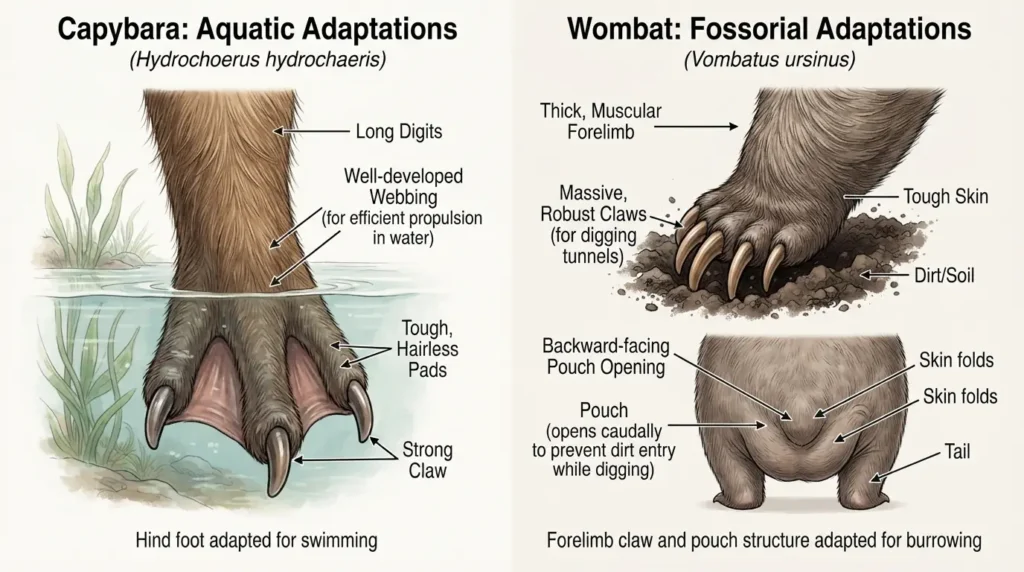
The capybara’s toolkit is all about water. Its feet are slightly webbed for swimming, much like a beaver, another semi-aquatic rodent, and its eyes, ears, and nostrils sit unusually high on its skull, letting it stay almost fully submerged while still watching, listening, and breathing.
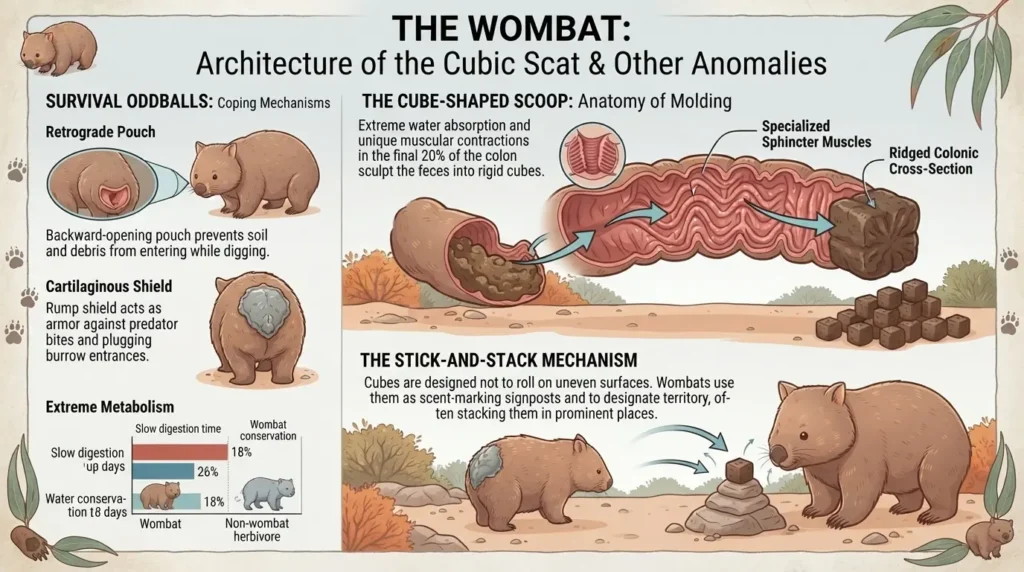
The wombat’s toolkit is all about earth. Its front claws are broad, flat, and powerful, essentially built-in shovels. Its pouch famously opens backward rather than forward, a design that keeps soil from getting flung into a joey’s face while its mother digs. And then there’s the rump: a genuinely reinforced plate of cartilage and thick skin, tough enough to block a burrow entrance and, when a predator makes the mistake of following a wombat underground, tough enough to crush that predator’s skull against the tunnel roof. Dingoes have reportedly lost that fight. It’s one of the more startling defense mechanisms in the mammal world, hiding in plain sight under what looks like a soft, round backside.
Habitat and Geographic Distribution: Wetlands vs. Woodlands
Where Capybaras Live
Capybaras range across South America, from Panama down through northern Argentina, and they never stray far from water. Rivers, lakes, swamps, flooded grasslands, if it’s wet, a capybara can probably be found nearby.
That water isn’t optional scenery. Capybaras rely on it for drinking, for cooling off in tropical heat, and for escaping predators like jaguars and caimans. They’re genuinely excellent swimmers, capable of staying submerged for up to five minutes at a stretch, often with just the tip of the nose breaking the surface.
Product recommendation: several wildlife channels host virtual tours and live webcams of Brazil’s Pantanal wetlands, a great way to watch wild capybara behavior firsthand without leaving your couch.
Where Wombats Live
Wombats occupy a very different map entirely: southeastern Australia, including Tasmania, plus one small, closely guarded population of northern hairy-nosed wombats tucked into a single patch of central Queensland. They favor forests, woodlands, heathlands, and mountainous terrain, anywhere the soil drains well enough to dig into.
A wombat spends most of daylight hours underground, inside burrow systems that can run more than 20 meters long with multiple entrances, some documented systems stretch even further. These aren’t casual dens. They’re engineered structures, and a wombat will maintain and expand one over years.
Expert tip: capybaras are tied to water. Wombats are tied to soil. That single distinction shapes almost every other difference on this list, from body shape to social structure to what each animal actually needs to survive in captivity.
Climate Preferences and Adaptations
Capybaras thrive in warm, humid conditions and genuinely struggle without shelter once temperatures drop. Wallowing in mud serves double duty for them, cooling the body and keeping biting insects at bay.
Wombats have settled into temperate and semi-arid climates instead. Their notably low metabolic rate, paired with a burrowing lifestyle, helps them conserve both energy and water, useful traits in the drier stretches of the Australian landscape.
Behavior and Social Structure: The Social Swimmer vs. the Solitary Digger
Capybara Social Life
Capybaras live in groups of 10 to 20 individuals as a rule, though during the dry season, when everyone crowds around shrinking water sources, herds can swell toward 100. A typical group centers on a dominant male, with females, subordinate males, and young rounding out the ranks.
These are unusually social rodents. Capybaras communicate with an entire vocabulary of capybara sounds and their meanings, purrs, barks, whistles, and clicks, and they groom one another and huddle together for warmth and bonding. They’re diurnal by default, active through the day, though populations under heavy human disturbance sometimes shift toward nocturnal habits to avoid people altogether.
Wombat Solitary Nature
Wombats run the opposite social model. They’re largely solitary animals, tolerating overlapping home ranges without much direct interaction beyond mating season. Territory gets marked not with scent glands or vocal calls but with that famous cube-shaped scat, deposited deliberately on rocks and logs where it won’t roll away and where a passing wombat can’t miss it.
Wombats come out at night to eat grass. During the day, they’re usually quiet. But if a wombat feels scared or trapped, it can hiss, growl, or make sharp squeaking noises.
People think wombats are gentle and slow. That’s true most of the time. But if a wombat gets cornered, it will fight back hard. It uses its sharp claws and strong rump (rear end) to defend itself.
Communication and Intelligence
Capybaras bend their body on sound to hold a group together and flag danger, and they’re famously tolerant of other species. Photos of birds sit calmly on a capybara’s back have made the rounds online for good reason. It’s not a fluke. Capybaras run one of the lowest-stress social systems of any mammal, which is exactly why so many other animals seem comfortable sharing space with them.
Wombats are quieter but no less capable. Their intelligence shows up underground, in the sheer complexity of the tunnel networks they excavate and maintain, and in a sense of smell sharp enough to guide most of their territorial and social decisions without a single sound.
Diet and Feeding Habits: Grazing on Grass vs. Grubbing on Roots
What Capybaras Eat
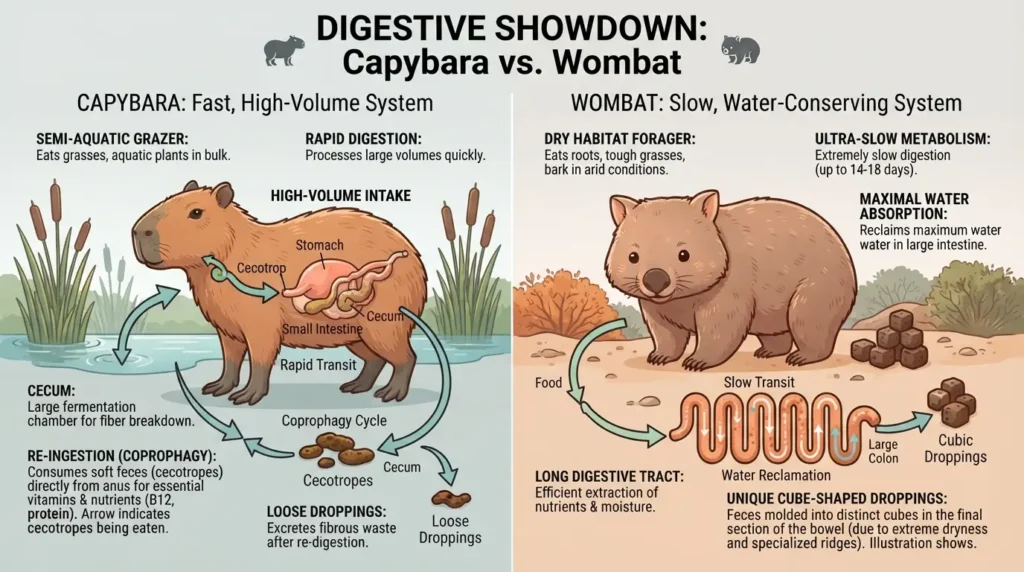
Capybaras are herbivores through and through, grazing primarily on grasses and aquatic plants, and showing a real preference for higher-protein, lower-fiber options when they’re available. Like other members of the Caviidae family, they practice coprophagy, re-ingesting their own droppings to squeeze every remaining nutrient out of a fibrous diet. It sounds unusual, but it’s a well-documented, entirely healthy rodent strategy.
What Wombats Eat
Wombats are herbivores too, but their menu leans tougher: native grasses, sedges, roots, and bark, whatever the landscape offers in a given season. Their digestive system compensates for that toughness with time. Food can spend up to 14 days moving through a wombat’s gut, an almost absurdly slow pace that lets the body wring out nearly every drop of moisture and nutrients before anything gets expelled.
Foraging Strategies and Impact on Ecosystem
Capybaras graze in groups, which shapes vegetation structure across the landscape and often carves natural pathways that other animals end up using too. They’re also a critical food source further up the chain, sustaining jaguars, anacondas, and caimans throughout their range.
Wombats leave their own mark on the land, just underground instead of on the surface. When wombats dig, they help the soil. Digging lets air and water get into the ground better.
Wombats also dig burrows to live in. When a wombat leaves its burrow, other animals often move in. Small mammals and reptiles use these old burrows for shelter.Australian ecological research increasingly treats wombats as genuine ecosystem engineers for exactly this reason.
Reproduction and Lifecycle: Pouch Life vs. Precocial Pups
Mating and Gestation
Capybaras can breed year-round, with a noticeable peak during the rainy season. Gestation runs about 150 days, and a female typically gives birth on land, not in water, to a litter of two to eight pups.
Wombats operate on a seasonal mating cycle and a strikingly short gestation, just 20 to 30 days. What emerges is a single, rarely twin, tiny and profoundly underdeveloped joey, which immediately crawls into that backward-facing pouch to continue developing.
Development of Young
Capybara pups arrive precocial: fully furred, eyes open, capable of running and even swimming within hours of birth. They nurse communally, taking milk from any female in the group rather than only their own mother, and they start grazing on solid food within about a week. That communal nursing setup is a genuine survival adaptation, spreading the workload and improving pup survival odds across the whole herd.
A wombat joey, by contrast, stays inside the pouch for six to ten months, then continues living alongside its mother for another eight to twelve months, gradually learning to forage and dig. Sexual maturity doesn’t arrive until two to three years of age. Where the capybara’s strategy is speed and shared care, the wombat’s is patience and one-on-one investment.
Lifespan in the Wild and Captivity
Capybaras typically live 6 to 10 years in the wild, stretching to around 12 in captivity. Wombats run a wider range, 5 to 15 years in the wild depending on the species and conditions, and over 20 years in captivity with good care.
Conservation Status and Threats: Least Concern vs. Vulnerable
IUCN Status and Population Trends
The capybara sits at Least Concern on the IUCN Red List, with stable numbers across most of its range, though local populations still take hits from hunting and habitat conversion in specific regions.
Wombats present a more layered picture. The bare-nosed wombat is also Least Concern. The southern hairy-nosed wombat is listed as Near Threatened, its population increasingly fragmented across isolated pockets of semi-arid South Australia. And the northern hairy-nosed wombat remains Critically Endangered, one of the rarest land mammals alive today.
Conservation spotlight: the northern hairy-nosed wombat’s story is worth knowing on its own. The species collapsed to somewhere around 30 to 35 individuals by the early 1980s, confined to a single site in Queensland’s Epping Forest National Park. Decades of dedicated conservation work, predator-proof fencing, habitat management, and careful translocation to new sites like Powrunna State Forest, have pushed that number past 400 today. It’s real progress. It’s also still a population small enough that a single bad drought or disease outbreak could undo much of it, which is exactly why the recovery effort continues.
Main Threats
Capybaras face hunting for meat and leather, habitat loss to agriculture, and competition with livestock, and in some regions they’re actively persecuted as crop pests.
Wombats contend with habitat destruction from agricultural and urban development, frequent vehicle collisions, introduced predators like foxes and wild dogs, and sarcoptic mange, a parasitic skin disease that spreads easily through burrow systems and can be fatal without intervention.
How to Help
Supporting organizations like WWF Australia’s wombat adoption program funds both habitat protection and mange treatment programs directly. Recording sightings through the iNaturalist app contributes real data to ongoing population research for both species. And visiting accredited zoos and sanctuaries, ones that actively fund conservation work rather than simply exhibiting animals, puts your visit dollars toward the same recovery efforts described above.
Unique Adaptations and Fun Facts: The Wow Factor
Capybara’s Aquatic Superpowers
Slightly webbed feet and high-set facial features built for a life half-submerged. The ability to hold its breath for up to five minutes, and to sleep in water with just the nose poking above the surface. And a coat that’s coarse and quick-drying rather than insulating, which is exactly why capybaras lean so heavily on water access and group huddling to stay warm.
Wombat’s Cube-Shaped Poop and Other Oddities
The cube-shaped scat deserves its own moment, because the mechanism behind it is genuinely elegant. It isn’t formed by a square-shaped anus, as the joke version of this fact usually implies. Researchers, including biomechanics work led by Georgia Tech’s Patricia Yang, traced the shape back to the wombat’s intestine itself, where sections of varying wall elasticity mold the waste into cubes as water gets extracted along the way. The resulting shape stacks neatly and refuses to roll off a rock or log, which makes it an efficient, long-lasting territory marker in the dark.
Add in the backward-facing pouch, the cartilage rump shield, and a set of continuously growing incisors despite not being remotely related to a rodent, and the wombat turns out to be one of the more quietly overengineered mammals in the world.
Myth vs. Fact: Debunking Common Misconceptions
Myth: wombats are just fat rodents.
Fact: wombats are marsupials, more closely related to koalas than to anything with rodent teeth. They carry young in a pouch and give birth to tiny, underdeveloped joeys, a reproductive system that shares nothing with rodent biology.
Myth: capybaras are always chill and make perfect pets.
Fact: they’re social and generally tolerant, yes, but they also require large water access, specific dietary care, and constant companionship. Poorly cared-for capybaras become stressed animals, and ownership is outright illegal in many places.
Myth: wombats are slow and clumsy.
Fact: a wombat can hit speeds up to 40 km/h in a short sprint, and its digging strength rivals animals many times its size.
Myth: capybaras are just giant guinea pigs.
Fact: they share a family, Caviidae, but a capybara’s aquatic adaptations, the webbed feet, the high-set eyes and ears, the swimming ability, have no equivalent in a guinea pig at all.
Capybara vs Wombat Comparison Table
Feature | Capybara | Wombat |
Classification | Rodent (Caviidae) | Marsupial (Vombatidae) |
Size (Length) | 106–134 cm (3.5–4.4 ft) | 70–120 cm (28–47 in) |
Weight | 35–66 kg (77–146 lb) | 20–35 kg (44–77 lb) |
Body Shape | Barrel-shaped, long legs | Low-slung, muscular, compact |
Fur | Coarse, sparse, reddish-brown | Dense, soft, sandy to dark brown |
Distinctive Features | Webbed feet, high-set eyes/ears/nostrils | Backward pouch, rump shield, powerful claws |
Habitat | Wetlands, rivers, swamps | Forests, woodlands, heathlands |
Geographic Range | South America (Panama to Argentina) | Southeastern Australia, Tasmania |
Social Structure | Highly social, groups of 10–20+ | Solitary, overlapping home ranges |
Activity Pattern | Diurnal (may shift nocturnal) | Nocturnal |
Diet | Grasses, aquatic plants | Grasses, roots, bark |
Digestive Adaptation | Coprophagy | Extremely slow metabolism (up to 14-day passage) |
Reproduction | Litters of 2–8 precocial pups | Single joey, pouch life 6–10 months |
Lifespan (Wild) | 6–10 years | 5–15 years |
Conservation Status | Least Concern | Bare-nosed: Least Concern; Southern hairy-nosed: Near Threatened; Northern hairy-nosed: Critically Endangered |
Pet Suitability | Legal in some areas with permits; needs a large water source, companionship, and specialized care | Not suitable; solitary, nocturnal, destructive digging, illegal to keep privately in nearly all places |
Unique Trait | Can hold breath for up to 5 minutes | Cube-shaped scat |
Pet Ownership: A Realistic Guide to Capybara and Wombat Care
Here’s the problem with basing a pet decision on a viral clip: the video never shows the fencing, the vet bills, or the legal paperwork. Skip that reality check and you risk ending up with an animal you’re not equipped to care for, and one that suffers for it.
Can You Keep a Capybara as a Pet?
Capybaras are classified as exotic animals, and they’re outright illegal in many states and countries. Where ownership is legal, typically in a handful of US states with permit systems, owners still face genuinely strict enclosure and care standards.
Space and water top that list. A capybara needs a large, securely fenced outdoor area with a pond or pool that gets cleaned regularly, not occasionally. Skip that, and the animal develops skin problems and chronic stress. Capybaras are also deeply social, and a solitary one will become withdrawn and may develop real behavioral issues, so the responsible baseline is at least two animals, never one.
Diet adds another layer: fresh grass, hay, specialized pellets, and vitamin C supplementation, since capybaras can’t produce that nutrient on their own. And finding a veterinarian genuinely experienced with exotic rodents this large is neither quick nor cheap, and the overall cost of owning a capybara can be substanti
Expert tip: before you even seriously consider a capybara, check your local exotic animal laws in detail and talk to current owners directly. The day-to-day reality is consistently more demanding than the highlight-reel version.
Why Wombats Don’t Make Good Pets
If capybara ownership is a serious commitment, wombat ownership is close to a non-starter for almost everyone. In Australia, keeping a wombat without a wildlife carer’s license is illegal, and even licensed carers are working toward eventual release back into the wild, not permanent private ownership. Outside Australia, wombats are rare enough, and export restrictions strict enough, that private ownership is essentially theoretical.
Beyond the legality, the behavior doesn’t cooperate either. Wombats are solitary, nocturnal, and capable of real aggression if mishandled. Digging is a core instinct, not a quirk, and inside a home that instinct will tear through floors, walls, and furniture with genuinely impressive speed. A proper enclosure would need deep, diggable soil and room for a real burrow system, something close to impossible to replicate in an ordinary backyard, let alone a house.
There’s also a deeper ethical layer here. Removing a wombat from the wild directly harms an already vulnerable population, particularly given how fragile two of the three species’ numbers remain. Supporting conservation work is a far better way to show up for this animal than attempting to keep one.

Where to See Capybaras and Wombats Ethically
In the Wild
For capybaras, Brazil’s Pantanal, Venezuela’s Los Llanos, and Argentina’s Iberá Wetlands all offer strong, reliable sightings, and a guided boat tour improves the odds considerably.
For wombats, Maria Island in Tasmania is famous for its dense, easygoing wombat population. Cradle Mountain and Wilsons Promontory in Victoria are solid options too. Wherever you go, keep a respectful distance and never feed a wild animal, for its safety as much as yours.
Product recommendation: the iNaturalist app turns any sighting into a small contribution to citizen science, whether you’re in a Brazilian wetland or a Tasmanian forest.
In Captivity: Zoos and Sanctuaries
Plenty of accredited zoos around the world house capybaras, often in shared, mixed-species exhibits. Look for AZA-accredited facilities, or well-known options like San Diego Zoo or Australia Zoo.
For wombats, Australian sanctuaries such as Healesville Sanctuary and Bonorong Wildlife Sanctuary offer close, well-managed encounters along with real educational programming. A smaller number of zoos outside Australia keep bare-nosed wombats as well.
Expert tip: when you visit, look for keeper talks or scheduled feeding sessions. That’s usually where you’ll actually learn something about day-to-day care and ongoing conservation work, and it’s a good way to gauge whether a facility is prioritizing welfare over spectacle.
Conclusion and Final Thoughts
Capybaras and wombats are both stocky, furry, and thoroughly beloved online. That’s roughly where the similarities end. One is a social, water-loving rodent from the wetlands of South America. The other is a solitary, burrowing marsupial from the forests and heathlands of Australia. Their bodies, their behavior, their reproduction, even their waste, have all been shaped by two entirely different continents solving two entirely different survival problems.
Both animals are worth genuine respect on their own terms, not despite their oddities but because of them. A capybara’s ease in the water and a wombat’s mastery underground are two very different answers to the same basic question every species has to solve: how do you survive here?
If this guide sparked your curiosity, there’s an easy next step. Support wombat conservation through WWF Australia’s adoption program, plan an ethical wildlife trip to see either animal in the wild, or simply share this guide with someone else who fell for the same viral video you did. Every bit of awareness adds up.
This article was reviewed by a wildlife biologist for scientific accuracy, with sources listed below. Spotted an error or have an update to suggest? Reach out through our contact page, we keep this guide current as new research and conservation data become available.
References and Further Reading
- IUCN Red List: Capybara, Bare-nosed wombat
- Australian Museum: Bare-nosed Wombat
- National Geographic: Capybara Facts
- WWF Australia: Wombat
- The Encyclopedia of Mammals by Dr. David Macdonald
- The Life of Mammals documentary by David Attenborough