
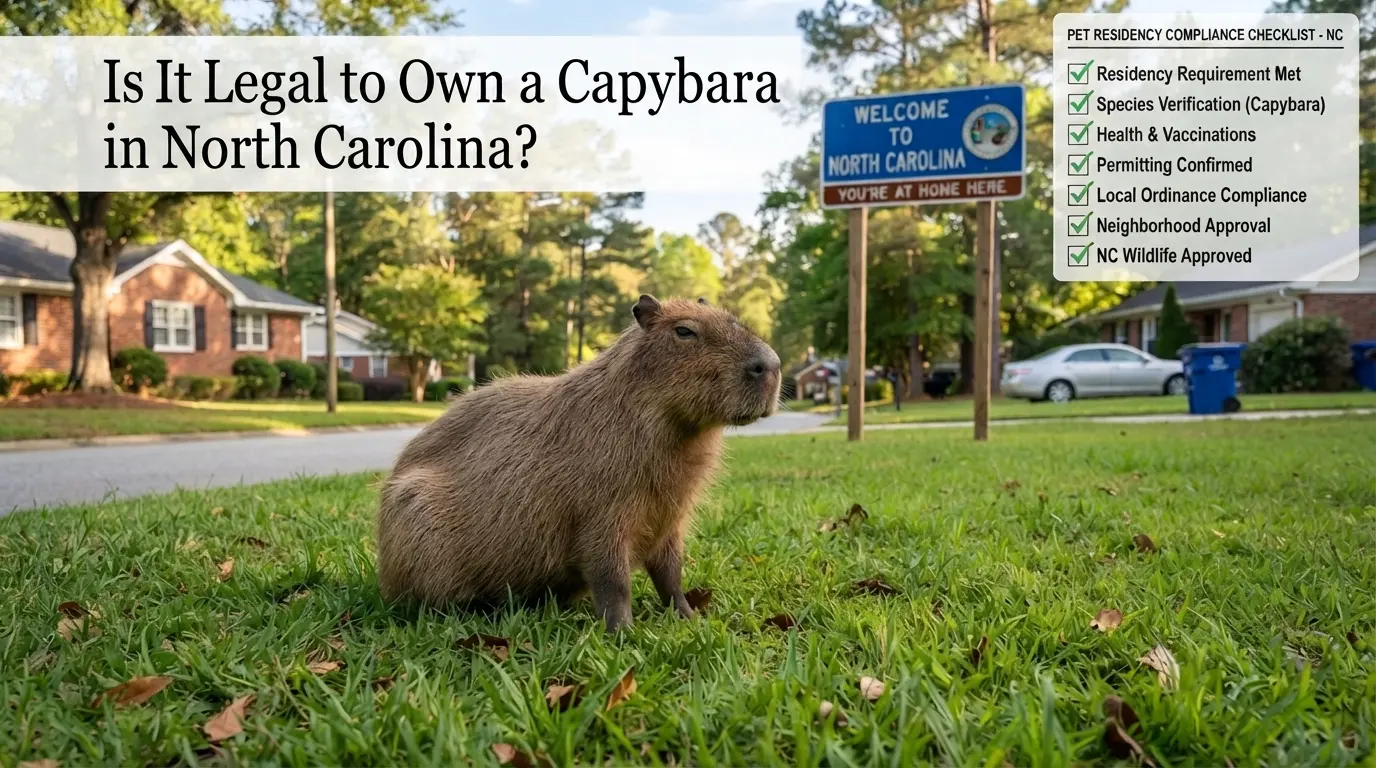
You’ve seen the videos. A capybara floating in a pool with an orange balanced on its head. A duck riding around on its back like that’s just how the world works. Somewhere around the third clip, the thought shows up: could I actually have one of these?
So you search “are capybaras legal in North Carolina,” and the internet immediately falls apart. One site says you need a state permit. Another says they’re banned outright. A forum post from four years ago says something completely different from the blog post you read yesterday. None of it agrees, and none of it tells you what to do with the address you actually live at.
Here’s what nobody leads with: North Carolina won’t stop you from owning a capybara. Your county might. Your city might. Your HOA definitely can. That gap between “state law says nothing” and “your specific street has an opinion” is where almost every aspiring owner gets tripped up, and it’s exactly what this guide is built to close.
We dug into the actual North Carolina statutes, the NC Wildlife Resources Commission’s own rules, and the reporting that first exposed how unusual this state’s approach really is. By the end, you’ll know the real legal status, the myth that keeps tripping people up, how to check your own address, and what two 100-pound semi-aquatic rodents actually cost to keep.
Let’s start with the part that surprises everyone.
North Carolina State Law: The Surprising Truth
Yes, capybaras are legal to own in North Carolina at the state level, and no, you don’t need a state permit to do it. That’s the short answer. The longer answer explains why, and why that’s both good news and a trap.
The Lack of Statewide Exotic Animal Laws
North Carolina is one of only four states in the country with no comprehensive law governing private ownership of exotic animals, which makes a capybara legal states guide especially useful for seeing how the state compares.. Reporting from WUNC first put a number on this back in 2019, and the gap hasn’t closed since. Instead of one statewide statute that says yes or no to a species, North Carolina leaves that decision almost entirely to individual counties and cities.
Unlike New York capybara ownership, which is subject to different regulations, North Carolina doesn’t have an equivalent box to check Compare that to California or Colorado, where private capybara ownership is banned outright, or Florida, where a Class III wildlife permit is mandatory before you can legally possess one.. North Carolina doesn’t have an equivalent box to check.
Expert Tip: Because there’s no state law, capybaras exist in a legal gray area where they’re treated something like a domestic pet, unless your local government says otherwise. That’s freedom on one hand and a trap on the other. Keep reading before you get excited.
What the NC Wildlife Resources Commission Says
Most people assume the state’s wildlife agency, the North Carolina Wildlife Resources Commission (NCWRC), must have some say here. It does, just not over capybaras.
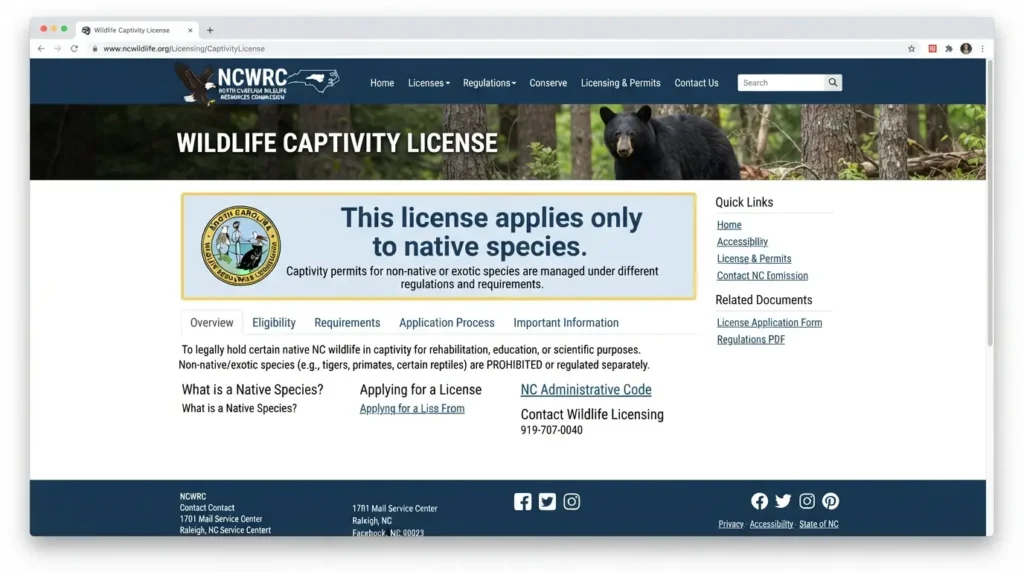
NCWRC’s authority covers native North Carolina wildlife: white-tailed deer, black bears, raccoons, foxes, and the rest of the animals that naturally occur in the state. Capybaras are from South America. They’ve never been native to anywhere in North America, which puts them entirely outside NCWRC’s jurisdiction the same way a parrot or a pet ferret would be.
You can verify this yourself directly on ncwildlife.gov, specifically on the agency’s wildlife captivity license pages. Nowhere on that site will you find capybaras listed, because the agency has no regulatory reason to list them.
Why Capybaras Are Not Classified as Native Wildlife
The legal definition matters more than it sounds like it should. North Carolina’s rules define “wild animal” and “wildlife” around species that occur naturally in the state. A white-tailed deer qualifies. A capybara, born and bred in captivity in a country it has never occurred in naturally, does not.
|
Native Wildlife (e.g., raccoon, fox, deer) |
Exotic Animal (e.g., capybara) |
|
|
Regulated by |
NC Wildlife Resources Commission |
Not regulated by NCWRC |
|
Possession without a license |
Illegal |
Legal, no state license required |
|
Governing rule |
15A NCAC 10H .1401 |
No equivalent state rule |
|
Who actually decides |
The state |
Your county and city |
That table is the whole reason this article exists. Once you understand that capybaras fall on the right side of it, most of the confusing advice you’ve read online starts to make sense, because most of it is talking about the wrong column.
Myth-Busting: Do You Need a Captivity License?
Nothing gets repeated more often, or more wrongly, about capybaras in North Carolina than this claim, and it deserves its own section.
What Is a Wildlife Captivity License?
The NC Wildlife Captivity License is a real permit, issued by the NCWRC. It exists for people who possess native wild animals or wild birds for rehabilitation, education, or exhibition. State rule 15A NCAC 10H .1401(b) spells it out directly: possession of native wild animals or wild birds is unlawful unless the individual holds a captivity license from the Commission.
Read that again. It says native. A capybara was never a candidate for this license to begin with, and the license itself is built around rehabilitators, zoos, and educational facilities holding animals like injured hawks or orphaned foxes. It is not a pet permit, and it never was.
Why It Doesn’t Apply to Pet Capybaras
Two separate facts stack together here. First, capybaras aren’t native, so NCWRC has no authority to issue a captivity license for one in the first place. Second, even where this license does apply, it explicitly forbids keeping the animal as a companion pet. A captivity license holder cannot use their native wild bird or mammal for cuddling on the couch, and the rule is clear about it.
So a capybara is doubly outside this system. Not native, and not a pet-eligible use case even if it were.
Expert Tip: If a breeder or online seller tells you that you need a captivity license for your capybara, they’re either confused or trying to sound more official than they are. Walk away from that conversation and go check ncwildlife.gov yourself.
Common Misconceptions and How to Avoid Them
“All exotic animals require a permit in NC.”
False. Only native wildlife, plus a short list of specifically regulated species like large carnivores, need anything from the state.
“The Captivity License is a loophole to legally own a capybara.”
False, and a dangerous one. Trying to use this license for a pet capybara would violate the terms of the license itself, not create a workaround.
“If it’s legal at the state level, I’m cleared to bring one home.”
False, and this is the one that actually causes problems. State silence does not mean local silence. That takes us straight into the section that matters most.
Local Ordinances: The Real Legal Hurdle
Why Local Laws Matter More Than State Law
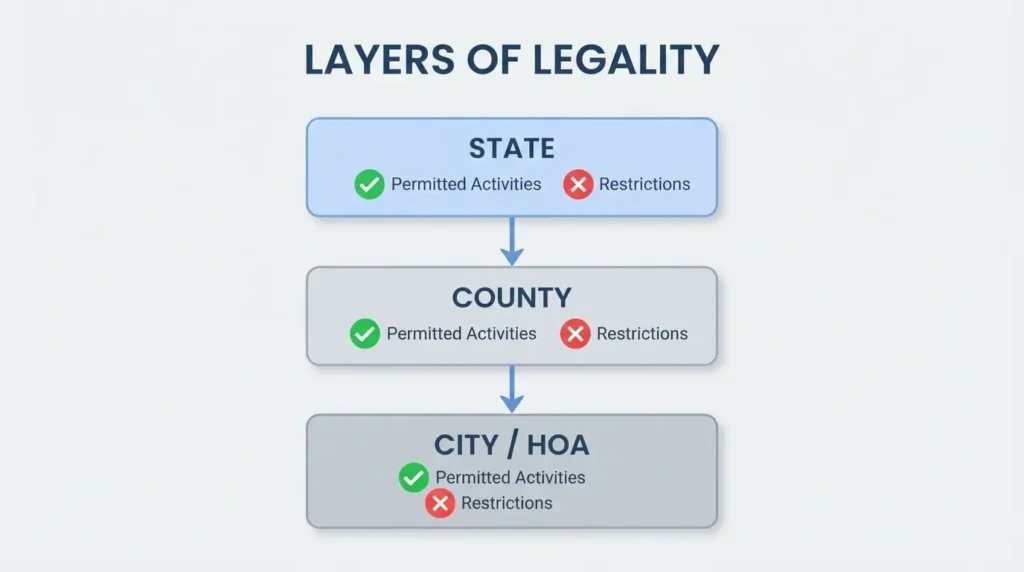
North Carolina counties and cities have the authority to write ordinances stricter than anything the state requires, and plenty of them have. Some ban “exotic animals” using broad, undefined language. A smaller number name capybaras specifically. Nearly every aspiring owner hits a wall right here, and it’s the layer almost no other guide walks you through step by step.
Even a county that allows capybaras can sit inside a city that bans them. Even a city that allows them can be overridden by an HOA covenant that has nothing to do with public law at all. Three layers, and you need a clean answer from all three before you spend a dollar.
Expert Tip: Wake County and Mecklenburg County both maintain active animal services departments that can and do enforce exotic pet rules beyond the state’s baseline. Rural counties tend to have thinner rulebooks, but “thinner” is not the same as “silent.” Verify, don’t assume.
How to Research County and City Ordinances
Work through this in order, and don’t skip a step because the first one came back clean.
- Find your county’s official website. Look for a “Code of Ordinances” or “Animal Control” section, usually published through Municode or a similar public code database.
- Search for keywords, not just “capybara.” Try “exotic animal,” “wild animal,” “rodent,” and “livestock.” Most ordinances use broad category language rather than naming specific species, and a rule banning “non-domesticated mammals” catches a capybara just as easily as one that names it outright.
- Check for a prohibited animals list. Some counties maintain one explicitly. If a capybara isn’t on it, that’s a good sign, but it isn’t proof. Silence in an ordinance is not the same as a written yes.
- Repeat the entire process for your city or town. Municipal codes are separate documents from county codes, and one can be stricter than the other in either direction.
- Pull your HOA covenants if you live in a planned community. A homeowners’ association is a private contract, not a government body, and it can restrict animals that every level of public law allows.
Sample Script for Calling Animal Control
Ordinance language is often vague enough that you genuinely can’t tell from the text alone. A phone call closes that gap faster than any amount of reading.
Call your county or city animal control office and say something close to this: “I’m looking into keeping a pair of capybaras, large South American rodents, about 100 pounds each, kept outdoors with a pond. Does our local ordinance allow that, or is there a specific permit I’d need?”
Be specific about the size and the outdoor housing. Vague descriptions get vague answers.
Expert Tip: Write down the name of the person you spoke with, the date, and exactly what they said. If they confirm it’s allowed, ask them to email you a short confirmation or point you to the exact ordinance section. That message is worth more than any phone call you can’t prove happened later.
Major NC County Ordinance Snapshot
The table below is a starting point, not a final answer. Ordinances change, and enforcement varies even within a county. Treat every row as a reason to call, not a reason to skip the call.
|
County |
General Stance |
Notes |
|
Wake (Raleigh) |
Verify locally |
Active animal services department; broad “wild animal” language may apply. |
|
Mecklenburg (Charlotte) |
Historically more permissive |
Has issued exotic pet permits for unusual species in some cases; confirm current rules directly. |
|
Guilford (Greensboro) |
Varies by municipality |
County and city codes may differ; check both. |
|
Durham |
Verify locally |
County and city rules are separate; both must be checked. |
|
Buncombe (Asheville) |
Reported as restrictive for some exotics |
Some sources note limits on ownership; confirm with the county directly. |
|
Rural counties (general) |
Often minimal additional rules |
Thinner codes are common, but not a guarantee of “anything goes.” |
Note on this table: these summaries reflect publicly available information at the time of writing and change without notice. Confirm every entry with your own county or city clerk before making any decisions. If you’re picturing this as a color-coded interactive map, green for likely allowed, yellow for unclear, red for banned, that’s exactly the tool this table stands in for until you verify your own address by phone.
Capybara Care Requirements at a Glance
Legal clearance is half the job. The other half is whether your property can actually support the animal humanely, and North Carolina’s climate and ordinance patterns don’t excuse you from any of it.
Space and Enclosure Needs
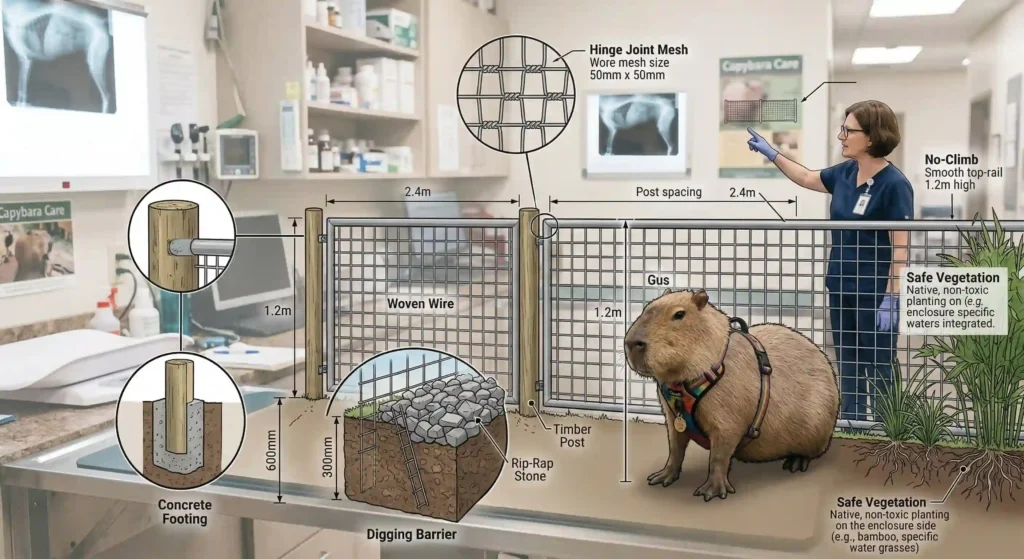
A pair of capybaras needs a minimum of roughly 200 square feet of secured outdoor land area, plus a separate water feature. Fencing should run at least 4 feet high and extend 1 to 2 feet below ground, because capybaras are strong diggers and will find the weak point in a lazy fence line.
Product Recommendation: Heavy-gauge welded wire fencing and livestock panels, available through most farm supply stores, hold up far better than standard yard fencing.
Care guidelines published by the Association of Exotic Mammal Veterinarians back up these space minimums, and they’re worth reading directly before you build anything.
Water and Swimming Requirements
A pool or pond is not optional decor, and while capybaras can hold their breath underwater, they still need a safe water feature. Capybaras spend a large part of their day in water to regulate body temperature, socialize, and yes, relieve themselves. The water feature needs at least 3 feet of depth with a gradual, non-slip entry point.
Skip chlorinated water. Fresh water with real filtration is the standard, and a low-salinity setup can work if freshwater filtration isn’t practical. Test water quality weekly.
Product Recommendation: A 300-gallon livestock water trough or a preformed pond both work well as a starting point. Pair either one with a basic water quality test kit and check it on a schedule, not when the water already looks wrong.
Diet and Nutrition
Capybaras are grazers, and their diet should be built around unlimited access to grass hay: Timothy, orchard, or Bermuda. Fresh vegetables and a specialized rodent pellet, something like Mazuri Rodent Block, round out the rest.
Skip high-sugar fruit, grains, and anything resembling a human snack. Capybaras run into obesity and dental disease fast when their diet drifts from hay-heavy to treat-heavy.
Social Needs: Why You Need at Least Two
Capybaras live in groups in the wild, and a single animal kept alone is a welfare problem waiting to happen. Isolation shows up as stress, depression, and downstream health issues that a solitary owner’s attention cannot fix, no matter how much time you spend with the animal.
Plan for at least two, ideally a bonded pair or same-sex pair acquired together as siblings. Introducing two adult strangers later is considerably harder.
Expert Tip: No reputable exotic animal veterinarian or care organization recommends solitary capybara housing. If a breeder offers to sell you just one, that’s worth a second look at the breeder, not just the animal.
Finding an Exotic Veterinarian in NC
Most small-animal clinics simply don’t see capybaras, and finding one that does needs to happen before the animal arrives, not during a Saturday-night emergency.
Use the Association of Exotic Mammal Veterinarians’ Find a Vet directory to locate NC-based members, then call ahead. Ask directly whether they’ve treated a capybara before, and ask about their after-hours emergency protocol. A vet who says yes to both is worth building a relationship with early.
Cost Breakdown: What It Really Takes to Own a Capybara in NC
The viral clips never show the receipts.
Here’s what a pair of capybaras realistically costs in North Carolina, breaking down the full range of capybara ownership costs.
|
Expense Category |
Initial Cost (One-Time) |
Ongoing Cost (Monthly/Annual) |
Notes |
|
Enclosure & Fencing |
$2,000 – $4,000 |
$50 – $100/year (repairs) |
Heavy-gauge wire, posts, gate, labor. Burying fencing adds cost. |
|
Pool or Pond |
$500 – $2,000 |
$30 – $60/month (water, electricity, chemicals) |
Livestock trough ($500) versus custom pond ($2,000+). Filtration extra. |
|
Shelter/Housing |
$300 – $800 |
$0 – $50/year (bedding) |
Insulated shed or dog house works for milder NC winters; bedding replaced regularly. |
|
Purchase Price (2 capybaras) |
$2,000 – $4,000 |
N/A |
Varies by breeder; includes transport. Always buy from a reputable, verifiable source. |
|
Initial Vet Check & Supplies |
$300 – $500 |
N/A |
Wellness exam, fecal test, initial supplements. |
|
Food & Supplements |
N/A |
$150 – $250/month |
Grass hay, fresh vegetables, rodent pellets, vitamin C supplement. |
|
Routine Veterinary Care |
N/A |
$200 – $400/year |
Annual check-ups, dental exams. |
|
Emergency Vet Fund |
N/A |
$500 – $1,000/year (set aside) |
Exotic emergency care runs expensive; treat this as a dedicated savings line, not optional padding. |
|
Miscellaneous |
$100 – $200 |
$20 – $40/month |
Enrichment items, water test kits, replacement parts. |
|
Total Estimated Range |
$5,200 – $11,500 |
$400 – $800/month (including emergency savings) |
Actual costs depend on DIY versus professional installation and local pricing. |
Hidden Costs to Consider
Homeowner’s insurance.
Some policies exclude exotic animals entirely or raise premiums once you disclose one. Check with your insurer before you assume you’re covered for a bite or property damage claim.
Local permit fees.
North Carolina doesn’t charge a state fee, but some counties or cities add their own exotic animal permit fee, often somewhere between $50 and $200 annually. Ask animal control directly.
Property modifications.
Reinforced fencing, added shade structures, and upgraded electrical for a pool pump all tend to surface after the initial budget is already spent.
Time.
Daily feeding, pool cleaning, and social interaction aren’t a dollar cost, but they’re a real one. Factor the labor in honestly before you commit.
Expert Tip: Budget at least $5,000 to $10,000 for initial setup and $400 to $800 monthly once the emergency fund is included. Under-budgeting is consistently the top reason exotic pets get surrendered, and a capybara is not the animal to test that theory on.
Step-by-Step Legality Checklist
Work through this checklist for your specific North Carolina address before you contact a breeder or spend a dollar.
- Confirm state legality. Verify that North Carolina has no statewide ban on capybaras, using this guide and the NCWRC site directly.
- Check county ordinances. Search your county’s code of ordinances for “exotic animal,” “wild animal,” “rodent,” or “capybara.” Note anything that applies.
- Check city or town ordinances. Repeat the search for your municipal government. A city can ban what the county allows, or the reverse.
- Verify HOA rules. If you live under a homeowners’ association, read the covenants directly or contact the board. Many HOAs prohibit “exotic pets” or “livestock” in blanket language.
- Call local animal control. Use the sample script above. Ask specifically about capybaras and any local permit requirements, and document the call.
- Get it in writing. If animal control confirms it’s allowed, ask for an email or letter. That’s your protection if a neighbor complains later.
- Check zoning for livestock classification. Some jurisdictions treat capybaras as livestock for zoning purposes. Confirm your property is zoned appropriately if that applies.
- Consult an exotic animal attorney, optionally. For real peace of mind, especially before investing thousands in an enclosure, a short consult can be worth it.
Expert Insights: What NC Exotic Animal Professionals Say
The Legal Reality Behind the Regulatory Gap
Confirm state legality by verifying that North Carolina has no statewide ban on capybaras, using this guide and the NCWRC site directly, a contrast from Michigan’s capybara regulations, which are more explicitly defined at the state level.
It’s a well-documented regulatory gap that veterinary and legal professionals in the state have been discussing publicly for years. Tara Harrison, an exotic animal veterinarian affiliated with NC State’s veterinary program, has been quoted in North Carolina news coverage noting that the state’s approach effectively opens the door to owning almost anything, provided a local ordinance doesn’t close it first. That framing applies directly to capybaras: the state doesn’t stop you, but it also doesn’t protect you from a local rule you haven’t checked.
Legal commentary on North Carolina’s exotic animal landscape consistently makes the same point from a different angle: the absence of a state permit requirement is not a green light on its own. Local governments hold the real authority here, and attorneys who work in this space generally advise treating every layer, county, city, and HOA, as a separate legal question that needs its own answer.
Veterinary Perspective: Welfare and Practical Care
Exotic mammal veterinarians who treat capybaras consistently raise the same handful of concerns: vitamin C deficiency from an incomplete diet, dental overgrowth from insufficient hay, and the stress of solitary housing. None of these show up as immediate red flags at purchase. They surface months in, once poor habits are already established.
Finding a vet before bringing the animal home isn’t just a nice-to-have. It’s the difference between a manageable Saturday-morning problem and a panicked, hourslong search for anyone willing to see an exotic emergency.
Expert Tip: Ask any vet you’re vetting about common capybara health issues specific to a humid Southeastern climate, particularly heat stress in the summer and parasite exposure from standing water.
Real Owner Experiences (From NC Communities)
Online communities like Reddit’s r/capybara and various North Carolina exotic pet groups surface the same patterns repeatedly. One recurring theme: pool maintenance is the daily grind that catches new owners off guard, with algae blooms becoming a constant fight in North Carolina’s warm, humid summers until owners invest in real filtration.
Another pattern shows up around local law specifically. More than one owner has described a county initially confirming capybaras were fine, only for a neighbor’s complaint to trigger a re-evaluation later. In each case, having a written confirmation from the initial call made the difference between a quick resolution and a real fight.
These stories aren’t a substitute for official verification, but they’re a useful reminder of where things actually go wrong in practice.
FAQ: Your Top Capybara Legality Questions Answered
Can I bring a capybara from another state into North Carolina?
Yes, as long as you comply with NC’s importation rules (which are minimal for exotic pets) and the animal is legal in your local jurisdiction. Always check the origin state’s export requirements, too.
What if my neighbor complains about my capybara?
If you’ve followed the legality checklist and have documentation, you’re in a strong position. However, nuisance laws (noise, odor) can still apply. Maintain a clean enclosure and good relationships with neighbors. Animal control will investigate complaints, so your written proof is crucial.
Are there any pending law changes in NC that could ban capybaras?
As of 2026, there are no active statewide bills targeting capybaras. However, exotic animal laws can be proposed quickly after an incident. Stay informed through the NC General Assembly website or exotic pet advocacy groups.
Do I need a permit if I only have one capybara?
No state permit is required regardless of the number. But remember, capybaras are social and should not be kept alone for welfare reasons. Local permit requirements, if any, would apply regardless of how many you have.
Can I let my capybara roam free in my yard?
No. Capybaras must be contained in a secure enclosure. Free-roaming risks escape, injury, and conflicts with wildlife or dogs. It could also lead to legal trouble if the animal leaves your property.
Is it legal to breed capybaras in NC?
There is no state law prohibiting breeding, but local ordinances may classify breeding as a commercial activity requiring a kennel or exotic animal permit. Check with your county planning department.
Expert Tip: Communities like Reddit’s r/capybara are genuinely useful for day-to-day questions and shared experience, but treat them as a supplement to official verification, never a replacement for it.
Conclusion and Next Steps
North Carolina is one of the few states where capybara ownership is legally possible without a state permit standing in your way. The real test isn’t Raleigh. It’s your specific county, your specific city, and whatever your HOA covenant happens to say. Verify all three, document what you find, and prepare before you commit.
Your roadmap from here:
- Work through the legality checklist above and confirm your specific address is clear.
- Budget realistically using the cost table, and build in the emergency vet fund from day one.
- Design an enclosure that meets the space, water, and social needs of at least two capybaras.
- Find an exotic vet and build that relationship before the animals arrive, not after.
Final Reminder: Do Your Due Diligence
Local ordinances change without much warning. Bookmark the NC Wildlife Resources Commission’s site and your county and city government pages, and re-check annually rather than assuming today’s yes stays a yes forever. Responsible ownership means staying informed and being a decent ambassador for exotic pet keeping generally, since one bad incident tends to tighten the rules for everyone else too.
If you ever do face a legal question or a neighbor complaint, stay calm and lead with your documentation. Trying to hide the animal or misrepresent the situation to officials only makes things worse, and it’s the fastest way to turn a fixable problem into a permanent one.
Disclaimer
This guide is informational and does not constitute legal advice. North Carolina’s exotic animal laws are spread across state rules, county ordinances, and municipal codes that change without notice. Verify current requirements with your county or city clerk and, where the stakes are high, an attorney familiar with North Carolina animal law before making any purchase or ownership decision.
Sources referenced: North Carolina Wildlife Resources Commission (ncwildlife.gov); 15A NCAC 10H .1401, Wildlife Captivity and Rehabilitation; WUNC, “Only Four States Have No Rules For Owning An Exotic Animal. North Carolina Is One.” (2019); subsequent North Carolina news coverage on the state’s exotic animal regulatory gap; Association of Exotic Mammal Veterinarians care guidelines.