
Before you fall for those viral videos of capybaras lounging in hot tubs, understand this: in New York, the line between a companion capybara and a court summons is drawn in the state’s Environmental Conservation Law, and it moves depending on which zip code you’re standing in.
Here’s the problem. Search “capybara legal in New York” and you’ll get three different answers from three different sources, and none of them agree. One site says the state prohibits it outright. Another says you just need a permit. A third says New York City has its own rule entirely, separate from the state.
Here’s the agitation. Acting on the wrong answer costs real money and, worse, can cost the animal its life. New York’s exotic animal law operates in layers, state, city, and locality, and each layer can reach a different conclusion about the same capybara sitting in the same backyard.
Here’s the solution: untangle all three layers using the actual statutes, the actual health code, and the actual permit process, not secondhand summaries. That’s the whole job of this guide.By the end, you’ll know exactly where you stand, whether that’s Manhattan, Buffalo, or a locality somewhere in between, and you’ll have a list of legal, ethical ways to enjoy capybaras regardless of the answer; for a broader perspective, see our state-by-state guide to capybara legality.
A note on accuracy: every legal claim below is sourced directly from New York State’s Environmental Conservation Law, the NYC Health Code, and NYSDEC’s own published materials, linked throughout, and none of it constitutes legal advice. Last reviewed July 2026; a changelog note appears at the end tracking any legislative updates.
New York State Law: What ECL § 11-0512 Actually Says
New York State’s wild animal prohibition does not currently name capybaras, which puts them in a genuine legal gray zone rather than a clear ban.
Environmental Conservation Law § 11-0512 prohibits knowingly possessing, harboring, selling, bartering, transferring, exchanging, or importing any “wild animal” for use as a pet in New York State. That sounds sweeping, and it is, for the animals the law actually covers.
The catch is in the definition. ECL § 11-0103(6)(e) defines “wild animal” as a closed, specifically named list, not a general category. As written, it covers:
- Nonhuman primates and prosimians
- Felidae (cats), with a narrow exception for domestic cats
- Canidae (dogs), with exceptions for domestic dogs and captive-bred fennec foxes
- Ursidae (bears)
- Venomous reptiles and certain other specifically named reptile species
Rodents, as a category, are not on that list. Capybaras aren’t named anywhere in it either. Under the statute as it stands today, a capybara does not meet New York State’s legal definition of a “wild animal” for purposes of this particular ban.
That’s not a loophole someone found. It’s a genuine gap in the statute’s language, and it’s the real reason so many websites contradict each other on this question.
Expert Tip: A gap in the law today is not a promise for tomorrow. Read the next section before you assume this settles anything.
The Pending Change That Could Close This Gap
New York State Assembly Bill A1804 and companion Senate Bill S00252, both introduced in the 2025-2026 legislative session, would amend ECL § 11-0103(6)(e) to add “Capybaras” as a named item on the wild animal list. If either bill passes, the current gray zone closes, and capybaras become explicitly prohibited under state law the same way primates and bears already are.
As of this writing, neither bill has passed. That means the current legal reality stands: capybaras fall outside the state’s wild animal definition. But given the bill’s existence, treating this as a stable, permanent gap would be a mistake. Legislation like this tends to resurface, particularly following a high-profile incident involving an exotic animal anywhere in the state.
New York City’s Explicit Capybara Prohibition (Health Code § 161.01)
The one-line answer: if you live in New York City, this entire state-level nuance is irrelevant. NYC prohibits capybaras by name.
Where the state’s definition is a gap, New York City’s Health Code closes it directly. Section 161.01(b)(14) defines prohibited “large rodents” and lists them explicitly: “gopher, muskrat, nutria, paca, woodchuck, marmot, beaver, prairie dog, capybara, sewellel, viscacha, porcupine and hutia.”
Capybara. Named. In the actual code text. There’s no ambiguity here at all, and it’s the cleanest citation in this entire guide.
The Narrow Exceptions
Section 161.01(a)(1) does carve out specific exemptions, but they’re built for institutions, not private residences:
- A zoological park or aquarium operated by the Department of Parks and Recreation, the Wildlife Conservation Society, or the Staten Island Zoological Society
- A laboratory operated under Public Health Law § 504
- A veterinary hospital or medical facility providing care for the animal
- A temporary exhibit, performance, or display holding a Commissioner-issued permit
None of these apply to a private residence keeping a companion capybara. A private household in any of the five boroughs simply does not have a legal pathway here.
Penalties for Violation in NYC
The city’s own penalty schedule sets a specific fine for this exact violation. Unlawfully keeping, selling, or giving a wild animal under NYC Health Code § 161.01 carries a $500 fine for a first violation and $1,000 for a subsequent or defaulted one, according to the city’s published Health Code penalty schedule. That’s before accounting for the animal’s likely confiscation, which happens separately from the fine itself.
Myth vs. Fact: Common Misconceptions About Capybara Legality in NY
Myth | Fact (With Citation) |
“Capybaras are illegal everywhere in New York.” | Not accurate at the state level. ECL § 11-0103(6)(e)’s “wild animal” definition doesn’t currently name capybaras or rodents generally. NYC’s Health Code § 161.01(b)(14) does name them explicitly, so the answer depends entirely on locality. |
“You can get a state permit for a companion capybara.” | No such permit exists for this purpose. NYSDEC’s Dangerous Animal License only applies to species already on the ECL § 11-0103(6)(e) wild animal list, which doesn’t currently include capybaras, so there’s nothing to apply for either way. |
“If the state allows it, my city or locality has to allow it too.” | False, and this is the trap. Localities can enact restrictions stricter than the state, and New York City demonstrates exactly that with its explicit name-based prohibition. |
“A breeder told me it’s totally legal here, so it must be fine.” | Breeder claims aren’t a legal source. Verify directly with NYSDEC or your municipality’s animal control office before relying on any seller’s representation. |
“Zoos and legal ownership work under the same rules.” | Institutions like the Bronx Zoo and Staten Island Zoo operate under specific exemptions built into the NYC Health Code for zoological parks. Those exemptions do not extend to private residences under any circumstance. |
The Permit Puzzle: Is There Any Legal Path to Ownership?
The one-line answer: for a private companion capybara, no realistic permit pathway currently exists in New York, in the state or the city.
NYSDEC’s Dangerous Animal License, issued through the department’s Special Licenses Unit, requires demonstrating that possessing facilities prevent escape and that the animal won’t threaten public safety or native wildlife. It’s a genuine license process with a real application. The problem is scope: this license only applies to species already classified as “wild animals” under ECL § 11-0103(6)(e). Since capybaras aren’t on that list, there’s no mechanism to apply the license to one, not because the bar is too high, but because the license doesn’t reach this species at all.
Educational and scientific exemptions exist under ECL § 11-0512(2), covering AZA-accredited zoological facilities and USDA-licensed exhibitors. These exemptions are built for institutions with facility inspections, insurance requirements, and ongoing regulatory oversight, not private individuals working from a backyard enclosure.
Expert Tip: If you’re a teacher or researcher genuinely exploring an educational exemption, expect a facility inspection process comparable to what an accredited zoo undergoes. It’s not a shortcut, and it’s not designed for companion ownership under any framing.
Local Ordinances: Why Your Municipality May Prohibit Capybaras Even If the State Doesn’t
The one-line answer: New York State’s gap and NYC’s explicit ban aren’t the only layers. Your specific municipality can add its own rule on top of both.
Rochester, for example, prohibits private possession of “wild animals” as pets under its own municipal code, with a list broad enough to include large, non-domesticated mammals generally, and notably, no grandfather clause protecting existing owners. Other localities across the state maintain similar codes, varying in how broadly they define “wild” or “exotic.”
Most guides skip this layer entirely, and it’s exactly why the brief for this guide called it out. A capybara that clears the state’s gap and sits outside NYC entirely can still run into a locality’s own prohibition. There is no substitute for calling your specific municipal or county clerk’s office directly and asking.
A Simple Way to Think Through Your Own Situation
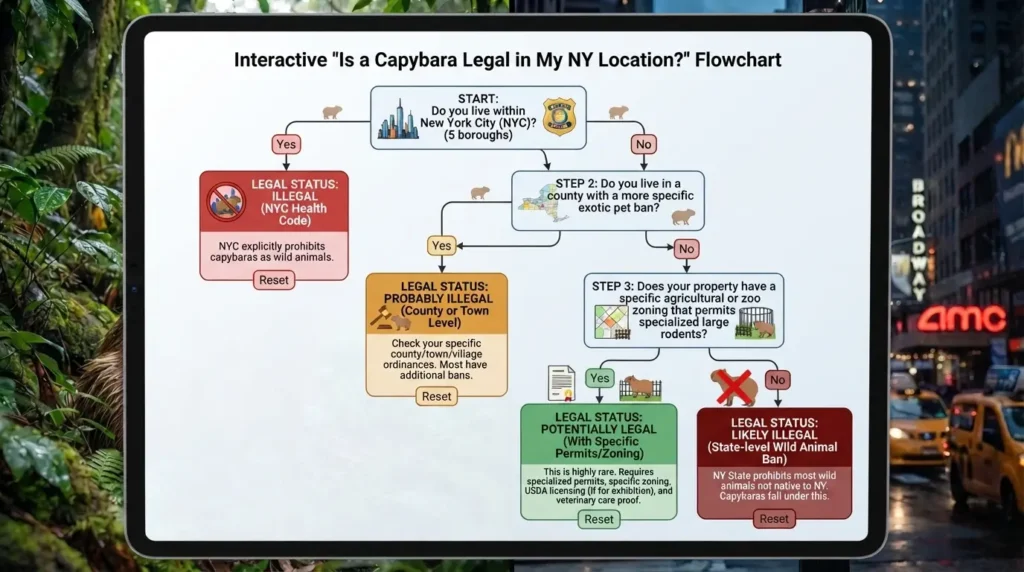
Picture this as a short decision path rather than a single yes-or-no question:
- Do you live within New York City’s five boroughs? If yes, capybaras are prohibited outright under Health Code § 161.01(b)(14). Stop here.
- If no, does your locality have its own exotic or wild animal ordinance? Contact your municipal or county clerk directly. If a prohibition exists locally, it controls regardless of the state gap.
- If your locality is silent on the issue, you’re currently in the state-level gray zone described above, legal today under the letter of ECL § 11-0103(6)(e), but subject to change if A1804 or S00252 passes.
Treat that gray zone as provisional, not permanent. A written confirmation from your local clerk’s office is worth far more than any forum post claiming a definitive answer.
A County-Level Snapshot (Verify Before Relying On This)
Region | General Status | Notes |
New York City (all five boroughs) | Prohibited, explicit | NYC Health Code § 161.01(b)(14) names capybaras directly. |
Rochester (Monroe County) | Locally restricted | Municipal code prohibits private wild animal possession broadly; no grandfather clause. |
Most upstate localities | Verify directly | State-level gap currently applies unless local ordinance says otherwise; confirm with your specific clerk’s office. |
Buffalo area | Verify directly | No confirmed blanket local prohibition found at time of writing; call before proceeding. |
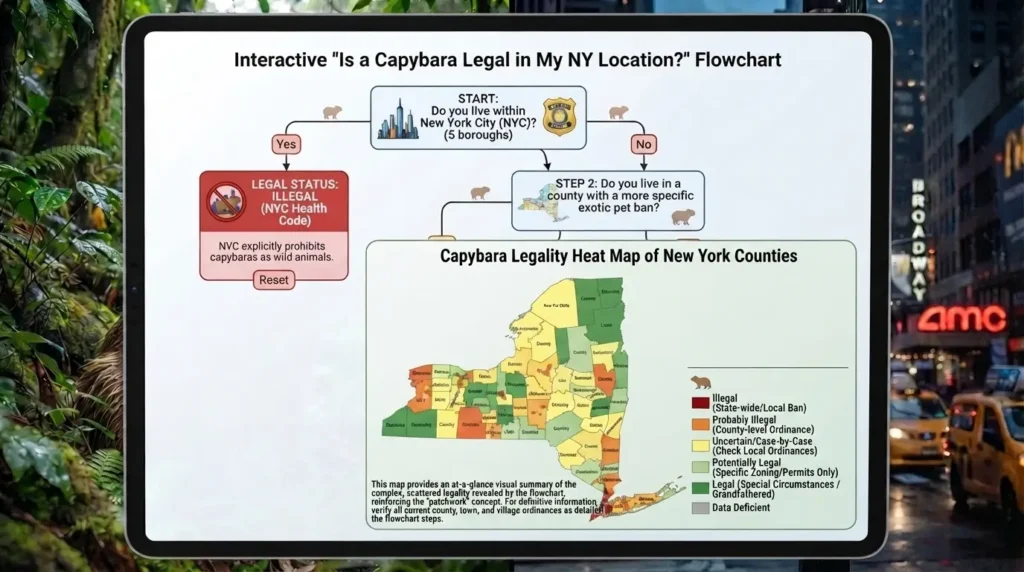
This table is a starting point only, not a verified legal map of all New York localities. If you’re picturing a color-coded heat map of every county, that’s the right instinct, but no reliable public dataset currently supports one at that resolution. Treat every row here as a reason to call your clerk’s office, not a final answer.
Penalties and Consequences of Illegal Ownership
Consequences stack depending on which layer you’ve run afoul of, and they’re not mutually exclusive.
Under NYC Health Code § 161.01: a $500 fine for a first violation, $1,000 for a subsequent or defaulted one, plus likely confiscation of the animal by the city.
Under New York’s separate wild animal liability statute: anyone possessing a wild animal or reptile capable of inflicting bodily harm who fails to exercise due care in protecting the public is guilty of a misdemeanor, punishable by up to one year of imprisonment, a fine of up to $500, or both. Notably, this statute imposes strict liability; the People don’t need to prove a prior attack or that the owner knew the animal was dangerous.
Beyond the fines: confiscated animals need somewhere to go. If no licensed sanctuary or zoological facility has space or capacity, euthanasia becomes a real, not hypothetical, outcome. That’s the cost nobody mentions in the viral clip.
What It Actually Takes to Care for a Capybara (If You’re in a Legal State)
Even setting New York’s law aside entirely, the practical care requirements are worth understanding before any of this feels appealing; the same demands apply in any state where capybaras are legal, so if you’re asking whether you can own a capybara in Michigan, expect the same care standards.
Capybaras require a large outdoor enclosure with a genuine swimming pool deep enough for full submersion, not a kiddie pool. They’re herd animals, and a single capybara kept alone experiences real, measurable stress and depression; the standard recommendation everywhere they’re legally kept is a minimum of two. Their diet is specialized, built around grass hay and a daily vitamin C supplement, since they can’t synthesize it themselves. Veterinary care requires a genuine exotic mammal specialist, and few clinics anywhere, including across New York, treat capybaras regularly. The Association of Exotic Mammal Veterinarians’ find-a-vet directory is the honest starting point for locating one.
None of that is compatible with a typical New York apartment, and most of it stretches even a generous suburban backyard. New York’s climate adds another layer entirely: capybaras evolved for warm, wet South American habitats, and a New York winter requires a genuinely heated shelter, not just an insulated doghouse.
Expert Tip: Consult an exotic animal veterinarian before acquiring any non-traditional companion animal, in any state. That single conversation tends to surface the lifelong costs and specialized demands faster than any amount of independent research.
Alternatives to Capybara Ownership in New York
Given everything above, the good news is that New York offers real, legal, and genuinely rewarding ways to enjoy capybaras without any of the legal exposure.
The Bronx Zoo (Wildlife Conservation Society), one of the largest metropolitan zoos in the country, maintains capybaras as part of its collection and operates under the NYC Health Code’s explicit zoological park exemption.
Staten Island Zoo, AZA-accredited since 1988, keeps resident capybaras at its Children’s Center exhibit, with general admission historically running around $10 for adults, $7 for seniors, and $6 for children ages 3 to 14. It’s one of the more accessible ways to see capybaras up close within city limits, legally and without any of the risk covered above.
Buffalo Zoo, further upstate, has also maintained capybaras as part of its collection, giving western New York residents a legal option without a trip to the city.
Confirm current hours, admission, and exhibit status directly with each facility before visiting, since zoo collections do change over time.
Expert Tip: Support and follow AZA-accredited facilities directly on social media rather than random viral accounts. Their content tends to be genuinely educational, and it gives an accurate picture of what real capybara care looks like day to day.
Conclusion and Quick-Reference Checklist
New York’s capybara question doesn’t have one answer. It has three, depending on which layer of government you’re standing under, and getting any single layer wrong is what turns a viral video into an enforcement action.
Run through this before you do anything else:
- Confirm whether you live within New York City’s five boroughs. If yes, capybaras are explicitly prohibited under Health Code § 161.01(b)(14), full stop.
- If you’re outside NYC, contact your specific municipality’s clerk or animal control office directly and ask about local exotic animal ordinances.
- Understand that the state-level gap under ECL § 11-0103(6)(e) is real today but provisional, given pending legislation (A1804 / S00252) that would add capybaras by name.
- Don’t rely on breeder claims, forum posts, or social media commentary as a legal source. Verify with NYSDEC or your locality directly.
If ownership isn’t realistic where you live, or even where it might technically be permitted, whether you’re in New York or wondering if capybaras are legal in Virginia, visit an AZA-accredited facility like the Bronx Zoo, Staten Island Zoo, or Buffalo Zoo instead.