
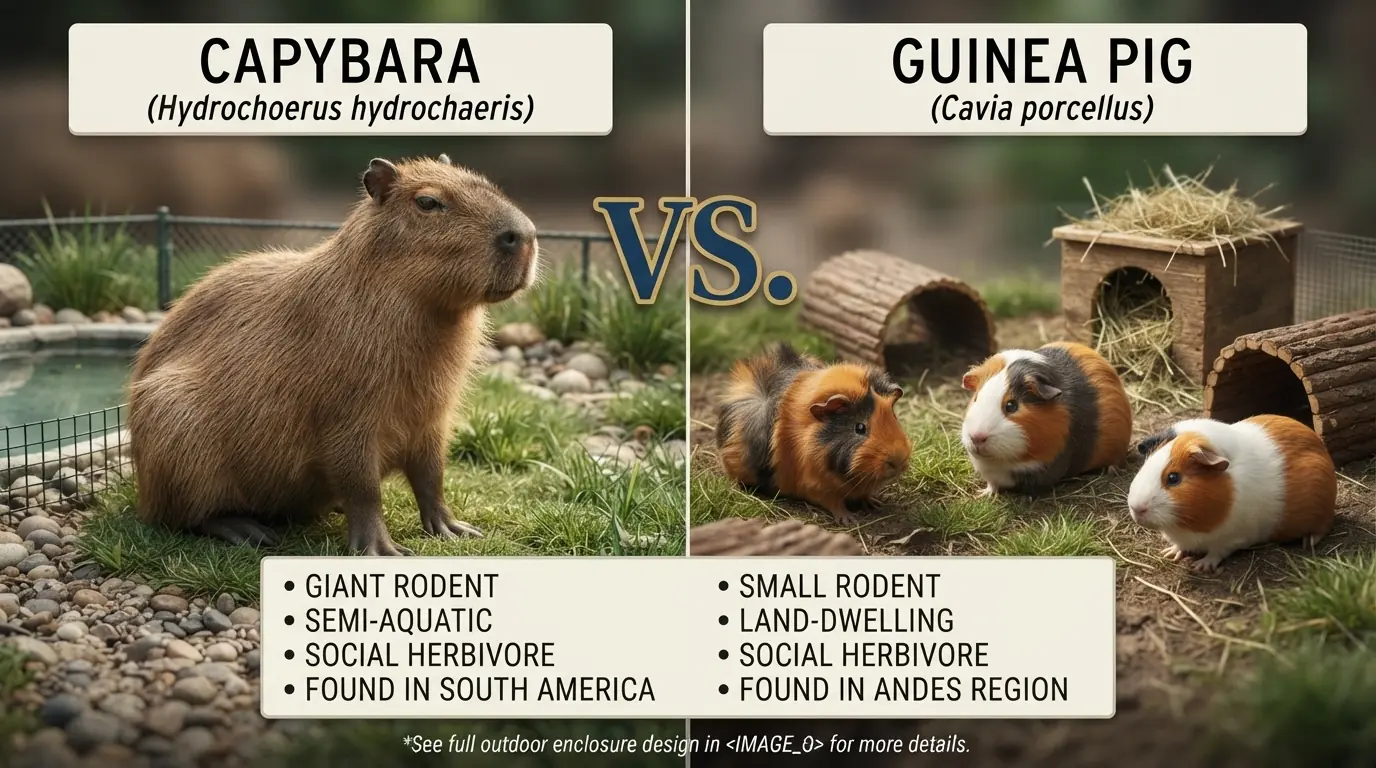
You’ve seen the video. A capybara lounging in a hot spring, orange slices balanced on its head, utterly unbothered by the world. Maybe you scrolled through a dozen more clips after that one. Herds of them wade through backyard pools. One getting a bath from a very patient owner. By the third video, you were already picturing one in your own backyard.
But before you start Googling “capybara for sale,” let’s talk about what it really takes to share your home with a 100-pound rodent that swims better than you do.
Here’s the twist nobody mentions in the comments section: capybaras and guinea pigs are cousins. Real ones, not internet-meme cousins. They sit in the same rodent family, and yes, that means your childhood guinea pig and the viral capybara are more closely related than a guinea pig is to a hamster. That family connection is exactly why so many people assume a capybara is just a guinea pig that skipped leg day for a decade. It isn’t. And the ways their care diverges will surprise you.
This guide isn’t a list of cute facts. It’s a reality check, built from veterinary insight, real owner routines, and an honest look at the hidden costs and legal hurdles nobody puts in a viral caption. You’ll walk away knowing exactly which animal, if either, actually fits your life, your budget, and your square footage. You’ll get a side-by-side comparison table, a myth-busting section, and a decision-making framework that cuts through the cute and gets to the practical.
Grab a coffee. This is the only guide you’ll need before you make this decision.
Evolutionary Relationship and Taxonomy
The Caviidae Family Tree
Capybaras (Hydrochoerus hydrochaeris) and guinea pigs (Cavia porcellus) both belong to the rodent family Caviidae, a group native almost entirely to South America; capybaras in particular are often mistaken for nutria, though the two are entirely separate species. That single fact explains more about these two animals than any physical comparison ever could.
Somewhere back in the fossil record, a shared ancestor gave rise to two very different survival strategies. One branch stayed small, stuck to dense vegetation, and became a foraging generalist built to hide from everything. The other branch scaled up, moved toward open floodplains, and turned water into its primary defense system. Over millions of years, that split produced a pocket-sized forager on one end and a nearly 150-pound semi-aquatic grazer on the other.
A few adaptations mark that divergence clearly:
- Body size: guinea pigs stayed compact; capybaras became the largest rodents on Earth, often compared to groundhogs in build, though far larger.
- Feet: guinea pigs kept simple, unwebbed toes; capybaras developed slightly webbed feet for swimming.
- Social scale: guinea pigs settled into small family groups; capybaras evolved into herds that can swell past 30 individuals in the wet season.
- Habitat strategy: guinea pigs rely on cover and burrows; capybaras rely on open water as an escape route from predators.
Same family. Completely different blueprints.
What “Related” Really Means for Pet Owners
Here’s where a lot of well-meaning pet owners get tripped up. Genetic closeness does not equal care similarity.
A wolf and a chihuahua share a family tree too. Nobody would suggest keeping them the same way. The same logic applies here, just with rodents instead of canines.
Guinea pigs have been domesticated for roughly 3,000 years, first in the Andes, bred over generations for temperament, coat, and companionship. Capybaras have not. Even a capybara raised from birth by a devoted owner is still, at its core, a wild animal with wild-animal instincts, wild-animal space requirements, and a wild animal’s tolerance for stress when those needs go unmet.
Expert tip: guinea pigs have been shaped by thousands of years of domestication. Capybaras are still wild animals at heart, even when hand-raised from a bottle.
That distinction is the foundation for everything else in this guide.
Physical Characteristics: Side-by-Side Comparison
At a Glance: Size, Weight, and Lifespan
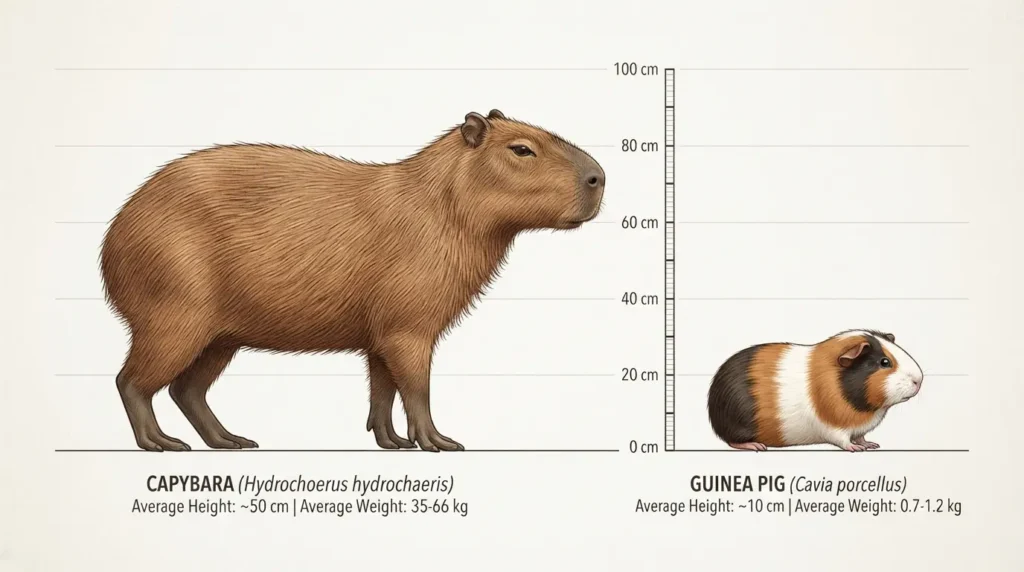
Before anything else, look at the numbers. The sheer size difference between these two animals dictates almost every other care decision you’ll make, from enclosure size to vet bills to how many bags of hay you’re hauling each month; for another angle on scale, a capybara vs wombat comparison reveals even more surprising contrasts.Table 1: Physical comparison of capybaras and guinea pigs.
Why Size Dictates Everything
A guinea pig weighs about as much as a can of soup. A capybara can weigh as much as a large dog, sometimes more. That’s not a small gap. It’s roughly a hundredfold difference in body mass, and it changes everything downstream of it.
You can pick up a guinea pig with one hand. You cannot pick up a capybara, and you shouldn’t try. A capybara that doesn’t want to be moved will simply plant itself, and there is very little a human can do about that.
Expert tip: a capybara’s size means you’re essentially building a small livestock enclosure, not a pet cage. That reframe matters. You’re not shopping for a habitat at a pet store. You’re planning infrastructure.
Natural Habitat and Wild Behavior
Capybara: Life on the Floodplain
Wild capybaras range from Panama down through northern Argentina, always tethered to water. That water isn’t a luxury for them. It’s how they cool off in tropical heat, how they escape jaguars and caimans, and even where much of their mating and social bonding happens.
They’re crepuscular, most active at dawn and dusk, though a herd that feels safe will graze openly at midday too. And they graze constantly. A wild capybara can put away close to 3 kilograms of grass a day, working through short grasses and aquatic plants in long, unhurried sessions.
Expert tip: in captivity, you must replicate access to water for swimming. A kiddie pool is not optional. It’s closer to a medical necessity than a toy.
Guinea Pig: From Andes Grasslands to Your Living Room
Guinea pigs trace back to the grasslands of the Andes, where they were domesticated thousands of years ago, first for food and later for companionship. Their wild relatives still live in small family groups today, foraging through dense vegetation and relying on cover rather than water to avoid predators.
That’s the fundamental behavioral split. Capybaras run toward water. Guinea pigs duck into the nearest thicket.
Unlike capybaras, guinea pigs have spent millennia under selective breeding for temperament, coat texture, and color. There’s no equivalent “domestic capybara” bred for easy handling. Every capybara you’ll ever meet, no matter how sweet, is only a generation or two removed from a wild floodplain herd.
Social Structures in the Wild
Wild capybara herds typically run 10 to 20 individuals, organized loosely around a dominant male, with subordinate males, females, and young grazing together with surprisingly little conflict. During the wet season, when food is abundant, those herds can swell past 30.
Guinea pigs form much smaller social units, typically pairs, trios, or small harems, tucked into dense cover rather than open water.
Both animals share one non-negotiable trait: neither species does well alone. But the scale of what “companionship” requires is worlds apart, and that difference carries directly into how you’ll need to house them.
Diet and Nutrition: What They Eat
The Hay Foundation
Both species share one dietary cornerstone: unlimited access to high-quality grass hay. Timothy and orchard grass are the gold standard for both, providing the fiber that keeps teeth worn down and digestion moving.
Expert tip: never use alfalfa as the primary hay for adult capybaras or guinea pigs. It’s too rich in calcium for a full-grown animal’s needs and can contribute to bladder stones over time. Save it for growing youngsters, not adults.
Fresh Foods and Special Needs
Here’s where the family resemblance gets genuinely useful. Both capybaras and guinea pigs belong to a lineage that cannot manufacture its own vitamin C. Neither species has the internal enzyme most mammals rely on to produce it, so both are entirely dependent on diet.
For guinea pigs, that means daily vitamin C is not optional. A guinea pig without enough of it can develop scurvy within a matter of weeks, a genuinely preventable tragedy that still shows up far too often in small-animal vet clinics. Safe, vitamin C-rich options include bell peppers, kale, and small amounts of citrus.
For capybaras, the requirement is dramatically larger in raw terms, simply because of body mass. An adult capybara needs a level of daily vitamin C that most owners underestimate until an exotic vet spells it out for them. Fresh vegetables help, but most capybaras still need a direct supplement to stay ahead of a deficiency.
Safe Foods Cheat Sheet
Guinea pig: bell peppers, kale, cilantro, small amounts of carrot, limited fruit as an occasional treat.
Capybara: fresh grasses, aquatic plants, leafy greens, small amounts of melon or sweet potato as treats.
Avoid both: avocado, onion, chocolate, and anything heavy in sugar or fat. These aren’t just unhealthy. Some are genuinely toxic to small herbivores.
Pellets and Supplements
For guinea pigs, choose a timothy-based pellet fortified with vitamin C, and check the mill date. Vitamin C degrades quickly, so a bag sitting on a shelf for months is no longer doing its job.
For capybaras, the picture is murkier. There’s no single industry-standard capybara pellet the way there is for guinea pigs, so most owners lean on a low-protein herbivore or rodent pellet, calibrated with guidance from an exotic vet rather than a pet store employee.
Product recommendation: Oxbow Essentials or Mazuri-line pellets work well for guinea pigs. For capybaras, treat pellet choice as a conversation with your vet, not a default purchase.
Expert tip: capybaras are grazers by nature. They need food available through most of the day, not just at two set mealtimes, or boredom and digestive stasis can follow.
Housing and Enclosure Requirements
Guinea Pig: Indoor Palace or C&C Cage
A pair of guinea pigs needs a minimum of about 10.5 square feet of floor space, and that’s a floor, not a starting point for negotiation. Most pet store cages fall well short of that, which is one of the quieter reasons guinea pigs end up stressed and under-stimulated in homes that mean well.
A C&C grid cage (roughly a 2×4 grid configuration) is the standard recommendation among rescues and long-time owners. Line it with paper-based bedding or fleece, and skip cedar or pine shavings, which can irritate a guinea pig’s respiratory system.
Product recommendation: C&C cage kits from Guinea Pig Cages Store or Kavee, paired with fleece liners from GuineaDad.
Expert tip: guinea pigs need a hidey house and a few tunnels. They’re prey animals by instinct, and feeling exposed around the clock takes a real toll on their stress levels.
Capybara: A Backyard Oasis (Not an Indoor Pet)
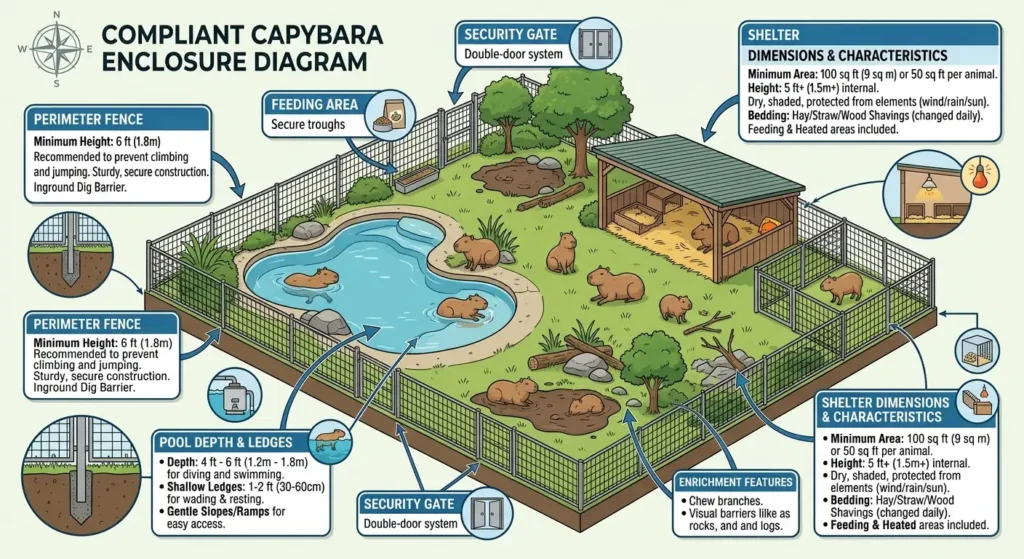
Now for the enclosure that changes the entire conversation. A capybara pair needs a securely fenced outdoor area of at least 12 by 20 feet, and that’s a floor for the minimum, not the ideal. Fencing needs to run at least 4 feet high, and it needs to be dig-proof. Capybaras are strong, curious, and perfectly capable of testing a weak perimeter until it gives.
Then there’s the pool. Not a decorative water feature. A genuine pool or pond, deep enough for full submersion, with a gradual entry point and a cleaning routine that happens far more often than most first-time owners expect. Capybaras defecate in water as part of their natural biology, which means that pool needs frequent, thorough cleaning to stay sanitary for the animal and manageable for you.
Expert tip:
capybaras are strong swimmers, and the pool has to be treated like a piece of daily-maintenance equipment, not a backyard accessory.
maintenance equipment, not a backyard accessory.
Climate and Temperature Control
Guinea pigs are sensitive on both ends of the thermometer. Keep their indoor environment between 65 and 75°F, and treat anything outside that range as a welfare issue, not a minor inconvenience.
Capybaras need a heated shelter once temperatures drop below about 45°F. They cannot tolerate a hard freeze, and in colder climates, that pool may need a heater of its own to keep ice from forming.
Expert tip: in colder regions, heating a capybara’s pool through winter adds a real, recurring line item to your electricity bill. Factor it in before you commit, not after your first cold snap.
Social Needs and Companionship
The Non-Negotiable: Same-Species Friends
Guinea pigs must live with at least one companion. A solitary guinea pig doesn’t just get lonely in some abstract sense. It can stop eating, withdraw, and develop real health problems as a result. In Switzerland, keeping a single guinea pig is actually illegal, which tells you how seriously welfare science takes this.
Capybaras carry the same rule at a larger scale. A single capybara will likely become stressed, vocalize far more than usual, understanding capybara sounds and their meanings can help you spot that stress early, and in some documented cases, engage in self-harming behavior out of sheer social deprivation.Keep at least two, always.
Expert tip: never house a guinea pig and a capybara together. The size difference alone makes it dangerous, and the two species don’t share the same social signals or body language. What reads as friendly to one can read as threatening, or simply confusing, to the other.
Human Interaction and Bonding
Guinea pigs bond with their people in small, charming ways. They learn to recognize a familiar voice, tolerate gentle handling, and let loose an enthusiastic wheel the moment they hear a fridge door open.
Capybaras bond too, sometimes surprisingly deeply, but on entirely different terms. A hand-raised capybara may follow you around the yard and demand scratches on command, showcasing why capybaras are so friendly with people they trust. What it won’t do is become a lap pet. Picking one up and cuddling it the way you would a guinea pig simply isn’t part of the relationship on offer.
Owner spotlight: one capybara owner described her pair greeting her at the gate every single evening, without fail, but flatly refusing to be picked up, tolerating only brief hugs entirely on their own terms.
Think of it as the difference between a couch companion and an outdoor companion who happens to adore you.
Introducing New Companions
Adding a new guinea pig to an existing pair calls for a slow, supervised introduction on neutral territory, ideally with an escape route for either animal if tensions rise.
Adding a new capybara to an established herd is a different scale of project entirely. Herd dynamics run deep, and a poorly managed introduction can trigger real aggression. Most experienced keepers bring in professional guidance for this step rather than improvising.
Health, Lifespan, and Veterinary Care
Common Health Issues
Guinea pig: vitamin C deficiency (scurvy), dental malocclusion from insufficient hay, respiratory infections, bladder stones, and bumblefoot from unsuitable enclosure flooring.
Capybara: heat stress, skin issues tied to poor water quality, obesity from overfeeding pellets or treats, dental problems from continuously growing teeth, and a real susceptibility to external parasites in outdoor settings.
Notice the overlap. Vitamin C and dental issues show up on both lists, a direct echo of that shared Caviidae biology. The rest of the list diverges based on where each animal actually lives.
Finding an Exotic Vet
This is one of the most underestimated hurdles in capybara ownership. Most small-animal veterinarians have never treated one, and some emergency clinics will simply decline to. You need someone with genuine experience in large exotic rodents, and you need to find that person before you bring a capybara home, not during a 2 a.m. emergency.
Product recommendation: telehealth services like Vetster or AirVet can offer initial triage for exotic pets in a pinch, but they’re a bridge, not a substitute for an in-person exotic vet relationship.
Expert tip: locate and interview an exotic vet before you commit to a capybara. Some emergency clinics will turn you away outright, and discovering that mid-crisis is the worst possible time to learn it.
Lifespan Commitment
Five to seven years for a guinea pig. Eight to twelve for a capybara. Neither number is small, and the second one deserves real thought, not a passing glance. A capybara you bring home today may still be part of your daily routine when your circumstances have changed entirely: a new job, a move, a growing family.
One rescue worker put it plainly: many capybaras get surrendered right around year three, exactly when the novelty has worn off and the real costs have started piling up. That statistic alone should give any prospective owner pause.
Legal and Ethical Considerations
Is a Capybara Legal Where You Live?
Here’s the problem: most people assume that if a pet store or breeder will sell them a capybara, it must be legal to own one. That assumption falls apart fast once you actually check.
Capybara ownership sits in a genuine legal patchwork across the United States. As of 2026, a handful of states, including Texas, Tennessee, and Oklahoma, allow ownership without a state-level permit. Roughly half of all states require some kind of permit or license before you can legally keep one. And several states, California and New York among them, prohibit private ownership outright.
Guinea pigs, by contrast, carry no such restrictions anywhere. That single legal gap is one of the sharpest differences between these two animals, and it’s the first thing you should check, not the last.
Expert tip: even where capybaras are legal at the state level, your HOA or landlord may prohibit them outright. Get that permission in writing before you sign a breeder contract.
Permits, Inspections, and Liability
In permit-required states, expect an application process that typically includes a fee, a description of your enclosure and facilities, and in many cases, a home inspection to confirm your setup actually meets the standard on paper. Some jurisdictions also expect proof of liability coverage. None of this is a rubber stamp. Budget real time for it.
Ethical Sourcing: Rescue vs. Breeder
Guinea pigs are, unfortunately, abundant in shelters and rescues, which makes adoption both the more ethical and often the more affordable path. Capybaras occasionally need rehoming too, usually from exactly the surrendered-at-year-three situation mentioned above, and reputable capybara sanctuaries can sometimes connect prospective owners with animals that already need a stable, permanent home.
Expert tip: avoid impulse purchases from online exotic pet marketplaces. Some of these animals are poorly bred, and worse, some are effectively wild-caught with a friendly-sounding listing slapped on top.
The Ethics of Keeping a Wild Animal
Here’s the harder question underneath all the logistics: is it fair to keep a semi-aquatic herd animal in a suburban backyard at all? There’s no single right answer, but there is a responsible way to approach it, and that starts with an honest look in the mirror before you look at a breeder’s website.
Ethical Self-Assessment
- Can I provide a genuine pool, not a decorative water feature?
- Can I provide a companion, ideally more than one?
- Can I provide year-round outdoor access, including a heated shelter in winter?
- Do I have an exotic vet within a reasonable drive?
- Is capybara ownership actually legal where I live, in writing, from my landlord or HOA as well as the state?
If any answer is no, that’s not a failure. It’s useful information, and it points you somewhere more responsible before any money changes hands.
Cost Breakdown: Initial and Ongoing Expenses
Guinea Pig: Startup and Monthly Costs
A reasonable first-year budget for a guinea pig pair looks something like this: a C&C cage setup between $100 and $300, bedding around $20 a month, hay and pellets around $30 a month, fresh vegetables around $20 a month, and a modest vet fund of roughly $200 a year for routine care. All told, a realistic first-year total lands somewhere between $800 and $1,200.
Product recommendation: budget-friendly C&C cage kits, paired with bulk hay from a supplier like Small Pet Select, keep ongoing costs predictable.
Capybara: The Real Price Tag
Now the number that tends to catch people off guard. Purchase price alone typically runs $1,000 to $3,500 per animal, and remember, you need at least two. Enclosure construction can range from $2,000 to $10,000 or more depending on materials and size. A proper pool or pond adds another $500 to $2,000. Monthly food runs $100 to $200. Annual vet care lands between $500 and $1,000. Permits, where required, add another $50 to $500 a year.
Add it up and a realistic first-year total for a capybara pair can clear $10,000 without much difficulty.
Expert tip: the ongoing cost of keeping that pool genuinely clean, and replacing whatever section of fencing gets chewed through next, is the part almost every new owner underestimates.
Hidden Costs and Emergency Funds
Regardless of which animal you choose, set aside an emergency vet fund of at least $1,000. Exotic and small-animal emergencies escalate fast, and “I’ll figure it out if it happens” is not a financial plan.
Differentiation opportunity: for real perspective, a capybara’s total cost of ownership sits closer to a large dog, or in some high-end setups, a small livestock animal, than anything resembling a traditional small pet.
Pros and Cons at a Glance
Guinea Pig Pros & Cons
Pros: compact size, gentle temperament, relatively quiet, lower overall cost, widely available vet care, well suited to apartment living.
Cons: shorter lifespan, requires a same-species companion, daily cage upkeep, mandatory vitamin C supplementation, can be skittish around new handlers.
Capybara Pros & Cons
Pros: highly intelligent, capable of a genuine bond with its owner, fascinating to observe, longer lifespan, can be trained to use a designated area to some degree.
Cons: genuinely expensive, restricted or banned in many places, requires substantial outdoor space and a pool, requires a companion, difficult to find qualified vet care, not a cuddly lap pet, prone to destructive chewing.
The Bottom Line
Choose a guinea pig if you want a manageable, indoor companion. Only consider a capybara if you have the land, the budget, and the dedication of a small farmer.
Myth vs. Reality: Debunking Common Misconceptions
“Capybaras Are Just Giant Guinea Pigs”
Reality: they share a family tree, not a care manual. Every section above, from enclosure size to legal status to vitamin C dosing, tells the same story. Same cousins, entirely different lives.
Expert tip: treating a capybara like an oversized guinea pig is a reliable recipe for a stressed, unhealthy animal.
“Guinea Pigs Are Low-Maintenance Starter Pets”
Reality: they require daily attention, mandatory social housing, and a real understanding of their nutritional needs. A five-to-seven-year commitment is not a casual one.
One rescue worker summed it up bluntly: guinea pigs rank among the most commonly surrendered small pets, precisely because people underestimate what they actually need.
“Capybaras Can Be Litter-Trained Like a Cat”
Reality: they can learn to favor a designated spot, but full house-training isn’t realistic. They’ll still defecate in water as part of their natural biology, and accidents happen.
Owner spotlight: one owner shared that her capybara reliably uses a puppy pad indoors, and still leaves the occasional surprise near the pool anyway.
“You Can Keep a Single Guinea Pig If You Give It Enough Attention”
Reality: human attention, however devoted, cannot substitute for same-species companionship. Some countries have made single-guinea-pig ownership illegal for exactly this reason.
Expert tip: always adopt in pairs. A lonely guinea pig can stop eating and decline surprisingly fast.
Real Owner Stories: Life with a Capybara or Guinea Pig
A Day in the Life: Guinea Pig Household
A guinea pig owner’s morning usually starts with fresh veggies and a quick cage spot-clean, followed by supervised floor time in the evening while the household unwinds. “I spend about 20 minutes a day on care,” one owner shared, “and they’re the best part of my morning coffee.” It’s a manageable rhythm that fits neatly around a normal work schedule.
A Day in the Life: Capybara Keeper
A capybara keeper’s morning looks entirely different: pool cleaning first, then fresh hay and grass, then a fence check to make sure nothing shifted overnight. Evenings often bring what owners describe as a “herd greeting,” the pair trotting over the moment the gate creaks open.
Expert tip: if you’re not ready to spend a full hour a day on enclosure upkeep, a capybara isn’t for you. That’s not a scare tactic. It’s the actual job description.
The Joys and the Unexpected
Every owner in this comparison has a favorite moment. Guinea pig owners talk about popcorning, the joyful little hop guinea pigs do when they’re genuinely delighted. Capybara owners talk about watching their pair splash into the pool together at dusk. And every owner, without exception, also has a story about a chewed garden hose or a surprise vet visit. That’s the honest, full picture. Not just the highlight reel.
Which Pet Is Right for You? A Decision-Making Guide
Lifestyle Self-Assessment
Ask yourself honestly:
- How much indoor and outdoor space do I actually have?
- What’s my realistic monthly pet budget?
- Am I prepared for a 5-to-7-year commitment, or an 8-to-12-year one?
- Can I provide genuine same-species companionship?
- Do I have access to an exotic vet nearby?
- Is capybara ownership actually legal where I live?
Differentiation opportunity: if you answered no to any of the capybara-specific questions, a guinea pig, or no pet at all for now, is the responsible choice.
The “Maybe Neither” Option
It’s worth saying plainly: after reading all of this, some readers will realize neither animal fits their life right now, and that’s a completely reasonable conclusion. A pair of rats, a bonded pair of rabbits, or visiting capybaras at a zoo can scratch a similar itch without the mismatch.
Final Recommendation and Next Steps
A guinea pig suits someone who wants a genuine indoor companion, manageable daily care, and a lower financial and spatial commitment. A capybara suits someone with real outdoor space, a serious budget, confirmed local legality, and the willingness to treat enclosure upkeep as a daily job, not a weekend chore.
Ready to take the next step? Download our printable checklist for guinea pig or capybara preparation, and share this guide with your family so you’re making the decision together.
Final Thoughts
The Responsibility of Pet Ownership
Both of these animals deserve a full lifetime of proper care, whichever one you choose. This guide was never meant to talk anyone out of either pet. It was meant to replace the highlight reel with the full picture, so the choice you make is one you can actually sustain for the next five, or twelve, years.
Expert tip: the best pet is the one you can care for completely, not just the one that looks best on Instagram.
This guide was reviewed by a licensed veterinarian with clinical experience in exotic small mammals and large rodents. Last updated July 2026.
Share Your Story
Have a guinea pig herd or a backyard capybara pair of your own? Share your routine, your favorite moment, or your honest questions in the comments below. This community gets smarter every time someone shares the real story, not just the highlight reel.

Carly Fiorina
Exotic Pet Research Specialist/Capybara Owner
Hi, I’m Carly, and I’m the heart behind CapybaraTalks.com. My journey with capybaras began when I met my first pet, and I was instantly fascinated by her calm, social, and endlessly curious nature. Capybaras are gentle, playful, and love to swim and explore each one has a unique personality that makes them such special companions.