
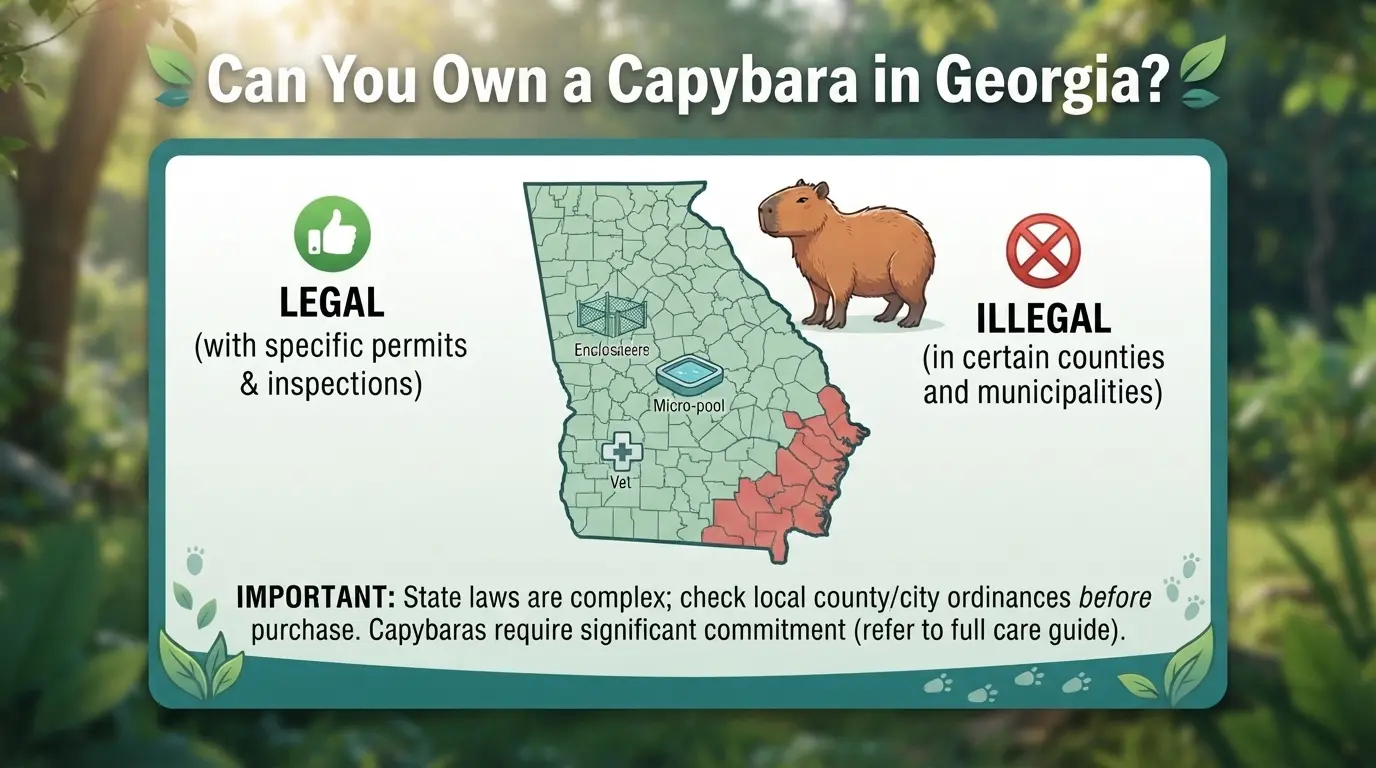
It’s hard to scroll through social media without landing on a capybara looking impossibly calm in a hot tub, or wandering through someone’s living room like that’s just a normal Tuesday. If you live in Georgia, you’ve probably had the thought: could I actually have one of these?
The short answer is no. Georgia law prohibits capybaras as companions, full stop. But the reasons behind that answer actually matter, and there’s a lot you can still do with your capybara enthusiasm that doesn’t involve a fine, a confiscated animal, or an ethical mess you didn’t sign up for.
Here’s the plan: cut through the myths, walk through exactly what Georgia’s ban says and why it exists, and hand you a real list of places across the state where you can meet a capybara legally and responsibly. By the end, you’ll know the law, understand what capybara care actually demands, and have somewhere to point your enthusiasm that doesn’t end in a seizure notice.
A note before we start: this article is informational, not legal advice. Every legal claim below traces back to official Georgia Department of Natural Resources sources, cited directly, and readers should verify current requirements with the DNR or their own attorney before making any decisions.
The Definitive Legal Answer: Georgia Law on Capybara Ownership
What the Georgia DNR Says
Capybaras are classified as exotic rodents in Georgia, and the state’s position is unambiguous. The Georgia DNR Law Enforcement Division’s own exotics page lists rodents, capybaras named specifically alongside cavies, prairie dogs, and degus, among the species that “may not be held as pets in Georgia.” The only carve-out applies to rodents normally domesticated in the state, things like hamsters, gerbils, and guinea pigs. A capybara doesn’t qualify.
You can verify this directly at gadnrle.org/exotics, the department’s own published list. Nothing about it is buried in legal jargon. It says what it means.
No Permits, No Exceptions
Some states, Texas and Pennsylvania among them, issue permits or licenses that let private individuals keep a capybara under specific conditions, while New York’s capybara laws take a different approach entirely.
Georgia doesn’t offer that path. The state’s Wild Animal License, authorized under O.C.G.A. § 27-5-4, exists exclusively for scientific, educational, or public exhibition purposes. Zoos, accredited sanctuaries, and research institutions qualify. A private household looking to keep a companion capybara does not, regardless of how well-prepared the enclosure or how genuine the intent.
There’s no application to file that changes this outcome. No amount of documentation converts a private residence into an eligible facility under Georgia law.
Expert Tip: Always check exotic pet rules at both the state and local level. Georgia DNR sets the floor, but your specific county or city government can add restrictions on top of it, and often does.
Penalties for Illegal Ownership
Keeping a capybara without authorization in Georgia carries real consequences: fines, confiscation of the animal, and potential misdemeanor charges depending on how the case is handled. Enforcement isn’t theoretical. Complaints from neighbors, veterinarians, or even social media posts can trigger an investigation.
The outcome for the animal itself is often the hardest part. An illegally kept capybara that gets confiscated has to go somewhere, and if no licensed facility has space or capacity to take it in, euthanasia becomes a real possibility. That’s not a scare tactic. It’s the practical reality of what happens when an animal ends up in legal limbo through no fault of its own.
County and City Ordinances: Even Stricter Rules
Georgia’s state-level ban is the floor, not the ceiling. Some counties and cities layer additional restrictions on top of the state rules, and local ordinances can be stricter, never looser. If your county has its own exotic animal code, it doesn’t matter how the state classifies capybaras; the local rule controls.
Contact your local animal control office or county clerk directly for current local regulations. Most guides covering this topic stop at the state line, but this level of local detail is worth the extra phone call, since it’s the layer where enforcement actually happens on the ground.
Myth-Busting: Common Misconceptions About Capybara Companions
Myth 1: Capybaras Are Just Giant Guinea Pigs
The problem: Social media loves to frame capybaras as oversized, huggable rodents, basically a guinea pig that grew up.
Why that’s misleading: Capybaras are rodents, technically, but the resemblance stops at the taxonomy. They’re semi-aquatic, they live in structured herd groups, and their dietary and behavioral needs bear almost no resemblance to a guinea pig’s. The AZA Capybara Care Manual describes an animal whose entire natural history revolves around water access, grazing, and constant social contact, three things a guinea pig cage never has to account for.
The reality: Comparing a capybara to a guinea pig undersells the commitment by an order of magnitude, and that gap is exactly where new owners get blindsided.
Myth 2: Capybaras Can Live Happily Indoors
The problem: Viral clips show capybaras lounging on couches and wandering through living rooms like any other companion animal.
Why that’s misleading: Capybaras need a large outdoor enclosure with a genuine swimming pool, not a kiddie pool and not a bathtub. Tree of Life Exotic Pet Medical Center’s capybara care guide recommends an enclosure of at least 12 by 20 feet per pair, with water deep enough for full submersion. They aren’t reliably house-trainable, and they’ll damage flooring, furniture, and anything else in reach.
The reality: An indoor capybara isn’t a companion adapting to home life. It’s a wild animal being denied the one thing its biology can’t function without.
Myth 3: Capybaras Are Legal Everywhere
The problem: Most people assume exotic animal law works roughly the same across the country.
Why that’s misleading:
It doesn’t, and the patchwork is wider than most people expect, Michigan’s capybara regulations, for instance, sit somewhere in the middle of that mix.
The StatsPanda 2026 capybara legality map shows a genuine mix: fully legal in some states, permit-required in the majority, and banned outright in nine, Georgia among them, and a detailed legal states guide can help you navigate the specifics.
The reality: Where you live determines the answer far more than anything about the animal itself. A capybara legally kept in Texas becomes contraband the moment it crosses into Georgia, and Virginia’s capybara laws are similarly strict.
Myth 4: Capybaras Are Low-Effort Companions
The problem: The “chill” image capybaras have earned online suggests an animal that basically takes care of itself.
Why that’s misleading: In practice, capybaras require daily pool maintenance, a carefully managed diet, constant outdoor access, and the company of at least one other capybara. None of that happens passively. Skip a day of pool cleaning and the water turns foul fast, since capybaras use it for more than swimming.
The reality: The daily task list runs closer to livestock management than anything resembling a light-effort companion animal. We break down exactly what that looks like hour by hour later in this guide.
Myth 5: Social Media Shows the Real Picture
The problem: Thirty-second clips of a capybara floating peacefully in a pool make the whole experience look effortless and serene.
Why that’s misleading: Those clips are curated by definition. They don’t show the daily grind, the smell of a neglected pool, the cost of an emergency vet visit, or what happens when a 100-plus-pound animal decides it doesn’t want to go back in its enclosure.
The reality: Treat viral capybara content the way you’d treat any highlight reel. Cross-reference it against sources built for accuracy rather than engagement, like the AZA care manual or an actual exotic veterinarian’s guidance, before you let a video shape a real decision.
Expert Tip: Be skeptical of any clip showing a capybara cuddling with a dog indoors or roaming a house freely. These moments exist, but they rarely show the full, demanding reality surrounding them.
Why Georgia Bans Capybaras: Ecological, Safety, and Welfare Reasons
Invasive Species Risk
Georgia’s climate, warm, wet, and full of wetlands, happens to closely resemble the environment capybaras evolved in throughout South America. If capybaras escaped or were released in meaningful numbers, wildlife biologists generally agree the state’s ecosystem offers little natural resistance to them establishing wild populations.
Nutria, another large semi-aquatic rodent, offers a real-world preview of what that looks like. Nutria populations established across the Southeast have caused documented damage to wetlands, levees, and agricultural land, and states dealing with nutria invasions have spent significant resources trying to control them after the fact. Georgia’s precautionary stance on capybaras follows the same logic: it’s considerably cheaper to prevent an invasive species problem than to manage one that’s already loose.
Public Safety and Zoonotic Disease Concerns
Capybaras can carry diseases transmissible to humans, including leptospirosis and salmonella, both of which spread through contact with contaminated water or waste. Add in a set of incisors built for gnawing through tough vegetation, and an unpredictable 100-plus-pound animal in a residential setting represents a real, if uncommon, safety risk.
Georgia’s ban reflects a precautionary approach to public health rather than a response to a specific incident. The state would rather avoid the risk category entirely than manage individual cases as they arise.
Animal Welfare: The Inability to Meet Complex Needs
Most private homes simply cannot replicate what a capybara needs to thrive. The AZA Care Manual’s standards for professional zoo habitats, built around square footage minimums, water depth requirements, and social group sizing, illustrate just how far a typical backyard falls short. Zoos design these enclosures with dedicated staff, veterinary access, and construction budgets that dwarf what most households could realistically commit.
Expert Tip: A capybara needs a large outdoor enclosure with a deep swimming area to thrive. It cannot live well in a typical house or apartment, no matter how much space feels available indoors.
The Precautionary Principle in Exotic Pet Laws
Georgia’s approach to capybaras reflects a broader pattern in how the state handles exotic species generally: prohibit unless proven manageable, rather than allow until problems surface. That’s a meaningfully different posture from states that permit first and regulate after incidents occur.
Understanding that logic reframes the ban. It’s not an arbitrary “no.” It’s a deliberate choice to keep the bar high before an animal with real ecological and welfare complexity gets introduced into backyards across the state.
What Capybara Ownership Actually Requires (In States Where It Is Legal)
Even where capybaras are legal, the requirements are steep enough that most prospective owners underestimate them badly. Here’s what real, responsible care actually looks like.
Space and Enclosure: Not Your Average Backyard
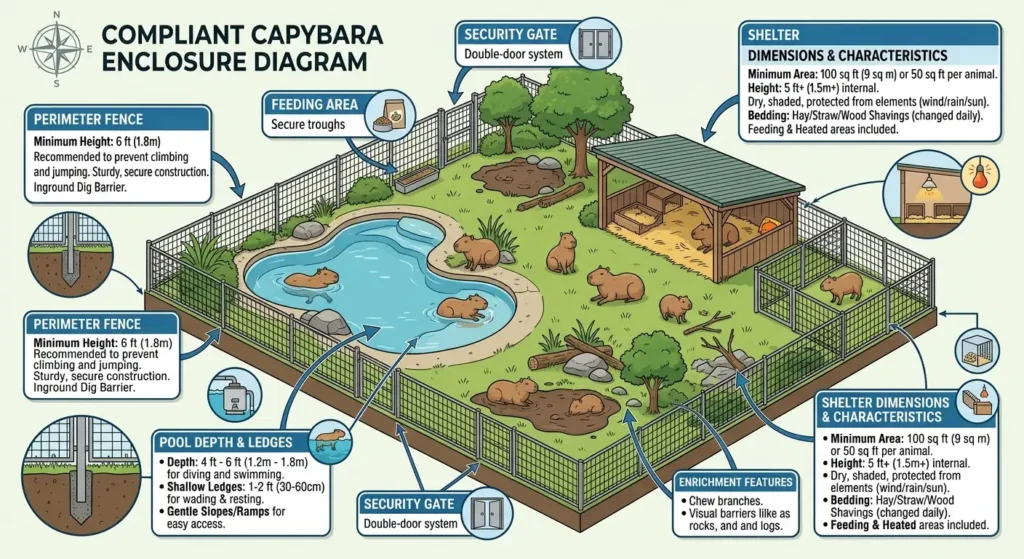
A single pair needs a minimum of roughly 12 by 20 feet of securely fenced outdoor space, with both sunny and shaded areas built in. The substrate should be grass, dirt, or sand rather than concrete, and a heated shelter matters even in a climate as mild as Georgia’s, since winter nights still dip cold enough to stress an animal built for a South American climate.
The AZA Capybara Care Manual lays out detailed enclosure specifications worth reading directly if you’re evaluating what a compliant setup would actually take.
The Essential Swimming Area
Capybaras are semi-aquatic by biology, not by preference. They need a pool or pond deep enough for full submersion, with a gentle, gradual entry and exit point. Water quality management isn’t optional maintenance; it’s a daily requirement. Filtration, regular cleaning, and temperature control all have to stay on top of a pool that a 100-plus-pound animal uses for swimming, cooling off, and relieving itself.
Social Needs: Why You Need at Least Two
Capybaras are herd animals by nature, and solitary living causes measurable stress, depression, and behavioral problems. A minimum of two, ideally a compatible pair acquired together, is the standard every reputable care source recommends.
Expert Tip: Never keep a single capybara. They require at least one companion of their own species to avoid the stress and depression that comes with isolation.
Diet and Nutrition: More Than Just Grass
The bulk of a capybara’s diet should be high-quality grass hay, supplemented with fresh grasses and access to aquatic plants where possible. Rodent pellets, fresh vegetables, and a daily vitamin C supplement round out the rest, since capybaras can’t synthesize vitamin C on their own the way most mammals can.
Skip high-sugar fruit and anything resembling processed human food. Tree of Life Exotic Pet Medical Center’s capybara care guide breaks down a full, detailed diet plan worth reviewing directly for anyone evaluating real ownership.
Veterinary Care: Finding an Exotic Vet
A standard dog-and-cat clinic isn’t equipped to treat a capybara. You need a veterinarian with genuine exotic mammal experience, and that relationship needs to exist before an emergency, not during one. Routine care includes annual exams, dental checks, and parasite control, while emergency concerns can range from bloat to respiratory infections to injury.
The Association of Exotic Mammal Veterinarians maintains a find-a-vet directory that’s worth using to locate a qualified provider before acquiring any exotic animal, capybara or otherwise.
Expert Tip: Consult an exotic veterinarian before acquiring any non-traditional companion animal. That conversation tends to surface the lifelong medical costs and specialized care demands faster than any amount of online research.
The Financial Reality: Lifetime Costs
Most sources gloss over the actual dollar figures. Here’s a transparent breakdown of what legal capybara ownership costs where it’s permitted.
Expense Category | Cost Estimate | Notes |
Enclosure construction | $2,000 – $5,000+ | Fencing, shelter, land prep; varies widely by DIY versus professional build. |
Pool setup and maintenance | $500 – $3,000 initial, ongoing filtration/cleaning costs | Livestock trough versus custom in-ground pond changes this significantly. |
Monthly food | $100 – $200 | Hay, fresh produce, pellets, vitamin C supplement. |
Veterinary care | $500 – $1,000/year | Routine exams; emergencies run considerably higher. |
Emergency vet fund | $500 – $1,000/year set aside | Exotic emergency care is expensive and hard to find on short notice. |
Lifetime total (8–12 year lifespan) | $20,000 – $30,000+ | Across the full lifespan, not counting unexpected emergencies. |
That lifetime figure is the number most viral videos never mention, and it’s worth sitting with before anyone gets attached to the idea.
Capybara Ownership Readiness Scorecard
Even in a state where ownership were legal, this scorecard is worth running through honestly. Answer yes or no to each:
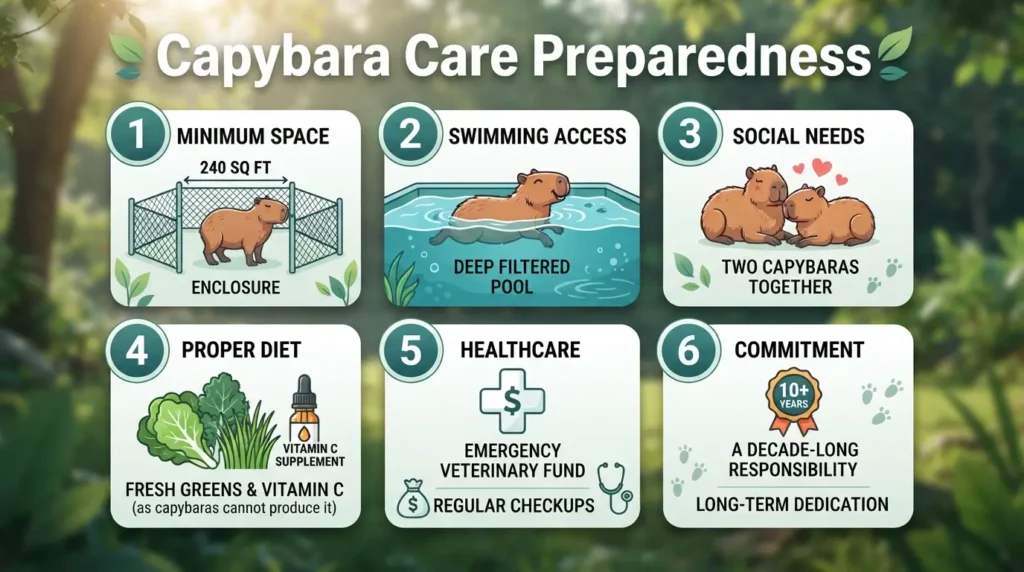
- I have at least 240 square feet of outdoor space I can permanently dedicate to an enclosure.
- I can build or install a pool deep enough for full submersion, with real filtration.
- I’m prepared to acquire at least two capybaras, never one.
- I have a specialized diet plan in place, including a daily vitamin C supplement.
- I’ve identified an exotic veterinarian within reasonable driving distance who has treated capybaras before.
- I can afford a $3,000 emergency vet bill without financial strain.
- I’m prepared to care for this animal for 10 or more years without exception.
- I have 2 to 3 hours available daily for pool, feeding, and enclosure maintenance.
Even a perfect score here represents an extreme commitment, not a casual one. That’s the point. If you’re struggling to check every box honestly, that’s not a failure. It’s useful information, and it’s exactly the kind of gap Georgia’s ban exists to prevent people from discovering the hard way.
A Day in the Life of a Capybara Caretaker
Based on real sanctuary routines, here’s what a typical day of responsible capybara care actually involves.
Morning: Pool cleaning and water testing, fresh drinking water refilled, hay stocks replenished for the day.
Midday: A visual health check for each animal, enclosure maintenance and fence inspection, dietary supplements administered.
Evening: Social time and enrichment, shelter secured for the night, a second feeding.
Total time commitment runs 2 to 3 hours daily, with longer weekend sessions for deep cleaning the pool and enclosure. None of that includes emergency situations, vet visits, or the unpredictable maintenance that comes with any large animal.
Expert Tip: Volunteer at a licensed wildlife rescue or sanctuary before deciding whether ownership, in a state where it’s legal, is genuinely right for you. Nothing replaces the hands-on reality of a real routine.
Legal Capybara Experiences in Georgia: Your Guide to Ethical Encounters
Why Choose an Ethical Encounter?
Visiting a licensed, accredited facility supports genuine animal welfare and conservation education, and it does so without the legal risk or ethical gray area that comes with illegal private ownership or an unaccredited roadside attraction. Every facility below operates legally in Georgia and gives you a real, hands-on way to meet a capybara.
Comparison Table of Legal Capybara Experiences
Facility Name | Location | Type of Experience | Approximate Cost | Booking Information |
North Georgia Wildlife & Safari Park | Cleveland, GA | Capybara & Friends Experience (guided, hands-on); also offers Baby Capybara, Young Capybara, and Meet & Greet formats | $75 – $150 per person plus park admission, depending on format | Online reservation required; book at northgeorgiazoo.com/capybara-experiences.html |
Georgia Untamed Zoo | Hogansville, GA | Private 15-minute Capybara Encounter; also available as part of a longer VIP behind-the-scenes package | Encounter fee plus general admission (starting around $13.50); confirm current combined pricing before booking | Reservation required; book at georgiauntamedzoo.org/encounters |
Wild Animal Safari | Pine Mountain, GA | Guided capybara encounter, roughly 15 minutes, part of a larger drive-thru safari and Walkabout Zoo | Encounter add-on starting around $15 plus park admission | Reservation required; book at animalsafari.com |
Note to reader: pricing, availability, and age restrictions change without notice at all three facilities. Confirm current details directly with each park before booking. If none of these fit your location or schedule, you can find a list of zoos with capybaras to explore more options.
What to Look for in an Ethical Facility
Accreditation. Look for AZA membership or GFAS (Global Federation of Animal Sanctuaries) status where applicable. These accreditations mean a facility is held to real welfare and safety standards, not just a marketing claim.
Transparency. A trustworthy facility openly shares its animal care practices and welcomes questions from visitors rather than deflecting them.
Welfare indicators. Clean enclosures, naturalistic habitats, healthy-looking animals, and no forced interactions are the signs worth watching for. If an animal looks like it’s trying to avoid the encounter, that’s worth noting and reporting, not ignoring.
Booking Tips and What to Expect
Book well in advance. Capybara encounters at all three facilities above tend to sell out, especially on weekends and during peak season. Ask ahead about the encounter format, whether it’s a behind-the-scenes tour, a feeding session, or primarily a photo opportunity, so expectations match reality.
Above all, respect the animal’s boundaries during your visit. A genuinely good facility prioritizes the capybara’s comfort over a visitor’s desire for a longer interaction, and that’s a sign you’re in the right place, not a limitation to push against.
How to Be a Responsible Capybara Fan Without Owning One
Support Capybara Conservation Efforts
Consider donating to organizations working to protect capybara habitats in South America, including groups focused on Pantanal wetland conservation. Capybaras thrive there in the wild precisely because that ecosystem still exists intact, and supporting its protection does more for the species than a backyard enclosure ever could.
Follow Accredited Sanctuaries on Social Media
Skip the random viral accounts and follow facilities like North Georgia Wildlife & Safari Park or other AZA-accredited zoos directly. Their content tends to be educational rather than purely engagement-driven, and it gives you an accurate picture of what real care looks like.
Educate Others About the Realities of Ownership
Share resources like this one when misinformation shows up in your feed. A gentle correction in a comment section, backed by an actual source, does more good than it might seem to in the moment.
Volunteer or Donate to Wildlife Rescues
Look for licensed wildlife rescues in Georgia that work with capybaras or other exotic species. Volunteering gives you hands-on experience with animal care while directly supporting welfare work, and it’s a far more honest way to satisfy the curiosity that started this whole search in the first place.
Expert Tip: Join online communities of responsible exotic animal caretakers to learn from real, long-term experience rather than viral trends built for engagement, not accuracy.
Enjoy Capybara Content Responsibly
Curate your feed around biologists, zookeepers, and accredited sanctuaries rather than accounts optimizing purely for views. Avoid sharing clips that show capybaras in unsafe or unnatural situations, since amplifying that content only reinforces the myths this guide just spent several sections correcting.
Conclusion: Respecting Wildlife Laws and Loving Capybaras Responsibly
Capybaras are illegal to keep as companions in Georgia, and the reasons hold up under scrutiny: real ecological risk, genuine public safety considerations, and welfare needs that almost no private home can meet. That’s not a reason to walk away from your interest in these animals. It’s a reason to redirect it somewhere it can actually do some good.
Georgia gives you real, legal, ethical ways to meet a capybara in person, support the habitats where they thrive naturally, and help correct the misinformation that got so many people asking this question in the first place.
Your enthusiasm for capybaras can make a genuine difference when it’s channeled into conservation support, ethical tourism, and honest education. Book that encounter. Share what you’ve learned. Help the next person considering this question get the accurate answer faster than you did.