
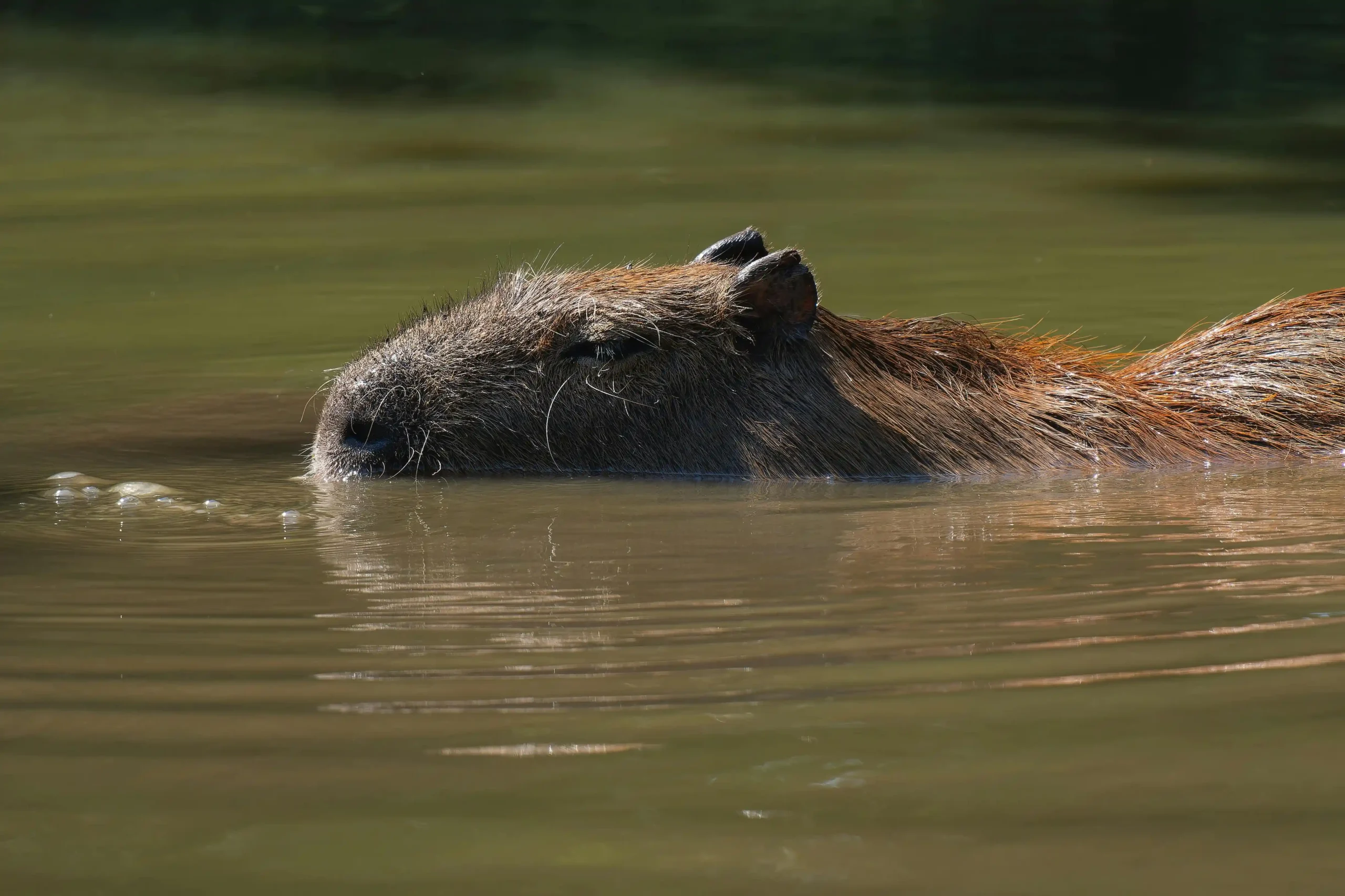
Begin with a surprising fact about the capybara not only just the world’s largest rodent, but an unparalleled master of the aquatic world whose life depends on rivers, lakes, and wetlands. They are as comfortable in the water as they are on the land.
In exploring their secret underwater world, you’ll discover how their unique biology and behaviors have turned water into both refuge and social hub. They are naturally great swimmers and while capybaras do not learn to swim as fast as other rodents such as beavers.
By the end of this journey, you won’t just know that capybaras swim—you’ll understand how water defines their survival, shapes their family bonds, and influences their place in ecosystems.
Why Water is Essential for Capybaras
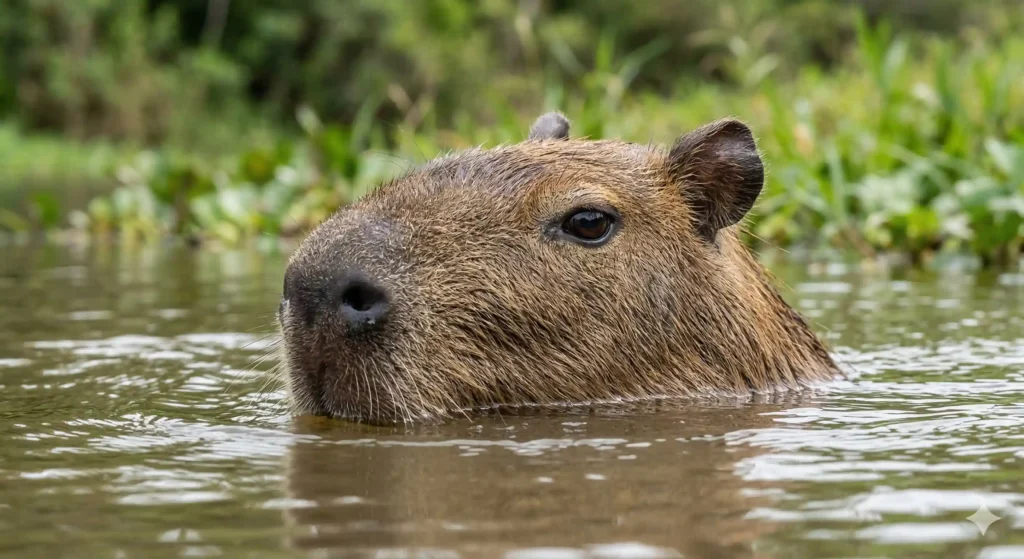
Capybaras spend long hours submerged to regulate their body temperature, preventing overheating. With only their eyes, ears, and nostrils above the surface, they can stay cool while remaining alert to their surroundings.
Unlimited access to fresh water plays a vital role in the health of capybars , they keep themselves hydrated in hot conditions. Without water, their survival would be at risk, as both their digestion and overall health depend on frequent intake.
In some cases water is used as a safety weapon for capybars. During the threat on land from jaguars anacondas, caimans, or other predators, capybaras dive beneath the water and hold there for a few minutes.
Anatomical Adaptations for an Aquatic Life
Their biological structure helps them to make a rapid swimmer. With the body structure capybara have , they can swim up to 8 km/h (5 miles per hour).
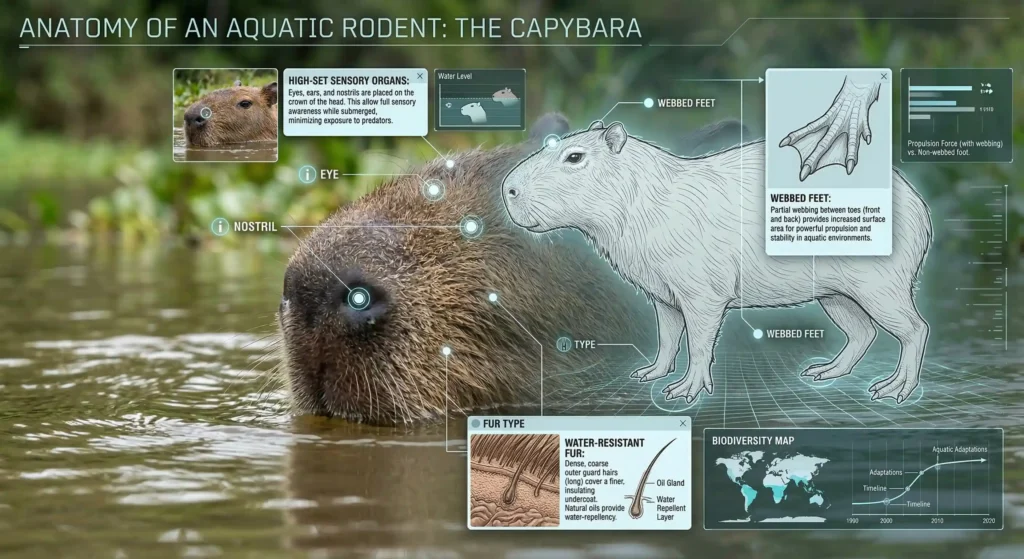
Capybaras are not built like typical land-dwelling rodents, their slightly webbed feet give them a major advantage in the water.
Evolution has gifted capybaras with a clever arrangement of their eyes, ears, and nostrils—all set high on the head. This is just a gift from god to protect them from predators of water like crocodiles and alligators.
The Art of Capybara Swimming: Techniques and Speed
Capybara swims smoothly, rhythmily under the water that closely resembles a dog-paddle. Their slightly webbed feet provide extra thrust, while their streamlined bodies cut through the water with surprising ease.while their heavy body structure wastes a little amount of heavy energy.
Once submerged, capybaras display remarkable agility. They can twist, turn, and shift direction quickly to avoid predators or to play with other members of their herd. Their ability to hold their breath for up to five minutes gives them good time to move silently beneath the surface.
DO YOU KNOW ? A capybara can swim at a speed of up to 5 miles per hour (or 8 kmh). On average they swim slower than that but their body is well built for swimming fast.
Surface vs. Submerged Travel
Capybaras adapt their swimming style depending on need. On the surface, they glide quietly, often with only their eyes, ears, and nostrils exposed—ideal for staying alert to danger while cooling off. When threatened, however, they slip below the waterline, using stealth and agility to vanish from view and travel unseen.
Comparative Analysis: Capybaras vs. Other Semi-Aquatic Mammals
| Mammal | Swimming Adaptations | Strengths | Distinct Traits |
|---|---|---|---|
|
Otter
|
Streamlined bodies and muscular tails
|
Speed and precision in underwater swimming
|
Playful, agile, and built for rapidTactics. |
|
Rodent
|
Broad, flat tails for propulsion and steering |
Strong divers, endurance-based swimming
|
Tail adapted for both swimming and construction (dam building)
|
|
Capybara
|
Slightly webbed feet, dense body aiding buoyancy
|
Balanced endurance, stealth, and energy conservation |
Social swimming, stealthy submergence, and survival-focused movement
|
Underwater Endurance: How Long Can They Hold Their Breath?
Capybaras can typically hold their breath for up to 5 minutes. , primarily this capability of capybars is used as a defense mechanism against predators like jaguars and anacondas.
During this they submerged themselves under the water and in this way, it deceives alligators and survives.
By keeping their nostrils positioned at the top of their heads, capybaras can remain almost completely submerged while still breathing. Remarkably, they even use this adaptation while sleeping in water, staying hidden beneath the surface for protection, with only their nostrils exposed to the air.
DO YOU KNOW ? : Capybaras can hold their breath for up to 5 minutes, primarily as a defense mechanism against predators like jaguars and anacondas.
Capybaras in Their Natural Aquatic Habitat
Capybaras thrive in landscapes where land and water meet. They favor lakes, rivers, swamps, and marshes—ecosystems that offer abundant grasses for grazing, fresh water for drinking, and aquatic cover for protection. These habitats are essential, as water is not just a resource but the very foundation of their survival.
Capybara Swimming: Myths vs. Facts
Capybaras are often misunderstood when it comes to their aquatic abilities. Let’s separate myth from reality.
Myth 1: Capybaras are slow swimmers.
Fact: In reality, capybaras are surprisingly efficient in water. Their slightly webbed feet provide powerful propulsion, allowing them to swim at speeds up to 10 km/h (6 mph).
Myth 2: They only enter water to escape predators.
Fact: While water does provide a vital escape route, it serves multiple essential functions in a capybara’s daily life. They use water for thermoregulation, resting, social bonding, foraging on aquatic vegetation, and even sleeping while partially submerged.
Myth 3: Capybaras cannot stay submerged for long periods.
Fact: Capybaras are capable of holding their breath for up to five minutes. This allows them to remain hidden from threats, rest in the water during the hottest part of the day, and travel underwater between feeding sites without detection. Their high-set eyes, ears, and nostrils facilitate this semi-submerged lifestyle.
Conclusion
Capybaras are remarkable swimmers. Their slightly webbed feet provide powerful propulsion, high-set eyes, ears, and nostrils allow nearly complete submersion while staying alert.
Behaviorally, they are agile underwater, hold their breath for minutes, and navigate complex waterways with precision.
Frequently Asked Questions
Can capybaras swim?
Yes, capybaras are highly skilled swimmers and spend a large part of their life in water. Swimming is natural for them and is one of their main survival skills in the wild.
Why do capybaras like swimming?
Capybaras love swimming because it helps them stay safe from predators, cool down in hot weather, and relax. Water is also their safest escape route when they feel threatened.
How long can capybaras stay underwater?
Capybaras can hold their breath underwater for up to around 5 minutes. This ability allows them to hide completely from predators until danger has passed.
Are capybaras born swimmers?
Yes, capybaras are naturally adapted to water from birth. Even young capybaras quickly learn to swim and follow their mother into water for protection.
Do capybaras sleep in water?
Capybaras do not fully sleep underwater, but they often rest in shallow water with their nose above the surface. This helps them stay cool and alert at the same time.
How fast can capybaras swim?
Capybaras can swim quite efficiently using their strong legs and partially webbed feet. They can move quickly enough in water to escape most predators.
Can baby capybaras swim?
Yes, baby capybaras can swim very soon after birth. They usually stay close to their mother and the group, which protects them while they are in the water.