
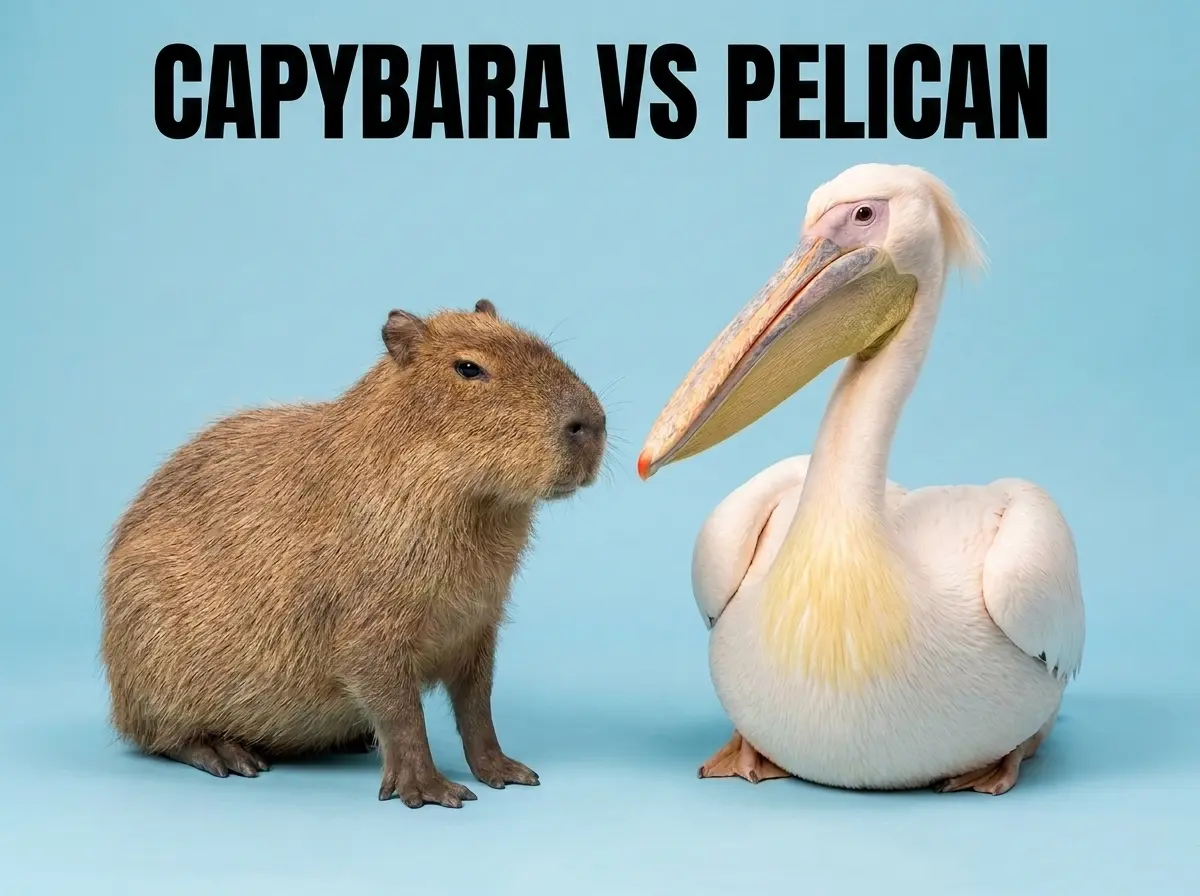
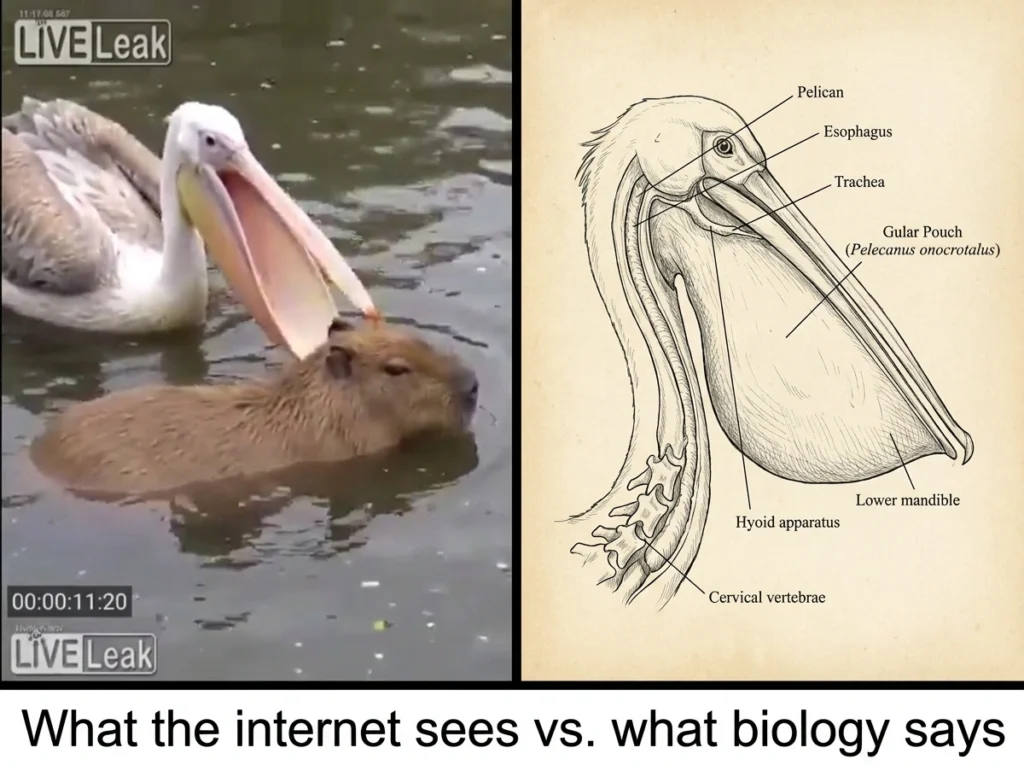
A pelican stands in shallow water, bill wide open, stretched over the head of a capybara that is, by all appearances, completely unbothered. The clip has racked up millions of views. The comments are full of shock, laughter, and at least one person insisting they’ve “seen nature is metal.” The question everyone eventually asks is the same one: can a pelican actually eat a capybara?
It’s a fair question, and the internet has never been great at answering it. Half the comment section thinks they just watched a predation attempt in progress. The other half thinks the whole thing is staged. Neither camp has the biology.
This article is going to settle it, not with opinion, but with anatomy, feeding ecology, and a close look at what these videos actually show frame by frame. The answer turns out to be simpler than the panic and more interesting than the memes. By the end, you’ll know exactly why a pelican’s gular pouch, that stretchy throat pouch you’ve definitely seen but maybe never had explained, was never built for this job, and why the capybara was never in danger to begin with.
Let’s get into it.
Capybara Profile: The Gentle Giant of the Wetlands
Physical Characteristics and Size
Start with the numbers, because they do a lot of the debunking on their own. An adult capybara weighs 35 to 66 kg, that’s 77 to 146 lbs, with a body length of 1 to 1.3 meters and a shoulder height around 50 cm. This is not a small, swallowable creature. It’s the largest living rodent on Earth, barrel-shaped, robust, and built like something between a large dog and a small pig.
Its body carries the signature adaptations of a semi-aquatic life: coarse fur that dries fast, slightly webbed feet, and eyes, ears, and nostrils set high on the skull so it can stay almost fully submerged while still keeping watch.
Habitat and Social Structure
Capybaras live across South America, from Panama down through Argentina, always close to wetlands, rivers, and flooded grasslands. And they’re social in a way most rodents aren’t, forming herds of 10 to 20 individuals, sometimes swelling past 100 in the wet season, complete with a dominant male, a running vocabulary of purrs and barks, and constant low-level communication.
Expert tip: capybaras hang around water because it’s their primary escape route from real predators, not because they’re passive, easy targets. Big difference.
Diet and Foraging Behavior
Capybaras are herbivores, grazing on grasses and aquatic plants, with the occasional bit of fruit or bark mixed in. They’re grazers, not fighters, by design.
They also practice coprophagy, re-ingesting their own droppings to pull every last nutrient out of a fiber-heavy diet. It sounds strange out of context, but it’s a genuinely specialized digestive strategy, not a weakness.
Defensive Strategies and Predator Awareness
Real capybara predators include jaguars, caimans, anacondas, and, in some regions, humans. Their defense toolkit is vigilance, group alarm calls, and a fast retreat into water, where they can stay submerged for up to five minutes with just the nostrils and eyes breaking the surface.
Here’s the piece that matters most for this whole discussion: the capybara’s calm demeanor in these videos is not the same thing as defenselessness. It’s an animal correctly assessing a non-threat, not an animal frozen in fear.
Pelican Profile: The Piscivorous Pouch-Bearer
Anatomy of the Gular Pouch
The gular pouch is a highly elastic, featherless sac of skin hanging from a pelican’s lower mandible. Its job is simple: it’s a fishing net, a scoop built to capture fish, not a storage bag for whatever the bird happens to find interesting.
That pouch can balloon out to hold roughly 3 gallons of water. But the esophagus behind it, the actual passage down to the stomach, stays narrow, just a few centimeters across even at full stretch. The pouch is a wide net attached to a narrow drain, and that mismatch is the whole story.
Feeding Ecology and Typical Prey
Pelicans are piscivorous, meaning fish make up nearly their entire diet: menhaden, mullet, anchovies, depending on species and region, with the occasional crustacean or small amphibian rounding things out.
Their hunting methods reflect that specialization precisely. Brown pelicans plunge-dive from the air; white pelicans work cooperatively, herding fish into shallow water and scooping them up from the surface. Neither technique has anything to do with subduing a large, struggling mammal. It’s simply not the tool for that job.
Expert tip: a pelican’s hunting strategy is tuned for energy efficiency. Attempting to swallow something the size of a capybara wouldn’t just fail, it would be a wildly poor use of energy for a bird that survives on tight caloric margins.
Species Variations and Size Limits
Pelicans split roughly into two camps: the smaller, coastal brown pelican, and the larger white pelicans found further inland. Even the biggest living species, the Dalmatian pelican, tops out around 7 to 15 kg with a throat diameter that maxes out somewhere around 5 to 7 cm.
Put that next to a large carp, a genuinely oversized meal for a pelican at maybe 5 kg and 40 cm long, and you’re still nowhere near capybara territory.
Pelican Behavior: Opportunism vs. Predation
Pelicans are curious birds, and genuinely opportunistic ones. They’ll peck at unfamiliar objects constantly, testing texture and size before deciding whether something’s worth a second look. That instinct doesn’t discriminate much. A capybara sitting still in shallow water is, from a pelican’s perspective, just one more object worth investigating.
That’s the real reframe here. It’s curiosity, not a hunting strategy.
The Viral Interaction Explained: What the Videos Actually Show
Step-by-Step Breakdown of a Typical Encounter
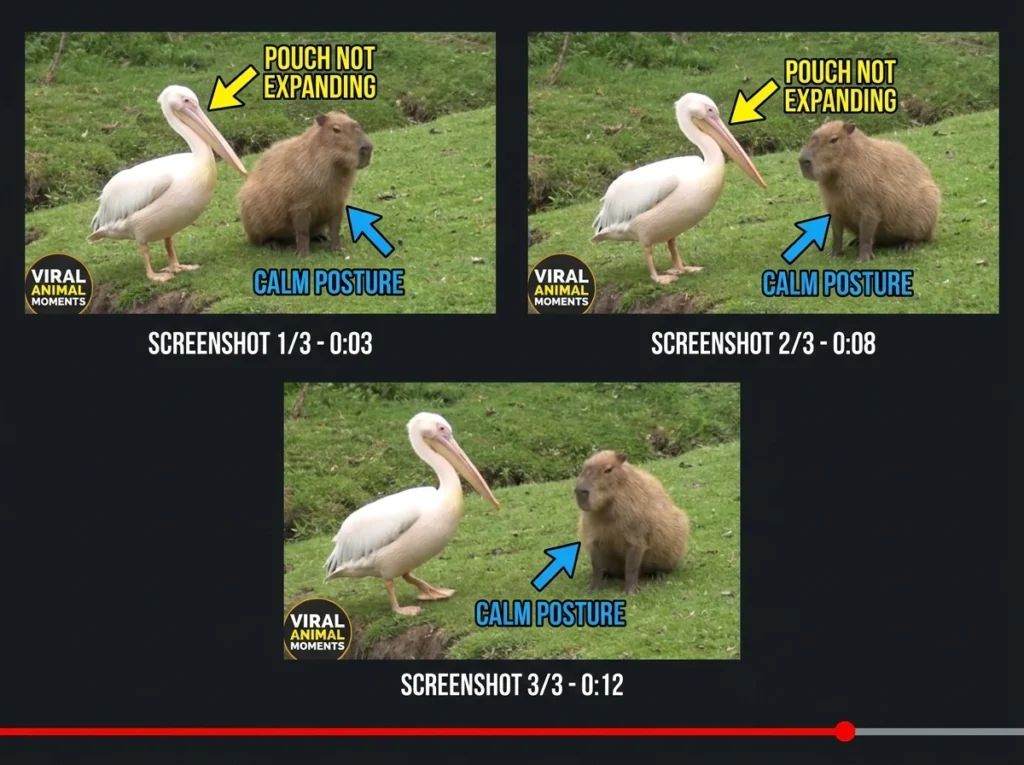
Here’s roughly how these clips play out. A capybara sits in shallow water, often on a rock or partially submerged. A pelican approaches, opens its bill, and lowers it over the capybara’s head or back. The capybara barely reacts, maybe a slight head shift, nothing more. The pelican adjusts its grip once or twice, seems to reconsider, and eventually gives up and wanders off.
Notice what’s missing from that sequence. No chase. No struggle. No expanding pouch actually closing around prey. That absence is doing a lot of work.
Distinguishing Exploratory Pecking from Predation
Exploratory pecking is a well-documented bird behavior: testing an object’s texture, size, and edibility without any real intent to consume it. True predation looks completely different. It involves stalking, a committed strike, and swallowing prey head-first using gravity and throat muscles working together. None of those signatures show up in these clips.
The Role of Capybara Calmness
Why doesn’t the capybara flee? Almost certainly because it doesn’t register the pelican as a threat. Capybaras are genuinely attuned to predator silhouettes and movement patterns, and a pelican’s shape and behavior simply doesn’t match anything on that danger list.
Expert tip: that stillness is a learned, assessed response, not passivity. Inside a herd, any capybara will still let out an alarm call the moment an actual threat shows up. This just isn’t one.
Viral Video Timeline: A Chronological Look at Famous Encounters
The footage that kicked off much of this meme cycle traces back to a zoo enclosure in Wuhan, Hubei Province, China, where a pelican and a capybara share the same space. That clip circulated widely through outlets like Newsflare and picked up millions of views on Twitter/X in early 2021, framed by most outlets at the time as “hungry pelican tries to eat capybara.” From there, the footage got recut, restitched, and recaptioned repeatedly across TikTok and other platforms, including popular commentary versions that leaned into the “attack” framing for laughs.
Worth being upfront about here: most of the viral spread traces back to this one core piece of zoo footage, not a wave of separate wild encounters. The internet just kept remixing the same clip with new captions, which is exactly how a single exploratory-pecking moment turns into “proof” of a supposed predator-prey relationship that doesn’t actually exist in nature.
Biological Feasibility Analysis: Why a Pelican Can’t Swallow a Capybara
Throat Diameter and Gular Pouch Constraints
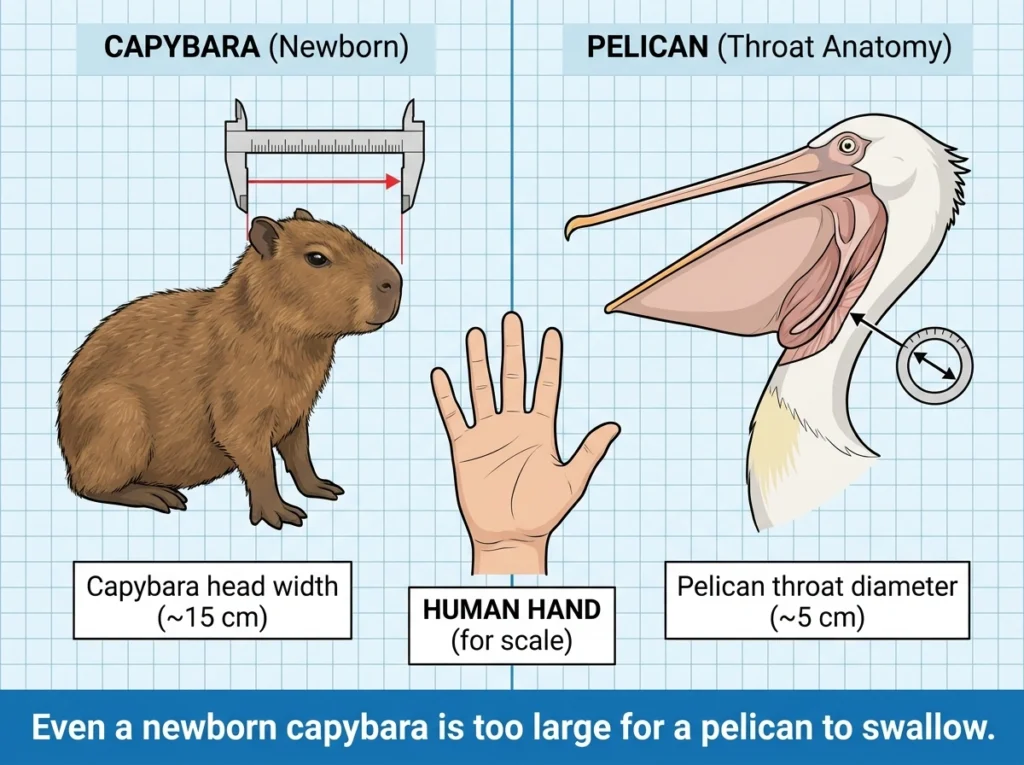
A pelican’s esophagus runs roughly 2 to 3 cm in diameter at rest, stretching to maybe 5 to 7 cm at absolute maximum. A capybara’s head alone measures over 15 cm wide. That’s not a narrow miss. That’s a different order of magnitude.
And the gular pouch itself isn’t a stomach. It’s a temporary holding net. Prey has to be maneuvered to the back of the throat and swallowed whole, and a capybara’s shape, rigid, jointed, and far too wide, simply doesn’t collapse down the way a fish does.
Digestive Tract Limitations
A pelican’s digestive system is built around fish: strong stomach acid, but no mechanism for processing large bones, thick hide, or a rodent’s dense muscle mass. Even in the purely hypothetical scenario where a pelican somehow forced something capybara-sized partway down, the result would be impaction or regurgitation, not digestion. There’s no documented case of a pelican consuming anything remotely close to that mass.
Comparative Prey Size: What Pelicans Actually Eat
The largest documented prey items for pelicans are things like sizeable carp, up to roughly 1.8 kg in some records, occasionally small birds or ducklings in opportunistic situations. None of it comes anywhere near a capybara’s mass. It isn’t even in the same conversation.
Side-by-Side Comparison: Capybara vs. Pelican
Characteristic | Capybara | Pelican |
Scientific Name | Hydrochoerus hydrochaeris | Pelecanus spp. (e.g., P. occidentalis, P. erythrorhynchos) |
Average Weight | 35–66 kg (77–146 lbs) | 2.75–15 kg (6–33 lbs), depending on species |
Body Length | 1–1.3 m (3.3–4.3 ft) | Body 1–1.5 m; wingspan 1.8–3 m (5.9–10 ft) |
Diet | Herbivore (grasses, aquatic plants) | Piscivore (fish, occasional crustaceans) |
Habitat | Wetlands, rivers, flooded grasslands | Coastal and inland waters |
Social Structure | Highly social, groups of 10–20+ | Colonial nesters, often feed in groups |
Defensive Mechanisms | Flight to water, submergence, group vigilance | Flight, bill thrusts; not built to overpower large prey |
Feeding Mechanism | Grazing, coprophagy | Gular pouch scooping, plunge-diving or surface feeding |
Gape/Throat Diameter | Head width over 15 cm | Esophagus roughly 2–3 cm relaxed, up to ~5–7 cm stretched |
Maximum Prey Size | Not a predator | Fish up to roughly 1.8 kg / 40 cm |
Interaction with Other Species | Tolerant of non-predators; may allow birds to perch | Curious; will peck at unfamiliar objects |
Myth Busting: Separating Fact from Fiction
Myth 1: “Pelicans Eat Anything That Fits in Their Mouth”
The claim: the internet joke that pelicans will try to eat literally anything, cats, capybaras, whatever’s nearby.
Why it’s wrong: this ignores the actual physical limits of the pouch and the esophagus behind it. A pelican’s mouth can open impressively wide, but the throat cannot accommodate large, irregularly shaped objects, no matter how the bill stretches.
The real science: pelicans are specialized fish-eaters. The gular pouch is a net, not a swallowing mechanism on its own. Width up front doesn’t translate to width all the way down.
Myth 2: “Capybaras Are Defenseless Prey”
The claim: that calm, unbothered look in the videos means the capybara is an easy target.
Why it’s wrong: capybaras carry a genuine set of anti-predator adaptations, speed both on land and in water, sharp incisors capable of real damage, and a functioning group alarm system. Passive is the wrong word entirely.
The real science: a capybara could injure a pelican with a single bite if it actually felt threatened. The fact that it doesn’t react isn’t submission. It’s confirmation that the animal doesn’t perceive any danger at all. Flip the framing here: the capybara is the one in control of this interaction, not the pelican.
Myth 3: “The Videos Show Attempted Predation”
The claim: the pelican is genuinely trying to eat the capybara.
Why it’s wrong: real predation follows a recognizable sequence, stalking, capturing, killing, swallowing. None of that sequence appears anywhere in this footage.
The real science: what you’re watching is exploratory behavior, not a hunting attempt. The clearest tell is the capybara itself: no alarm call, no flight response, no sign of distress anywhere in the clip. That absence is the whole answer.
Ecological Context: Overlapping Worlds in South American Wetlands
Shared Habitats and Seasonal Encounters
Wild capybaras and wild pelicans do share overlapping range in places like the Pantanal, the Llanos, and parts of the Amazon basin, and seasonal flooding can push both species into closer proximity than usual.
The Role of Water in Both Species’ Lives
For a capybara, water is refuge, feeding ground, and social hub all at once. For a pelican, it’s simply a hunting ground. That shared dependence on the same wetlands sets the stage for the occasional curious crossover, even though the two species aren’t pursuing the same resources at all.
Expert tip: worth being clear that these encounters are rare and brief wherever they happen, in the wild or in captivity. This isn’t an established ecological relationship. It’s a quirk of two very different animals occasionally sharing the same patch of shallow water.
Why These Interactions Are Rare
Pelicans and capybaras run on different activity patterns and different microhabitat preferences. Pelicans want open water for fishing. Capybaras stick closer to vegetated edges. The viral clips capture a genuinely fleeting moment of overlap and curiosity, not anything resembling a regular occurrence.
Expert Insights: What Wildlife Biologists Say
Ornithologists who study pelican feeding ecology consistently point back to the same mechanical bottleneck: the gular pouch may look like it can hold almost anything, but the esophagus behind it is the real limiting factor, and it simply isn’t built to pass anything shaped like a capybara. Published feeding-ecology research on pelicans (including studies specifically on the brown pelican) documents prey sizes that top out at large fish, nowhere near mammalian body plans.
Mammalogists studying capybara behavior describe the species as wary of genuine novelty but quick to habituate once something proves harmless, which lines up neatly with what these videos actually show: an animal that clocked the pelican early, decided it posed no risk, and simply continued as usual.
The broader lesson researchers keep coming back to is a familiar one: viral animal footage gets misread constantly, and the corrective is almost always the same, go find the actual biology before accepting the caption at face value.
Conclusion: The Verdict
Here’s the verdict, plainly: pelicans cannot eat capybaras. The anatomy rules it out. The physics rules it out. And the behavior in every one of these viral clips lines up with curiosity, not predation. What looks like a near-miss attack is actually a bird testing an object with its bill, and an animal that correctly clocked zero danger in the situation.
Understanding the biology behind the meme doesn’t kill the joke. If anything, it makes the clip funnier once you know exactly why the pelican never had a chance and exactly why the capybara never needed to care.
Next time this clip resurfaces in your feed, you’ll have the real story ready to go. Share it, and bring a little healthy skepticism to the next viral animal video that crosses your timeline too.
So next time you see a pelican sizing up a capybara, go ahead and laugh. Then explain exactly why the capybara has nothing to worry about.

Carly Fiorina
Exotic Pet Research Specialist/Capybara Owner
Hi, I’m Carly, and I’m the heart behind CapybaraTalks.com. My journey with capybaras began when I met my first pet, and I was instantly fascinated by her calm, social, and endlessly curious nature. Capybaras are gentle, playful, and love to swim and explore each one has a unique personality that makes them such special companions.
1 thought on “Can a Pelican Really Eat a Capybara? The Truth”
Comments are closed.