
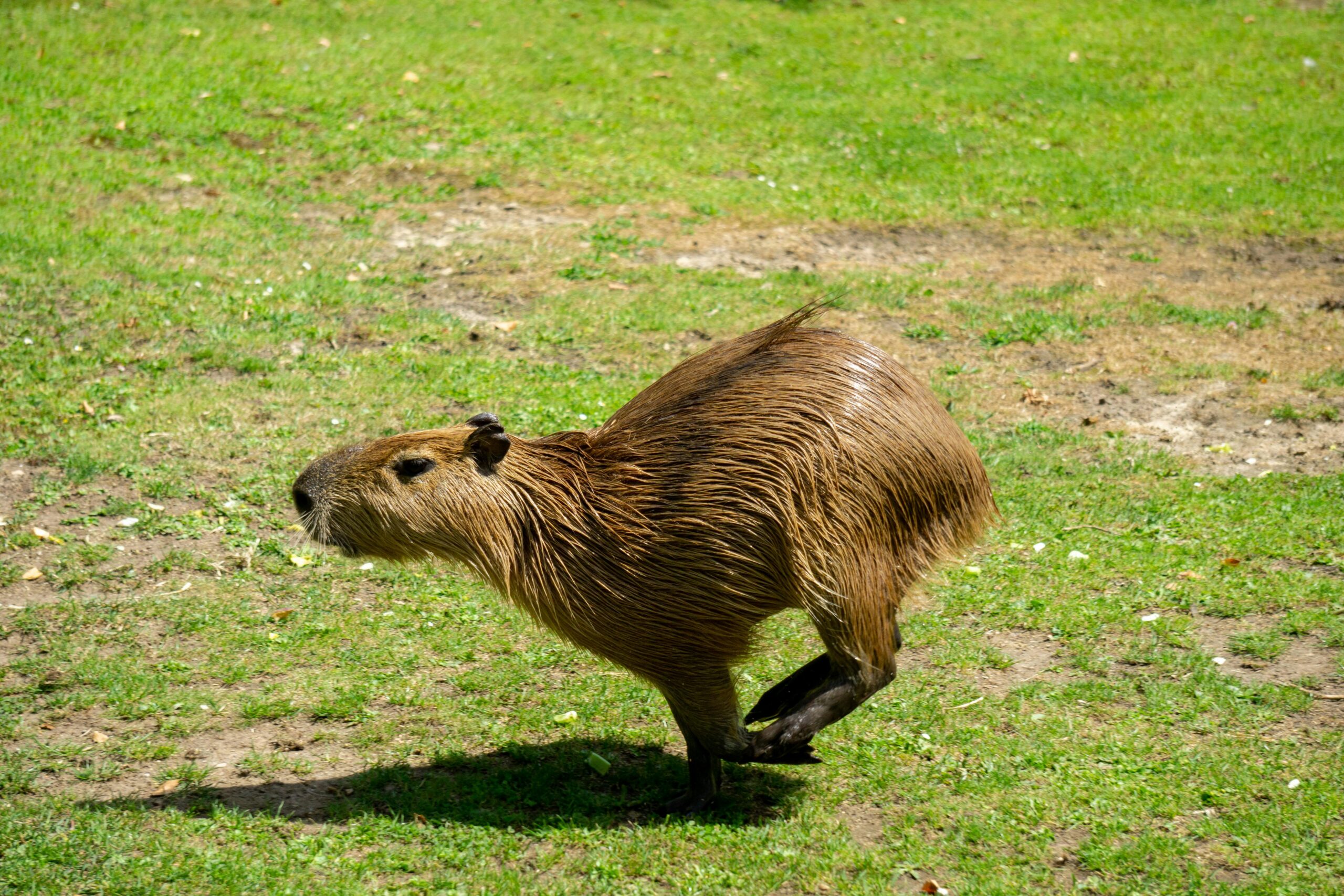
Have you ever wondered about the hidden athletic ability of the world’s largest rodent, the Capybara? Often portrayed as calm, slow-moving, and endlessly relaxed, capybaras have earned a reputation as nature’s gentle giants. But this popular image hides an important truth: when survival demands it, they can move with remarkable speed and precision.
This guide cuts through the confusion and conflicting claims to present verified, research-based facts about how fast capybaras truly are. You will learn their scientifically supported top speeds on land and in water, the anatomical and biomechanical adaptations that enable these speeds, and the environmental pressures that shaped their movement capabilities. We will also examine how they use speed strategically to evade predators and how their performance compares to other animals.
The Capybara’s Terrestrial Burst: Top Speed on Land
Defining Their Maximum Land Speed
The Definitive Answer
The Capybara can reach a top land speed of approximately 35 km/h (22 mph) in short bursts. This figure is widely cited by established zoological references and wildlife authorities, including data compiled by the Smithsonian’s National Zoo and the San Diego Zoo Wildlife Alliance, both of which document capybaras as capable of rapid acceleration when threatened.
It is important to emphasize that this speed represents peak burst velocity, not sustained running capacity. Capybaras are not built for long-distance running. Their bodies are designed for quick, fast escapes instead of running for a long time.
Range of Reported Speeds
You may encounter slightly different numbers across articles—some sources mention 30 km/h, others 35 km/h, and occasionally lower “average” figures. These variations typically arise from:
- Peak burst speed vs. cruising speed
- Observational estimates vs. controlled zoological measurements
- Confusion between sustained speed and maximum acceleration
In practical terms, capybaras can sustain high-speed running for only short intervals, typically under a few minutes, before transitioning to their primary safety strategy: water escape.
Expert Insight:
Think of their land speed as an emergency sprint mechanism. It is designed to create immediate distance from predators such as jaguars or feral dogs, buying critical seconds to reach water or dense vegetation. Running long distances is not part of their natural lifestyle or something they evolved to do.
Expert Insight:
Think of their land speed as an emergency sprint mechanism. It is designed to create immediate distance from predators such as jaguars or feral dogs, buying critical seconds to reach water or dense vegetation. Running long distances is not part of their natural lifestyle or something they evolved to do.
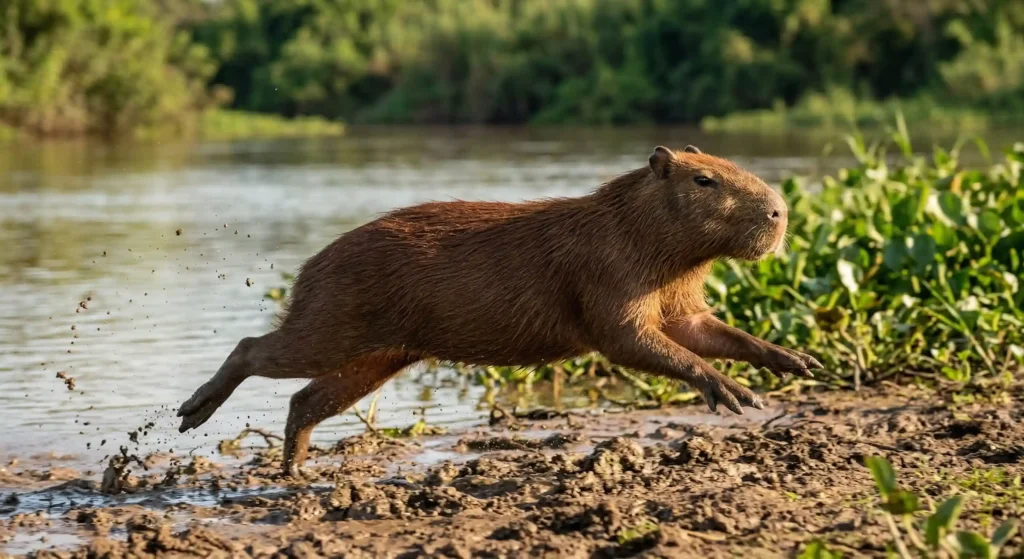
The Aquatic Advantage: Speed and Agility in Water
If land speed is the capybara’s emergency sprint, water is its true stronghold. The Capybara is not just capable in water—it is evolutionarily engineered for it. Understanding their aquatic performance reveals why wetlands are central to their survival strategy.
Swimming Speed and Efficiency
Average Swimming Speed
While precise measurements in the wild vary, capybaras typically swim at speeds estimated between 5–8 km/h (3–5 mph) in a steady glide. This may not sound extraordinary compared to marine mammals, but within freshwater ecosystems, this speed is more than sufficient for evasive maneuvers.
Their swimming style is smooth and energy-efficient. Instead of frantic splashing, capybaras use coordinated paddling with their partially webbed feet, keeping their bodies level and streamlined. This controlled propulsion allows them to conserve energy while maintaining steady movement toward safety.
Submerged Capabilities
One of their most powerful defensive tools is not just swimming—but disappearing.
Capybaras can hold their breath for up to five minutes when necessary. They often submerge their entire body, leaving only the nostrils exposed—or fully disappearing beneath the surface to avoid detection. In predator-rich habitats where jaguars or caimans patrol the banks, this ability can mean the difference between survival and capture.
Rather than outrunning danger indefinitely, they frequently outwait it.
Evolutionary Link: Built for a Semi-Aquatic Life
Capybaras are semi-aquatic mammals, and several anatomical features demonstrate this specialization:
- Partially webbed feet increase propulsion and control in water.
- A barrel-shaped body enhances Lightness..
- Eyes, ears, and nostrils positioned high on the head allow them to remain mostly submerged while still seeing, hearing, and breathing.
Capybaras have eyes, ears, and noses placed on top of their heads, which works like a natural periscope. This helps them stay mostly underwater while still watching their surroundings. This is very important for staying safe in areas with many predators.
Their body is designed for survival. They can move well on land to escape danger, but their strong swimming ability helps them stay safe in water.
Water as a Primary Escape Route
Strategic Use of Water
Rivers, marshes, ponds, and flooded grasslands are not just habitats—they are sanctuaries. Capybaras deliberately remain close to water sources at all times. In fact, their home ranges are structured around reliable aquatic access.Water provides:
- A refuge from terrestrial predators
- A cooling mechanism in hot climates
- A feeding zone rich in aquatic vegetation
A safe resting area with reduced exposure
Factors Influencing Capybara Speed
A capybara’s top speed is not a fixed number activated under all conditions. Understanding the variables in their speed provides a more accurate and scientifically grounded view of their true athletic capability.
Environmental and Terrain Considerations
Habitat Impact
Capybaras inhabit grasslands, riverbanks, marshes, and seasonally flooded savannas across South America. Each of these environments influences how efficiently they can run.
- Open grasslands: Allow higher burst speeds due to fewer physical obstacles.
- Wetlands and marsh edges: Favor quick acceleration toward water rather than prolonged sprinting.
- Dense vegetation: Reduces stride length and limits visibility, forcing more cautious movement.
Their running efficiency is highest in semi-open areas near water, where escape routes are clear and accessible.
Terrain Challenges
Unlike animals adapted for rocky or mountainous landscapes, capybaras are built for lowland ecosystems. Their performance changes depending on ground conditions:
- Uneven ground: Can reduce stride stability due to their heavy body mass and relatively short legs.
- Mud and waterlogged soil: While their broad, partially webbed feet help distribute weight, deep mud still decreases acceleration efficiency.
- Firm soil near riverbanks: Offers optimal traction for rapid bursts.
From a biomechanical perspective, their low center of gravity enhances stability, but excessive sinking into soft substrate increases energy expenditure and reduces top speed.
Differentiation Insight:
Capybaras are not universally fast across all terrain types. Their speed is context-dependent, optimized for the transitional zones between land and water where their survival strategy is most effective.
Physical and Biological Factors
Age and Health
As with most mammals, speed varies by life stage:
- Juveniles and young adults: Typically display faster acceleration and stronger muscular response due to peak muscle tone and joint flexibility.
- Older individuals: May show reduced burst capacity due to natural muscle mass decline and sloer neuromuscular response.
- Injured or ill animals: Experience significantly compromised speed and stamina.
Body Condition and Fitness
Capybaras are herbivores with high-fiber diets consisting primarily of grasses and aquatic plants. Their ability to maintain healthy muscle mass depends on:
- Nutritional quality of available forage
- Hydration levels
- Energy reserves
Adequate muscle density in the hindquarters is essential for explosive acceleration. Since they are not built for endurance, muscle power—not long-distance cardiovascular capacity—is the defining factor in their burst speed
From an anatomical standpoint, capybaras possess a muscular pelvic girdle and strong femoral structure that support short-duration, high-force output. Their skeletal alignment supports rapid extension but is not adapted for elongated, elastic running like that of predators. This distinction explains why their speed is effective in bursts but limited in duration.
Capybara Speed Compared to Other Animals
Capybaras are the largest rodents in the world, and size influences speed mechanics. Smaller rodents typically rely on rapid, darting movements, while larger ones favor short bursts of strength.
| Animal | Environment | Top Speed (MPH/KPH) | Notes |
|---|---|---|---|
|
Capybara
|
Land
|
20-22 MPH (32-35 KPH)
|
Short, explosive bursts for evasion
|
|
Capybara
|
Water
|
3-5 MPH (5-8 KPH)
|
Efficient swimmer, primary escape route
|
|
Human (Average Sprint)
|
Land
|
15-20 MPH (24-32 KPH)
|
Varies greatly by individual fitness
|
|
Jaguar
|
Land
|
~50 MPH (80 KPH)
|
Primary predator, much faster over short distances |
|
Anaconda
|
Land/Water
|
~1-2 MPH (1.6-3 KPH) on land, faster in water
|
Ambush predator, relies on stealth, not speed
|
|
Domestic Dog (e.g., Labrador)
|
Land
|
~20 MPH (32 KPH)
|
Comparable to capybara sprint
|
Dispelling Common Myths About Capybara Speed
This section directly addresses common myths using scientifically grounded data and behavioral analysis to separate perception from reality.
Myth 1: “Capybaras Are Inherently Slow and Clumsy.”
Reality: They Are Agile and Capable of Explosive Burst Speed
Verified data shows capybaras can reach land speeds of approximately 35 km/h (22 mph) in short bursts. This level of acceleration is impressive for an animal weighing up to 66 kg (145 lbs).
Their biomechanics include:
Strong hindquarters for propulsion
A low center of gravity for stability
A bounding gallop that increases stride efficiency
Rather than being clumsy, their movement is purpose-built for rapid escape within grasslands and wetlands. Their gait may look unusual compared to long-legged antelopes, but it is mechanically efficient for short-distance survival.
Conclusion: They are not slow—they are strategically built for burst acceleration, not endurance racing.
Myth 2: “They Are Only Fast in Water.”
Reality: They Excel in Water, But Their Land Speed Is Crucial
Capybaras are exceptional swimmers. They can move efficiently in water and hold their breath for up to five minutes. This often leads to the assumption that water is their only domain of speed.
In reality, their survival strategy depends on both environments.
On land: Burst speed creates immediate distance from ambush predators.
In water: Agility and submergence provide refuge and concealment.
Without sufficient land speed, they would not reliably reach water when threatened. Their terrestrial acceleration is the first phase of a two-step defense system.
Conclusion: Water enhances their survival—but land speed enables them to access that safety.
Commitment to Accuracy and Verified Data
Claims about animals are often exaggerated online. This article relies on verified zoological references, wildlife research data, and established ecological studies to ensure factual accuracy.
By prioritizing evidence-based information and fact-checking, we aim to replace assumptions with reliable insight. Capybaras deserve to be understood not just as calm social animals—but as highly adapted survivors.
Conclusion: A Perfectly Adapted Runner
When evaluating the speed of the Capybara, it becomes clear that raw numbers alone don’t define the full story.
On land, capybaras can reach impressive burst speeds of around 35 km/h (22 mph)—a surprising figure for the world’s largest rodent. In water, they transition from sprinter to specialist, demonstrating exceptional swimming ability, directional control, and the capacity to remain submerged when necessary.
But their speed was never meant to compete with apex predators in a straight-line chase.It was meant to serve a purpose.