
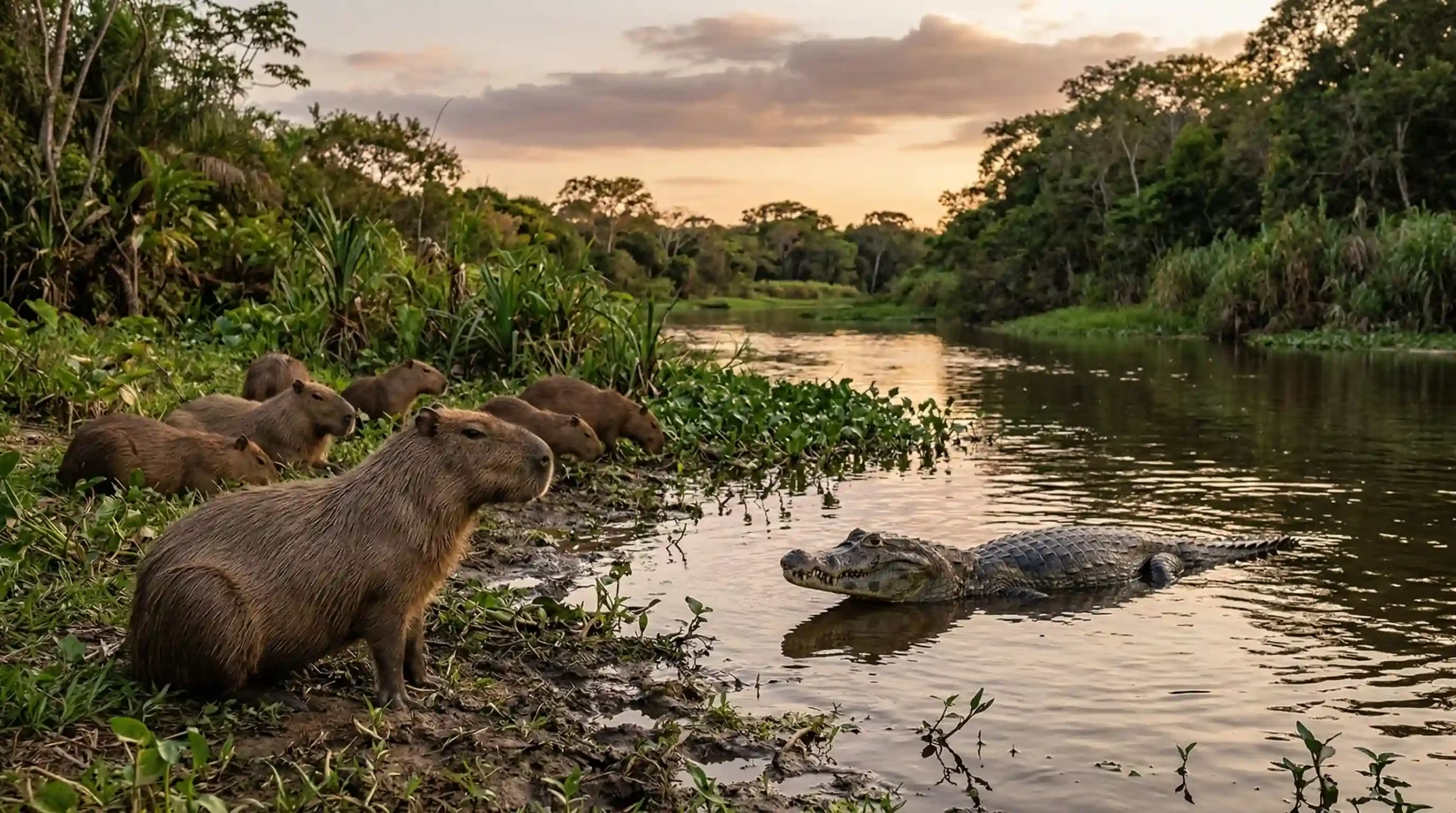
The internet is filled with photos showing crocodiles and capybaras together, sometimes even appearing to share food or relax side by side. This has sparked widespread curiosity: do these animals really coexist peacefully?or Are they friends?
On one hand, crocodiles are among the most powerful and fearsome predators in the animal kingdom; on the other, capybaras are known for their gentle and social nature. In the lush wetlands of South America (not South Africa), it’s common to see these two species near the same water sources. They seem to be friends but are they? In this article we will break myths about their relationship and get the facts to you. You also got the environmental effect on their relationship and all the interesting facts regarding their relationship.
Capybara: The World's Largest Rodent and Aquatic Ally
Before studying the relationship between these species of animal kingdom you must know about them. The first question that comes to my mind is who is capybara?
Who is Capybara?
Capybara is the largest rodent in the world with an average size of 50 – 62 cm while the adult capybara grows between 106 cm.Typically they gain weight around 65 kg. An interesting fact is that capybara is a semi aquatic and herbivore animal.
Their diet consists of grasses, aquatic plants, and other vegetation. Capybaras are native to South America. They inhabit areas near bodies of water like rivers, lakes, ponds, where they can be found in dense vegetation.
They are very social and polite nature animals found in groups.The Benefit of surviving in harsh environments make it more preferable as a pet. Yes, these cute animals can be your pets.
The Capybaras Survival Toolkit: How They Thrive Alongside Apex Predators:
Capybara is famous for temperament and the ability of semi -aquatic lifestyle. The question arises is can capybara breath under the water? How fast can capybara swim? These Question arise due to semi aquatic nature
Answer is : no capybara cannot breathe under the water; they rely on lungs like other mammals. Capybaras come to surface for inhaling oxygen then dive into the water
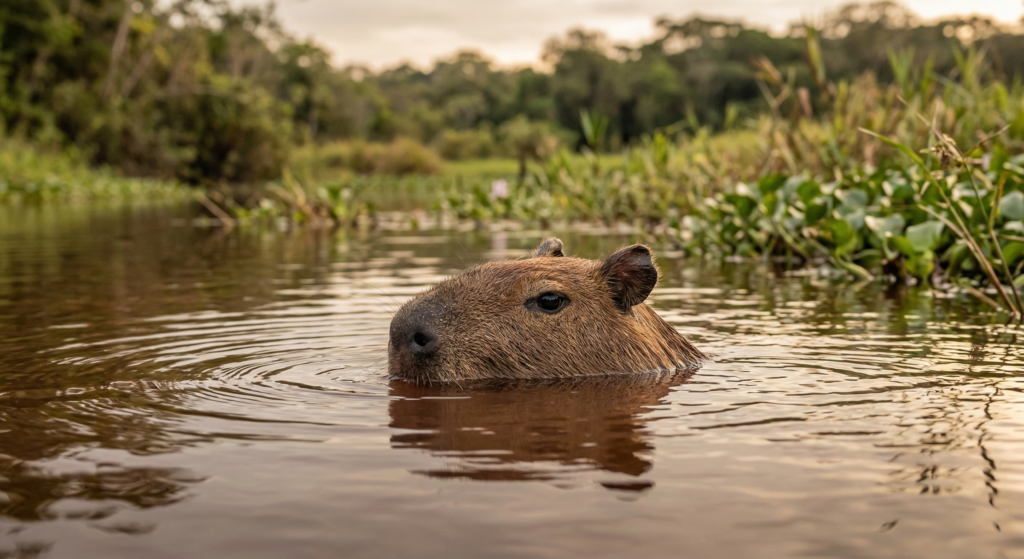
Some extra facts you might be want to know:
Capybaras are remarkably adapted to their semi-aquatic lifestyle, and one of their unique characteristics is their facial features which allows them to stay mostly submerged in water while still being able to see, hear, and breathe much like a hippopotamus or crocodileIt gives them a survival advantage, allowing for constant vigilance against predators while keeping a low profile.
Natural behaviours:
Capybaras have a high reproductive rate which plays a crucial role in maintaining their growth rate. They can reproduce up to twice a year under a suitable environment. Capybaras can run at speeds up to 35 kilometers per hour, which is approximately 22 miles per hour. Due to this adaptability they are faster than almost 70% of humans. These characteristics have proved their survival mechanisms against their predators.
Crocodilians: Apex Predators of the Waters
Crocodiles are found all over the world but they have very large populations among the south asia and africa regions. They are known as the apex predators of the water because they are the strongest predators among water species.
General Characteristics & Introduction
One of their defining features is their incredibly strong jaws, capable of delivering one of the most powerful bites in the animal kingdom. They also have semi aquatic life styles that is the strongest relation among capybara.Their eyes and nostrils are positioned on top of their heads, This feature is common between both animals allowing them to remain nearly invisible while lurking just beneath the water’s surface.
Globally they distributed among species like crocodiles, alligators,
Hunting Behaviour
Crocodiles rely on their strong nail-like teeth to hunt species like capybara. They have a strong bush to catch the food strongly. Their strategy of hunting completely relies on patience near the water despite off attacking strategy.When the opportunity arises, they strike swiftly, using their powerful jaws to seize and drag the prey into the water where it can be drowned and consumed.
Alligators vs. Crocodiles vs. Caimans: Key Distinctions
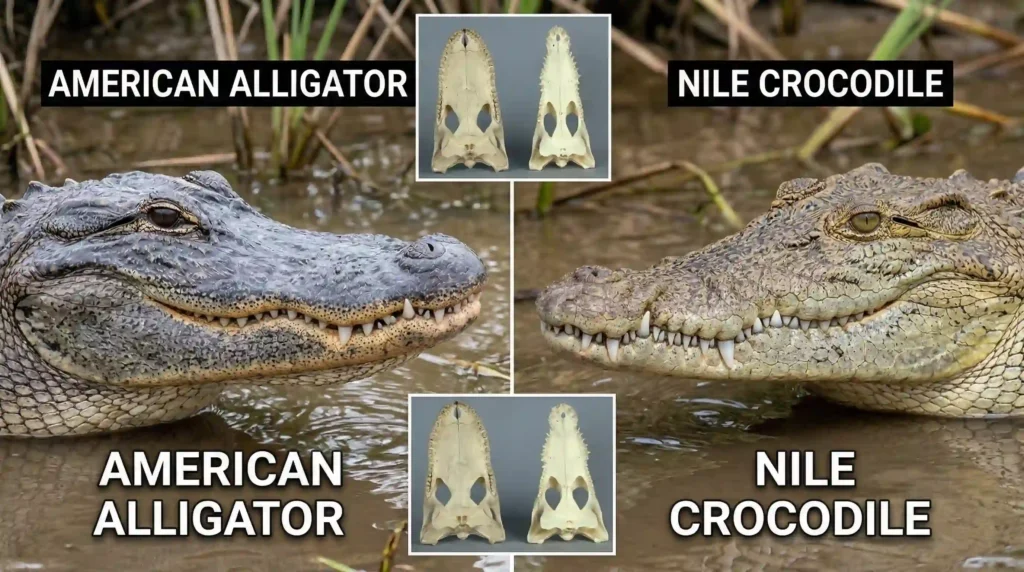
Alligators, crocodiles, and caimans are distinct species within the crocodilian family, One of the most noticeable distinctions is teeth size and shape. Alligators have U shaped teeth ideal for crushing prey like turtles,while crocodiles sport narrower, V-shaped snouts built for a wider variety of prey.Caimans, closely related to alligators, have a more rounded snout and are generally smaller.
Another difference is teeth visibility . crocodile teeths still shown when their jaws are closed.especially the large fourth tooth, while in case of alligator upper jaws overlap with lower hiding their teeth.. You can read more differences in below table:
| Feature | Alligator | Crocodile | Caiman |
|---|---|---|---|
|
Snout Shape
|
Broad, U-shaped
|
Narrow, V-shaped |
Rounded or slightly pointed |
|
Teeth Visibility (Mouth Closed) |
Upper jaw overlaps lower teeth; teeth not visible |
Upper and lower teeth visible; especially the 4th tooth
|
Some lower teeth may be visible
|
|
Habitat Preference
|
Freshwater (rivers, swamps, lakes)
|
Brackish & saltwater tolerant (coasts, estuaries)
|
Primarily freshwater (marshes, slow-moving rivers)
|
|
Geographic Range
|
USA (Southeast) and China
|
Africa, Asia, Americas, Australia
|
Central & South America
|
|
Size Range
|
Up to 13-15 feet (4.5 m)
|
Can exceed 20 feet (6 m) in some species
|
Generally smaller; up to 6.5–8 feet (2.5 m)
|
|
Aggression Level
|
Less aggressive, more tolerant of humans
|
More aggressive, especially when threatened
|
Moderately aggressive, varies by species
|
|
Coloration
|
Dark gray to black
|
Olive green to brown
|
Varies; often darker than alligators
|
Myth vs. Reality: Debunking Common Misconceptions
In the age of social media, some rumors spread without any proof. It has been widely spread that crocodiles do prey on Capybara but the reality is different.
Some species such as Caimans, do prey on capybaras. But other species are completely safe for them unless they have to fight for their food in their areas like in the lake.
Ecological Dance: Key Factors influencing Capybara-Crocodilian Interactions
Habitat Overlap: Where Worlds Meet
Geographically capybaras and crocodiles exist in the same region of South Africa, America, Australia, Brazil, Venezuela, Colombia, Argentina, and Panama. But primarily they are a breed of South Africa’s jungles.
Both of them love the aquatic environment due to their semi aquatic lifestyle. They primarily inhabit areas near water sources such as rivers, lakes, ponds, marshes, and swamps

Capybaras Aquatic Agility: An Evasion Strategy
Capybaras are not only social and calm by nature—they’re also highly adapted for life in and around water, which gives them a crucial survival edge. With webbed feet, dense bodies, and strong hind limbs, they move through water with surprising speed and agility, making it difficult for predators like crocodilians to catch them. One of their most effective defense strategies is to dive underwater and stay submerged for up to 5 minutes.Their eyes, ears, and nostrils are positioned high on the head, allowing them to observe their surroundings.
Crocodilian Hunting Strategies: The Ambush Predator
Crocodilians are the master ambush predators , they rely on patience and timing rather than speed. They wait for long hours under the water and strike a very perfect moment when prey gets distracted . However it is not the primary food source but capybaras stray from the group or injured can be an easy food for alligators, environmental dry changes can be a main reason for crocodiles’ attack on capybaras.
What Do Crocodiles Really Eat? Species-Specific Diets Explained
While crocodilians are all opportunistic predators, their diets vary significantly by species, size, and environment. Caimans primarily consume fish, aquatic birds, and small mammals, though larger individuals like the black caiman are capable of taking down larger prey, including capybaras—especially during the dry season. American alligators, native to the southeastern U.S., typically feed on fish, turtles, snakes, and small mammals, with adult capybaras being rare but possible prey On the other hand, apex predators like the Orinoco crocodile and black caiman possess powerful jaws and massive size, allowing them to target larger mammals like capybaras with more frequency, particularly in the Amazon and Orinoco basins.,
- Key facts: Understand that predator-prey relationships are dynamic and can vary based on geographic location, specific species involved, and environmental conditions.
Non-Predatory Interactions between Capybara and Crocodiles:
Capybara and crocodiles found calmly in amazon jungles. A capybara could peacefully stand among thousands of crocodiles. Although capybara is a prey and crocodiles are predators, in many situations they share water from the same river and walk alongside. According to a 2020 field report in the Journal of Tropical Ecology, these interactions are not signs of interspecies tolerance but rather contextual behavior shaped by opportunity, risk, and energy conservation.
In the age of social media, some rumors spread without any proof. It has been widely spread that crocodiles do prey on Capybara but the reality is different.
Some species such as Caimans, do prey on capybaras. But other species are completely safe for them unless they have to fight for their food in their areas like in the lake.
Comparative Analysis Table: Capybaras vs. Crocodilians
This table provides a quick, at-a-glance comparison of key attributes to compare the capybaras and the alligators of different species and how they relate with each other.. Research typical adult sizes, weights, and average lifespans for representative species (e.g., Yacare Caiman, American Alligator).
| Attribute | Capybara | Caiman (e.g., Yacare) | American Alligator |
|---|---|---|---|
|
Typical Size
|
Up to 4.3 ft (1.3 m) long, 150 lbs (68 kg)
|
4-8 ft (1.2-2.5 m) long, 20-120 lbs (9-54 kg)
|
10-15 ft (3-4.5 m) long, 500-1000 lbs (227-454 kg)
|
|
Diet
|
Herbivorous (grasses, aquatic plants)
|
Carnivorous (fish, birds, small mammals, some capybara)
|
Carnivorous (fish, birds, turtles, small mammals, occasional capybara)
|
|
Habitat
|
Wetlands, rivers, swamps, near water
|
Wetlands, rivers, swamps, lakes
|
Freshwater wetlands, swamps, rivers, lakes
|
|
Primary Defense |
Aquatic evasion, herd vigilance, speed |
Ambush hunting, powerful bite
|
Ambush hunting, powerful bite, territorial |
|
Social Structure
|
Highly social, live in groups
|
Generally solitary, but can congregate
|
Solitary, but may gather at feeding sites
|
|
Lifespan (Wild)
|
8-10 years
|
20-30 years
|
30-50 years
|
Conclusion
The end of the story is that the relationship between capybara and alligators is more intense than people think. They could be prey for alligators like caiman but this is an opportunistic hunt, although capybaras are not the primary food source for alligators.
In the jungles of Amazon a single capybaras peacefully stand among thousands of crocodiles. However prey and predators play an important role to balance the ecosystem. Wildlife isn’t just fascinating—it’s full of scientific insights. Keep asking questions, challenge assumptions, and explore the rich evidence-based stories behind every creature, big or small.
If you’re inspired to help, consider supporting organizations actively protecting these animals and their habitats read more from local zoological or ecological societies,Wetlands-focused conservation programs