
Introduction
Scroll through social media and you’ll see capybaras lounging on sofas, cuddling with cats, and nuzzling their owners like oversized guinea pigs. The message is irresistible: these gentle giants make perfect indoor companions. Search for “buy a capybara Florida” and you’ll find breeders ready to ship one to your door.
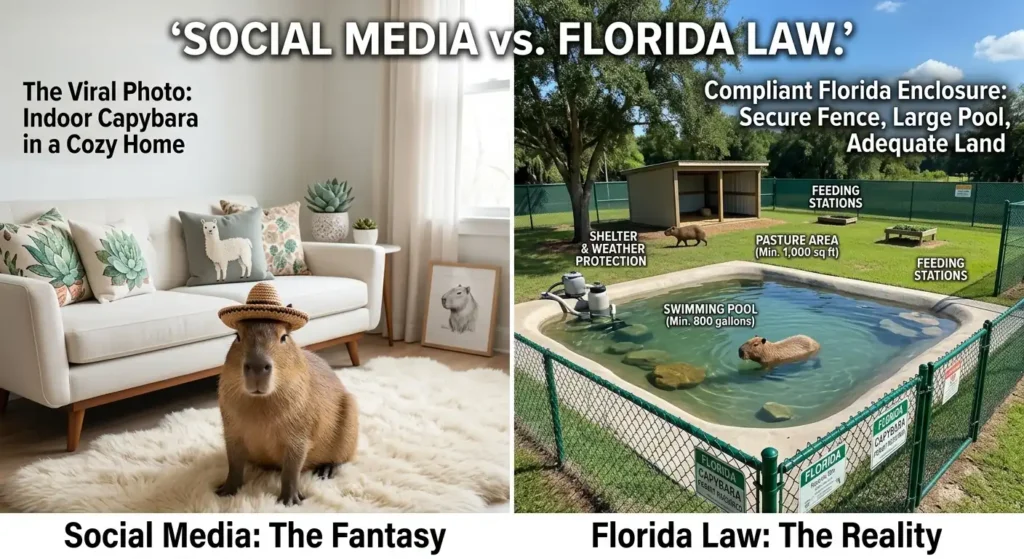
The reality waiting for you in Florida law is a cold splash of water. What those viral clips never show is the mandatory outdoor semi-aquatic enclosure, the county ordinance that bans them outright, or the HOA rule that overrides your state permit before you even apply. I’ve watched too many Florida residents fall into this gap between the online fantasy and the legal maze, and the consequences are immediate, expensive, and permanent.
KEY TAKEAWAYS
- State law allows capybara ownership only with a Class III wildlife permit, but county and city ordinances can override this permission entirely.
- You must build a compliant outdoor semi-aquatic enclosure before applying; indoor-only housing is illegal.
- Unpermitted possession is a second-degree misdemeanor carrying fines, confiscation, and potential jail time.
- Social media portrayals of capybaras as indoor pets are legally and biologically inaccurate for Florida compliance.
- HOAs, landlords, and local exotic bans often make legal ownership impossible even with state approval
The state’s wildlife agency, the Florida Fish and Wildlife Conservation Commission (FWC), classifies capybaras as Class III wildlife. On paper, that means you can own one with a permit. But that piece of paper is just the first layer of a permit trap. The state says yes, but your county, your city, your landlord, or your neighborhood association can say no: their no is final.
You can hold a valid FWC license and still face confiscation of an animal you’ve already paid thousands for, simply because your zip code makes ownership illegal.
Real Life Experience
In 2024, a Florida resident Oliver believed they had done everything right before purchasing a capybara from an out-of-state breeder. After researching the animal’s care requirements, securing a suitable outdoor enclosure, and spending several thousand dollars on the purchase and transportation, the buyer assumed ownership would be legal because capybaras are permitted in some parts of Florida.
The problem emerged only after the animal arrived. During a routine inquiry with local officials, the owner learned that while state regulations allowed possession under certain circumstances, their county had additional restrictions prohibiting capybaras as private pets. The discovery came too late: the animal was already living on the property, and the owner faced potential fines and enforcement action if they kept it.
With few options available, the resident was forced to find a licensed facility willing to take the capybara. The rehoming process proved both time-consuming and costly. In addition to losing the original purchase price, the owner absorbed transportation expenses, enclosure construction costs, veterinary fees, and surrender-related charges. Altogether, the financial loss amounted to several thousand dollars.
The experience highlights a common mistake among prospective exotic pet owners: verifying state laws without thoroughly checking county and municipal regulations. Exotic animal ownership rules often vary significantly between jurisdictions, and what is legal in one Florida county may be prohibited in another. For this owner, a single overlooked local ordinance transformed what was intended to be a unique pet ownership experience into an expensive and stressful rehoming process.
Key Takeaway: Before purchasing any exotic animal online, prospective owners should confirm legality at every level of government state, county, city, and homeowner association rules before committing to the purchase.
This guide exists to cut through the confusion. I’ll walk you through every layer of the compliance maze: the state permit, the enclosure standards, the local-level checks that most buyers never think to research. You’ll learn exactly what the FWC requires, what your county likely prohibits, and how to verify your property’s eligibility before you spend a dime.
The stakes are not theoretical.
Unpermitted possession of a Class III animal is a second-degree misdemeanor, punishable by up to 60 days in jail and a $500 fine (as of publication), plus the seizure of the animal. And that’s just the legal penalty; the cost of scrambling to build a compliant enclosure or rehome a capybara you can’t legally keep will run far higher.
To understand why the answer isn’t simple, you first need to grasp the basic state classification, and why it doesn’t tell the whole story.
Immediate Legal Status: Yes, But Only with a Class III Permit
Before diving into paperwork, you need to understand the foundational legal classification that shapes everything else. Capybaras are designated as Class III wildlife in Florida, a category that makes personal possession legal only when you hold a state-issued Captive Wildlife License. No license, no capybara. That much is straightforward. But the moment you start pulling at that thread, the simplicity unravels.
The governing regulation is now Florida Administrative Code Rule 68A-6.004, which replaced the older 68A-6.0022. If you are reading outdated guides or forum posts, you are already working with the wrong rule. The current code is what the FWC enforces, and it is your only reliable reference.
|
A state permit, however, does not grant you immunity from local government authority. Florida does not preempt municipal codes on exotic animal ownership. Counties and cities across the state have enacted their own ordinances, and many of them ban or severely restrict capybara possession outright. Your state-level authorization can be completely nullified by a local law you never thought to check.
Even at the state level, the permit is not a blanket approval. It is a conditional license.
The FWC requires you to prove that your capybara came from a USDA-licensed breeder, with captive-bred documentation that traces its origin. You must also meet enclosure standards that reflect the animal’s semi-aquatic nature, a requirement that goes well beyond a fenced yard. These conditions turn the permit into something you earn through compliance, not something you simply receive.
This is where the trap tightens. Holding a valid Captive Wildlife License can create a false sense of compliance because the state said yes. But if your county or HOA says no, you are still violating the law. A second-degree misdemeanor charge does not care that Tallahassee approved your paperwork
FWC Class III Permit: Your Step-by-Step Guide
Assuming your locality allows it, obtaining the state permit is the next hurdle. The Florida Fish and Wildlife Conservation Commission (FWC) calls this a Class III Personal Pet Permit. It is a document that says you may keep a capybara at a single, specific address. The application is free. The real price is paid in months of preparation, paperwork, and a property built to satisfy an inspector who has seen every shortcut.
Step 1: Understand the Permit Category
Class III wildlife covers species the state considers unlikely to threaten public safety but still subject to oversight. Capybaras fall here, alongside animals like sloths and certain small primates. That classification is not a casual endorsement. It is a gate.
You are not applying for a commercial breeding license or an exhibition permit.
A Personal Pet Permit means you keep the animal for non-commercial purposes, at home, and you are personally responsible for meeting every caging standard the FWC writes into rule 68A-6.004.
The permit is tied to the physical address you list on the application. Move to a new house, and you must reapply from scratch. That permanence matters because it forces you to build the enclosure where you live now, not where you might live later. If you rent, expect the FWC to ask for proof that the property owner consents to a semi-aquatic rodent the size of a large dog living on the premises.
Step 2: Prepare Your Documentation
Before the FWC will schedule an inspection, you must submit a packet that proves three things: you know what you are doing, the animal was born in captivity, and a veterinarian has agreed to treat it. This is where most applications stall.
Proof of experience can take several forms. A log of hours spent volunteering at a licensed facility that houses capybaras is strong. Letters from recognized keepers attesting to your hands-on care carry weight. The FWC is not asking for a degree. They are asking for evidence that you have fed, watered, and handled a 100-pound rodent without incident.
The captive-bred documentation is non-negotiable. You need a certificate or a bill of sale from a USDA-licensed breeder that states the animal’s date of birth, the parents’ identification, and the facility’s license number. Without this, the FWC will not process your application. The state has zero tolerance for wild-caught capybaras. A missing or questionable pedigree is a fast track to a denial.
The veterinary commitment letter must come from a Florida-licensed veterinarian who agrees to provide care for the animal. This is not a generic wellness pledge. The letter should acknowledge the species specifically and confirm the vet’s willingness to treat it. Most small-animal clinics will decline. You need a vet with exotic mammal experience.
|
|
Step 3: Design and Build the Enclosure to FWC Standards
FWC caging requirements are detailed in the administrative code. They are not suggestions you can negotiate after the fact. The inspector will measure. They will check water quality. They will push on the fence. Your job is to have everything finished before they arrive.
A compliant capybara enclosure must provide generous land area, a pool deep enough for full submersion, perimeter fencing that prevents escape, and a shelter that protects from Florida’s heat and storms. The land area should be at least 200 square feet per animal, a practical minimum that satisfies the spatial requirement.
The pool should be three feet deep or more, with a gradual entry so the animal can wade in and out safely. Fencing must be a minimum of six feet high, constructed of a material the capybara cannot climb or chew through.
A dig barrier extending two feet below ground level is mandatory because these animals are competent excavators.
Shade is not decorative. It is a survival requirement in Florida’s climate, and the shelter must be weatherproof, well-ventilated, and large enough for the capybara to turn around and lie down comfortably. Drainage is another silent pass-or-fail item. Standing water around the enclosure signals poor planning and can lead to rejection.
|
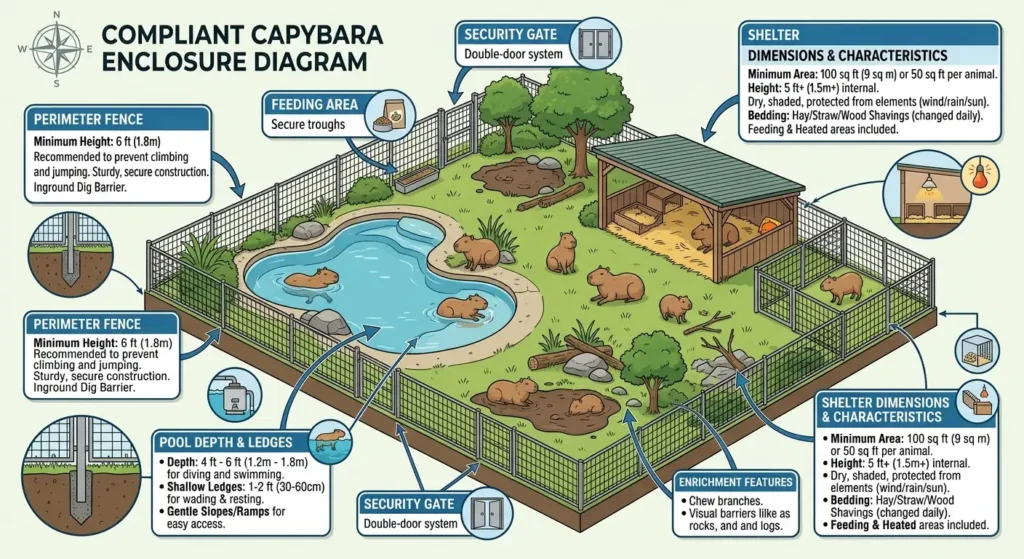
And here is the rule that trips up well-intentioned owners: the enclosure must be fully built and compliant before the FWC inspection, not after. You cannot schedule the inspection and then finish the fence over the weekend. The inspector will walk onto your property expecting to see a finished, functioning habitat. If it is not ready, the application goes back to the bottom of the pile.
Step 4: Submit the Application and Schedule Inspection
The application itself is straightforward. You download the Personal Pet Permit form from the FWC website, attach your documentation packet, and submit it to the regional office that covers your county. There is no fee for the application. That zero-dollar line item is deceptive. By the time you have built the enclosure and assembled the paperwork, you will have invested thousands of dollars and countless hours.
Once the FWC accepts your paperwork as complete, they will contact you to schedule an on-site inspection. This is a mandatory step. The officer will verify that the enclosure matches the specifications you described, that the locks are secure, the water is clean, the dig barrier is intact, and that the shelter is adequate. They will also confirm that the address matches the permit application and that the animal will be housed there permanently.
The permit, once issued, is not a license to roam. It authorizes you to keep the capybara at that address and to travel with the animal under certain conditions. Transport requires a secure carrier and a copy of the permit on hand. It does not authorize you to take the capybara to a park, a pet store, or a friend’s house for a visit. The permit is a leash on your location, not a passport.
Step 5: Obtain the Capybara from a Licensed Source
The final step is acquiring the animal itself. Florida law requires that the capybara comes from a USDA-licensed breeder. That license number must appear on the captive-bred documentation you submitted. A social media post offering a “hand-raised baby” from an unlicensed backyard breeder is a trap. The FWC will not accept that animal’s paperwork. You risk permit denial, and you could end up with a wild-caught capybara, which is illegal to possess in Florida.
|
Retain every document. The breeder’s invoice, the health certificate, the transport records. Keep them with your permit. If the FWC ever questions the animal’s origin, you will need to produce that chain of custody. A missing link is a second-degree misdemeanor waiting to happen.
However, holding that state permit is meaningless if your county disagrees.
The County & City Trap: Where State Law Stops
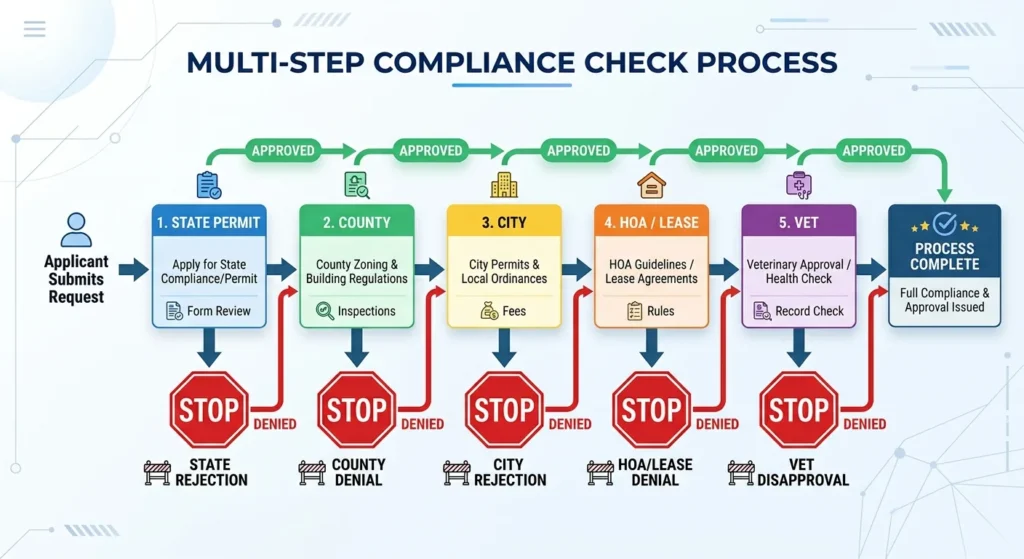
This is where most aspiring owners fail: state permission does not override local prohibition. You can hold a valid Class III wildlife permit from the FWC, complete with a pristine enclosure inspection, and still find yourself in violation the moment a code enforcement officer knocks.
Florida’s regulatory structure is a layered patchwork, and the state’s green light means nothing if your county, city, or even your neighborhood association has thrown up a red one. The result is a permit trap that catches people who assume state law is the only law.
How to Check Your Local Laws About capybara?
Verifying local legality must happen before you spend a dollar on a breeder or an enclosure. The process is tedious but non-negotiable.
Start with your county’s municipal code, which is typically published online through a database like Municode or General Code. You will search for terms such as “exotic animal,” “wildlife,” “capybara,” or “Class III.” Do not stop at the word “capybara.” Many ordinances use blanket language that prohibits “non-domesticated mammals” or “animals requiring a state wildlife permit,” which silently captures capybaras without naming them.
After the county, repeat the search for your city. A county may permit capybaras while a city within that county bans them, or vice versa. The jurisdiction with the stricter rule will control. If you find ambiguous language, call the city or county clerk’s office directly and ask for a written determination. Verbal assurances are worth nothing if enforcement comes later.
|
|
The consequences of skipping this step are severe. A violation can lead to animal confiscation, fines, and even a second-degree misdemeanor charge, depending on the local ordinance. Some jurisdictions treat an illegal exotic pet as a public safety issue, and they do not grandfather existing owners.
You will not be granted time to rehome the animal voluntarily; it will be taken, and you may be prohibited from owning wildlife in the future.
Major Florida County & City Risk Highlights
The regulatory stance varies dramatically across Florida. Some counties have explicitly banned capybaras, others require a separate local permit, and a few remain silent, which often defaults to the state permit being sufficient. The table below summarizes the landscape for several of Florida’s most populous counties, based on municipal codes as of this writing. Treat this as a starting point, not a final answer.
County | Regulatory Stance | Notes |
Miami-Dade | Likely Prohibited | County code prohibits “wild animals” including capybaras; no exceptions for state permit holders. |
Broward | Likely Prohibited | Ordinance classifies capybaras as prohibited exotic wildlife; enforcement is active. |
Palm Beach | Requires Local Permit | Requires a separate county permit for certain exotic animals; capybaras may fall under this if not explicitly listed. |
Hillsborough | Generally Allowed with State Permit | No county-wide ban; state Class III permit is typically sufficient, but check city codes within the county. |
Orange | Generally Allowed with State Permit | Similar to Hillsborough; local municipalities may have stricter rules, especially in urban zones. |
Pinellas | Likely Prohibited | County ordinance restricts ownership of non-domesticated mammals; capybaras are not exempted. |
Duval | Requires Local Permit | Jacksonville’s consolidated government requires a local permit for wild animals, which includes capybaras. |
Lee | Generally Allowed with State Permit | No county-level prohibition, but Cape Coral and other cities may have separate rules. |
|
Even within a “Generally Allowed” county, pockets of prohibition exist. A city like Miami Beach or Coral Gables inside Miami-Dade may add its own layer. Never assume a county’s stance covers the city you live in. This is the grind of multi-jurisdictional compliance, and it is where many well-intentioned owners get tripped up.
HOA and Lease Restrictions: The Hidden Barrier
Private governance can undo everything the state and local government allow. Homeowners’ associations and landlords hold contractual power that no wildlife permit can override.
An HOA covenant that prohibits “livestock,” “exotic pets,” or “animals not customarily kept as household pets” will almost certainly be interpreted to include a capybara. A single neighbor complaint about odor or noise can trigger a violation notice, and the association can demand removal of the animal regardless of your FWC permit.
|
The legal reality is blunt: an HOA is not a government entity, so constitutional protections against unreasonable searches or seizures do not apply in the same way. If you violate a covenant, the HOA can fine you, place a lien on your property, and ultimately force the animal’s removal through civil court.
Renters face even less protection. A lease violation can lead to eviction, and no landlord will risk their property for your capybara. You cannot argue state preemption here; private contracts are a separate legal universe.
This layered gauntlet of county, city, and private restrictions is where the social media dream of a capybara as a backyard pet shatters against reality. The permit from Tallahassee is just one piece of paper. Without local and contractual clearance, it is worthless. But legal permission is only half the battle; the animal’s biological needs create additional legal requirements.
Capybara Biology & Housing: Why Permits Demand More
FWC’s strict caging standards exist because capybaras are not domesticated pets. They are wild rodents whose biological programming demands a specific set of conditions that a typical Florida living room simply cannot provide. Ignoring these needs does not just risk a denied permit. It creates an animal welfare crisis that unfolds in slow motion, behind closed doors.
Capybaras are semi-aquatic by nature, a term that defines their entire existence. Their skin requires constant moisture to prevent cracking and infection. Without a permanent body of water deep enough for full submersion, they cannot thermoregulate in Florida’s heat. A kiddie pool or a bathtub is not enough.
These animals need to swim, defecate in water, and use it as a refuge from perceived threats. Depriving them of this leads to chronic stress, skin lesions, and a weakened immune system. The viral videos of a capybara lounging on a sofa miss the reality: that same animal, if kept indoors without a large, filtered pool, will deteriorate rapidly.
Semi-Aquatic Requirements
The FWC’s cage specifications for Class III wildlife are not arbitrary paperwork hurdles. They translate biological imperatives into measurable standards. A capybara’s pool must be large enough for the animal to submerge completely and turn around. This isn’t a luxury. It’s the baseline for skin health and behavioral normalcy.
In the wild, capybaras spend a significant portion of their day in water to avoid predators and regulate body temperature. A captive environment that fails to replicate this forces the animal into a state of perpetual discomfort.
The water quality itself becomes a major undertaking. A stagnant pool breeds bacteria that cause eye and skin infections. You will be managing a filtration system, monitoring pH, and cleaning waste daily, tasks that dwarf the effort of caring for a dog or cat.
Social Structure: You Need More Than One
A single capybara is a welfare failure waiting to happen. These animals live in stable social groups in the wild, relying on constant communication and physical contact. Isolation triggers anxiety, stereotypic behaviors like pacing, and even self-harm. FWC permit reviewers are increasingly aware of this. While the regulation may not explicitly state “you must own two,” an application that proposes housing a solitary capybara can be denied under general welfare provisions.
A solitary capybara is a stressed capybara, and that stress will manifest in ways that draw the attention of neighbors, animal control, and ultimately the FWC.
|
Space and Enrichment
Minimum cage dimensions are just that: a floor, not a ceiling. Capybaras are grazers. Their digestive systems are designed for near-constant consumption of grasses and aquatic plants. A barren enclosure with a patch of sod will be stripped bare in days, leading to malnutrition and boredom.
You need a rotation system for grazing areas, or a steady supply of fresh browse. Enrichment goes beyond a floating toy. It means varied terrain, hiding spots, and substrates that allow natural behaviors like wallowing. The cost of constructing a predator-proof, escape-proof enclosure that meets these needs often runs into the tens of thousands of dollars.
That’s before you factor in ongoing water and electrical costs.
|
Diet and Veterinary Care
Feeding a capybara is not a matter of tossing in a bowl of rodent pellets. They require a specialized herbivore diet high in fiber and low in sugars, with careful attention to vitamin C levels. A deficiency leads to scurvy, a common but entirely preventable disease in captive capybaras.
Dental health is another critical concern. Their teeth grow continuously, and without proper forage to wear them down, malocclusion sets in, making eating painful or impossible.
Finding a veterinarian qualified to treat these issues is a challenge in itself. Most small-animal clinics will not see a 100-pound rodent. You need a board-certified exotic veterinarian, and you need to have that relationship established before an emergency, not during one.
|
Failing to meet these standards isn’t just bad welfare. It’s a legal violation with serious consequences
Penalties & Risks: What Happens If You Skip the Capybra Permit
Skipping permits or cutting corners on housing leads to specific, severe penalties. Unpermitted possession of a capybara in Florida is a second-degree misdemeanor, a criminal charge that carries up to 60 days in jail and a fine that can reach hundreds of dollars per offense. This is not a traffic ticket. A conviction creates a permanent record, and each day of illegal possession can be treated as a separate violation, multiplying the exposure.
The Florida Fish and Wildlife Conservation Commission (FWC) does not issue warnings for Class III wildlife violations. Officers can immediately confiscate the animal. Where it goes next depends on whether a permitted facility has space. If no sanctuary, zoo, or licensed rehabilitator can accept the capybara, euthanasia is a real outcome. The animal pays the price for the owner’s failure to comply.
Civil penalties stack on top of criminal liability. FWC can impose additional fines and, critically, can permanently disqualify you from ever obtaining a Captive Wildlife License or any future wildlife permits. That door closes for life. For someone who dreams of working with exotic animals, one shortcut erases the possibility.
Liability for damage or injury falls entirely on the owner. A capybara’s teeth can cause serious wounds, and its size makes it capable of knocking over a child or an elderly person. Standard homeowner’s insurance policies almost universally exclude exotic animal incidents. If your capybara injures someone or destroys property, you face out-of-pocket costs. Medical bills, legal fees, and repairs come with no coverage.
|
Understanding these risks also means understanding the legal distinctions between different types of capybara possession. Not every capybara in Florida falls under the same rules, and confusing them can lead straight into the permit trap.
Wild, Captive-Bred, or Cafe Animal? Legal Distinctions
Recent news about wild sightings and viral cafes has blurred important legal categories, making it easy to assume that a capybara is just a capybara. Florida law sees it differently. The moment you decide how you’ll interact with the animal, you step into one of several distinct regulatory boxes: each with its own permit class, local entanglement, and enforcement posture.
Getting this wrong doesn’t just mean a rejected application. It can convert a lawful pet into an illegal exhibition overnight, voiding your permit and exposing you to the penalties covered in the previous section.
The table below maps the four most common contexts a Florida resident might encounter. Use it to pinpoint exactly where your situation falls before you spend a dollar or make a single phone call.
Context | State Permit Type | Local Law Interaction | Key Requirement |
Private pet (captive-bred) | Class III Wildlife Permit (personal use) | County ordinance and HOA rules can ban capybaras outright, regardless of state permit; must verify local zoning and deed restrictions before applying. | Captive-bred documentation from a USDA-licensed breeder; semi-aquatic enclosure that meets FWC’s caging standards. |
Wild capybara (sighted in Florida) | None: capture or possession is illegal | N/A (state law prohibits taking from the wild) | Report the sighting immediately to the FWC via the Ive-Got1 hotline at 1-888-483-4681 or the FWC Reporter app. |
Exhibition (capybara cafe, mobile zoo) | Captive Wildlife License (Class III for exhibition) or a separate commercial exhibition permit | County business license, zoning for animal exhibition, and public safety ordinances apply; some counties ban commercial exotic animal display entirely. | Insurance, facility inspection, public barrier requirements, and a clear separation from any personal-use permit; no private-pet loophole exists. |
Sanctuary or rescue possession | Captive Wildlife License with sanctuary/rescue designation; often requires documented non-profit status | County land-use and special exception requirements for non-profit animal facilities; may face stricter local oversight than a private residence. | Non-profit incorporation, no breeding, no commercial activity, and enhanced caging standards that exceed personal-pet minimums. |
The wild-caught column is the simplest: if you see a capybara in a Florida canal or retention pond, you cannot trap it, keep it, or rehome it yourself. The FWC considers all free-roaming capybaras to be unauthorized exotic wildlife, and the only legal action is to report the animal through the Ive-Got1 hotline or the Reporter app. Doing anything else risks a misdemeanor charge for illegal possession of a Class III species.
The private-pet path, by contrast, is the one most people researching “capybara ownership Florida” believe they’re on. A captive-bred capybara kept solely for personal enjoyment, with no public interaction of any kind, falls under a personal-use Class III permit. But the permit is only half the battle; local law can slam the door even after the state says yes. That’s the “permit trap” at work.
The exhibition category is where well-meaning owners get into the most trouble. The moment you charge admission, accept a “donation,” or let strangers pet your capybara at a birthday party or pop-up event, you’ve moved into commercial exhibition. Florida’s licensing staff draw a hard line here: the transaction itself, not the dollar amount, triggers the reclassification.
That single interaction can void your personal-use permit on the spot, leaving you without any valid authorization while the animal is still in your possession. The state’s logic is simple: any form of public interaction for compensation, no matter how casual, makes you an exhibitor. And exhibitors must carry insurance, pass facility inspections, and meet public-safety requirements that a private keeper never signed up for.
Sanctuaries and rescues occupy a fourth, often misunderstood space. Even a genuine, non-commercial rescue must operate under a Captive Wildlife License with a sanctuary designation, which typically demands non-profit status and a ban on breeding and commercial activity. The caging standards are higher, and local governments frequently treat a sanctuary as a distinct land use, not a residential pet setup. You can’t simply declare yourself a rescue and bypass the personal-pet rules.
With these distinctions clear, you can now assess your actual eligibility. The next section walks you through a self-assessment checklist that tests whether your home, your local government, and your lifestyle can support a legal capybara before you ever contact a breeder.
Am I Actually Allowed? Self-Assessment Checklist
Before spending any money, use this checklist to verify feasibility.

Social media videos make capybara ownership look effortless, but the regulatory and care realities are unforgiving. This checklist forces a hard look at the prerequisites before you spend a dollar. Print this page, check the boxes, and keep it as your reality check.
The state’s Class III permit is only one layer; county codes and HOA covenants can override it, so the first two items are the real gatekeepers.
Run through each item honestly. A single “no” or “I’m not sure” means you should pause. Skipping any step could lead to a misdemeanor charge, or an animal that suffers in inadequate conditions. Only a full set of confident “yes” answers clears the path to ownership.
- My county and municipal zoning laws explicitly permit capybara ownership on my property.
- My homeowners’ association or community association rules do not prohibit exotic animals.
- I meet all FWC Class III permit eligibility requirements (age, no recent wildlife violations, etc.).
- I can provide a secure semi-aquatic enclosure that meets the species’ space and water needs.
- I have the financial resources and daily time commitment to support a capybara’s lifelong care.
If you can honestly check every box, you’re ready to confront the social media myths that lead others astray, and the next section will arm you with the facts to do exactly that.
Myth-Busting: TikTok vs. FWC Reality
Social media creates dangerous misconceptions that drive illegal ownership. A fifteen-second clip of a capybara lounging on a couch erases the reality of Florida’s wildlife code. Before you even glance at a breeder’s website, you need to see through the four most persistent myths that land well-meaning people in legal trouble.
Myth 1: ‘Capybaras are just big guinea pigs, they can live inside like a dog.’
The image is harmless: a capybara curled up on a bath mat, maybe wearing a tiny hat. The reality is a semi-aquatic enclosure requirement that no apartment or suburban living room can meet. Capybaras are herd animals that depend on constant access to water deep enough to submerge in, not just a kiddie pool.
They defecate in water to maintain hygiene, meaning that indoor setup would become a biohazard within hours. An FWC-compliant enclosure must provide a pool or pond with a filtration system, a grazing area, and shelter from the Florida sun. This is not a pet that can be house-trained; it’s a wild animal whose welfare collapses without an outdoor, water-centric habitat.
If you can’t build a purpose-built semi-aquatic enclosure, you cannot legally or ethically keep a capybara.
A viral video never shows the daily labor of draining, scrubbing, and refilling that water source, nor the herd of at least two animals that the species’ social nature demands.
Myth 2: ‘I saw a capybara cafe in Florida, so I can just get one as a pet.’
Those cafes operate under a commercial exhibition license, often tied to a USDA-licensed facility. That license is not a personal pet permit.
It authorizes public interaction for educational or entertainment purposes, subject to strict biosecurity and liability insurance requirements that an individual homeowner cannot replicate. When you see a capybara in a cafe, you’re looking at a business asset, not a companion animal.
The owner is not cuddling that animal on their sofa after hours; they are maintaining a regulated exhibit.
Applying for a Class III wildlife permit as a private individual puts you in an entirely different legal category, one that does not allow you to charge admission or bypass local zoning. Confusing the two is a fast track to a second-degree misdemeanor.
Myth 3: ‘If I get a state permit, my county can’t stop me.’
This is the heart of the permit trap. A Class III wildlife permit from the FWC authorizes you to possess the animal under state law, but it does not preempt stricter local ordinances. Florida grants counties and municipalities the power to ban exotic animals outright, and many do. Even if you secure your state permit, a county code enforcement officer can still fine you or order the animal removed.
Then there’s the HOA layer. A private covenant restricting livestock or exotic animals will nullify your state authorization on that property. You can hold a valid FWC permit in your hand and still be in violation of three layers of local governance. The state permit is necessary but never sufficient on its own.
Myth 4: ‘Wild capybaras are showing up in Florida, so it’s okay to catch one and keep it.’
Wild capybaras spotted in Florida are an invasive species, likely escaped or released from captivity. They are not a free pet. It is illegal to capture, possess, or transport any wild capybara without explicit FWC authorization. Doing so is not a loophole; it is a second-degree misdemeanor. If you see one, you are required to report the sighting to the FWC’s Exotic Species Hotline. The state’s goal is removal or control of the population, not adoption.
Even if you could somehow obtain a permit later, a wild-caught animal lacks the captive-bred documentation required for legal possession. That animal carries unknown disease risks and will never adapt to a captive environment without extreme stress. The only legal path to ownership is through a USDA-licensed breeder who provides that documentation up front.
For specific quick questions that cut through the remaining confusion, consult the FAQ below.
Frequently Asked Questions
Addressing the most common real-world scenarios.
Can I own a capybara in Florida without a permit?
No. Capybaras are classified as Class III wildlife in Florida, and possession of any Class III animal without a valid Captive Wildlife License from the Florida Fish and Wildlife Conservation Commission (FWC) is illegal.
Even a single animal kept as a pet falls under this requirement. Unpermitted possession is a second-degree misdemeanor, and ignorance of the law or social media trends is not a defense.
The permit is the baseline; it does not guarantee you can legally keep the animal at your specific address.
I’m moving to Florida with my pet capybara. What do I need?
Florida does not offer reciprocity for wildlife permits issued by other states. You must apply for a Florida Class III Captive Wildlife License before bringing the animal into the state.
Additionally, you will need captive-bred documentation from a USDA-licensed breeder proving the animal was legally acquired, as the state prohibits the possession of wild-caught capybaras. Do not assume that a permit from your previous state will be honored upon arrival.
Start the application well in advance of your move to avoid a gap in legal standing.
|
Do I need a permit for just one capybara?
Yes. The Class III permit requirement applies regardless of how many capybaras you own. There is no “pet exemption” for a single animal. In fact, keeping only one capybara raises a separate, serious welfare concern.
Capybaras are highly social animals that live in groups in the wild. A solitary capybara, even with abundant human attention, often develops stress-related behaviors and health issues.
Responsible ownership, the goal the permit system is meant to encourage, practically demands keeping at least two compatible individuals. That doubles the space and care requirements.
Can my HOA really stop me if the state says it’s legal?
Absolutely. A Class III permit from the FWC grants you state-level authorization, but it does not override private contracts or local ordinances. Homeowners’ associations (HOAs) enforce covenants that frequently prohibit livestock or exotic animals. Capybaras are almost always included in those definitions.
Similarly, many Florida counties and municipalities have their own codes banning Class III wildlife within their jurisdictions, even if the state permit is in hand. State permission is hollow if your county or HOA says no. You must check both layers before investing in an enclosure.
Neither the FWC nor the permit will shield you from fines or a lawsuit from your association.
What happens if I’m caught with an unpermitted capybara?
Enforcement is complaint-driven. If a neighbor, a veterinarian, or an HOA reports you, an FWC officer can investigate. A first offense for unpermitted possession of Class III wildlife is a second-degree misdemeanor, carrying up to 60 days in jail and a $500 fine.
More critically, the animal will be seized and likely rehomed to a licensed facility. You will bear the costs of that seizure. A criminal record, even for a misdemeanor, can complicate future permit applications and may affect your housing or employment. The risk is not hypothetical.
FWC officers do respond to these reports.
Are capybara cafes legal in Florida?
No, not in the sense of a public, walk-in café where patrons handle or feed capybaras. Those operations require a commercial exhibition license. This is a separate, far more stringent category under FWC regulations. A personal Class III permit does not authorize public interaction.
Any facility charging admission for capybara encounters must meet extensive caging, insurance, and safety standards. The few legitimate wildlife education centers that house capybaras operate under these commercial permits, not as casual cafés.
If you see a social media post promoting a Florida capybara café, it is either an illegal operation or located in another state.
How much does it cost to own a capybara in Florida legally?
The purchase price of a captive-bred capybara, often a few thousand dollars, is the smallest part of the total cost. The real financial commitment lies in building and maintaining a compliant semi-aquatic enclosure. You need a securely fenced outdoor area with a pond or large pool, filtration, and year-round temperature control, costs that routinely run into five figures.
Annual expenses include the FWC permit renewal fee, specialized veterinary care from an exotic animal practitioner, a diet of fresh produce and hay, and ongoing water and electrical costs. When you factor in the need for a second animal to meet social welfare needs, the first year of legal, ethical ownership commonly exceeds $15,000 as of publication, and annual maintenance adds several thousand more.
This is not a budget pet.
Expert Insights & Legal Disclaimer
This guide synthesizes current legal frameworks and expert consultation. I’ve personally navigated the Class III wildlife permit process in Florida, and that hands-on experience grounds every recommendation you’ve read here. The regulatory landscape isn’t just a stack of forms. It’s a living set of hurdles that shift from county to county, and I’ve seen how easily a well-intentioned owner can stumble.
The analysis you’ve just worked through rests on a foundation of primary sources: Chapter 68A-6 of the Florida Administrative Code, FWC’s Captive Wildlife Critical Incident and Operational Guidelines, and dozens of municipal code databases from across the state. Every legal threshold and permit requirement described here traces back to those documents.
|
Still, this article is informational, not legal advice. The statutes and local ordinances that govern capybara ownership are subject to change, and only a qualified attorney who reviews your specific property, county, and HOA covenants can give you a definitive answer. I’ve worked with an exotic mammal veterinarian who reinforced that capybaras are not casual pets.
Their semi-aquatic, social, and dietary needs demand a level of husbandry that most households simply cannot provide, and the welfare consequences of getting it wrong are severe. That veterinary perspective informs the enclosure and care standards I’ve emphasized throughout.
Before you take another step, verify everything independently. Call your county’s animal control office and ask for the current exotic animal ordinance by name. Contact the FWC’s Captive Wildlife section directly to confirm that a Class III permit remains the correct path for capybaras. These two phone calls will protect you from the permit trap more reliably than any written guide ever could.
1 thought on “The Legal Reality of Owning a Capybara in Florida: What Social Media Doesn’t Show”