
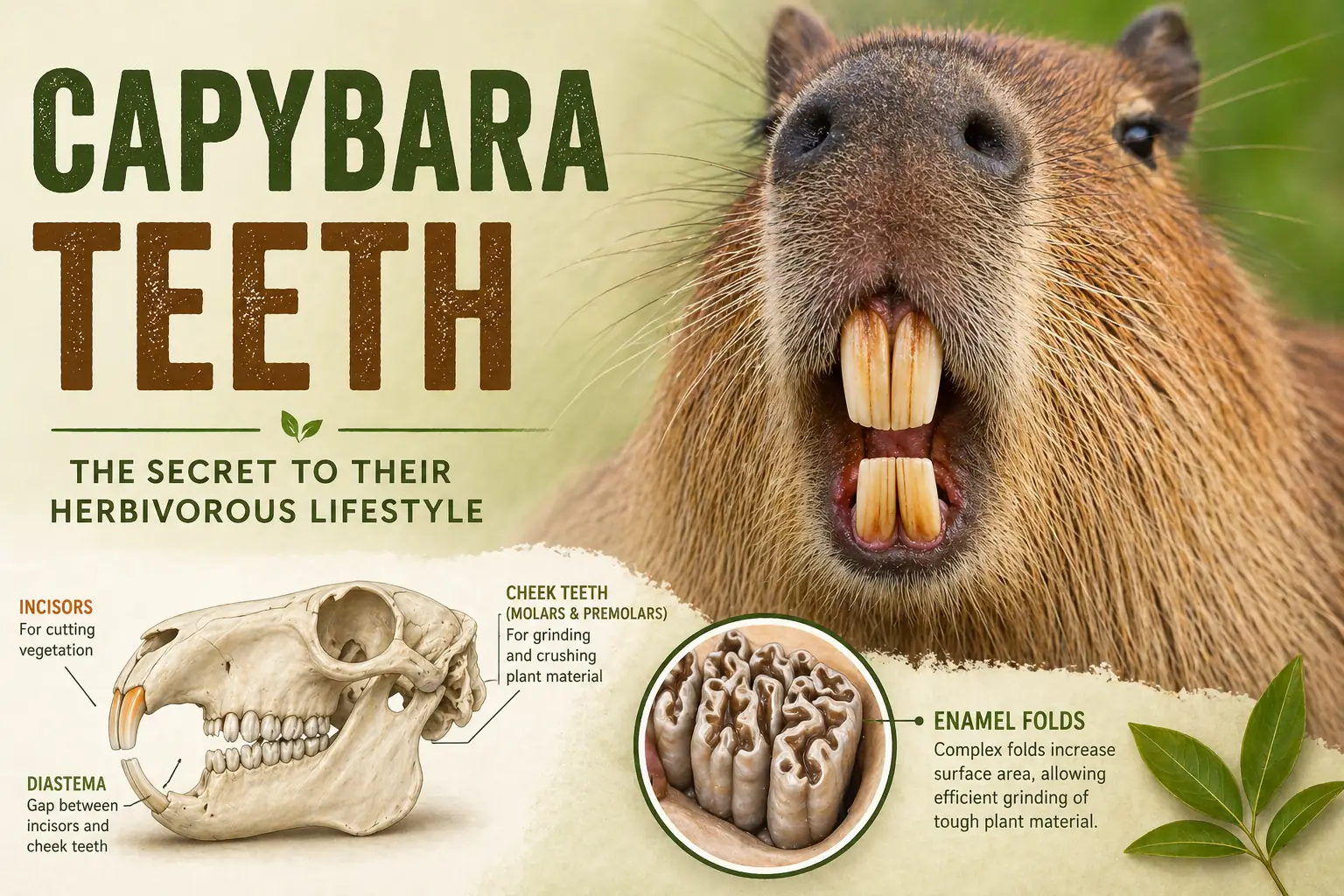
The Capybara, known as the world’s largest rodent, has a fascinating dental feature hidden behind its calm and friendly appearance teeth that never stop growing. This unusual biological trait plays a crucial role in helping capybaras survive in the wild. Because they constantly eat tough grasses and plant material, their teeth must keep growing to replace the natural wear caused by chewing.
In this guide, we will explore the fascinating world of capybara teeth in simple and easy-to-understand terms. You will learn about their unique dental structure, why their teeth grow continuously, and how their diet helps control this growth. We will also discuss common dental problems and practical ways to prevent them.
The Unique World of Capybara Dentition.What Makes Capybara Teeth So Special?
The teeth of the Capybara are specially designed to support its plant-based lifestyle. As the largest rodent in the world, capybaras spend many hours each day grazing on grasses and other fibrous plants. To handle this constant chewing, their teeth have evolved unique features that allow them to cut and grind tough vegetation efficiently.
One of the most important characteristics of capybara teeth is that they are built for continuous use and wear. Unlike many animals whose teeth stop growing after reaching adulthood, capybara teeth keep growing throughout their lives. This adaptation ensures that their teeth remain functional even though they are constantly worn down by chewing coarse plant material.
In this guide, we will explore the fascinating world of capybara teeth in simple and easy-to-understand terms. You will learn about their unique dental structure, why their teeth grow continuously, and how their diet helps control this growth. We will also discuss common dental problems and practical ways to prevent them.
Largest Rodent, Specialized Dental Adaptations
Because capybaras are much larger than most rodents, they need to process large amounts of food every day to meet their energy needs. Their dental structure helps them do this effectively.
Their front teeth (incisors) are strong and sharp, allowing them to cut through thick grasses and aquatic plants. Behind the incisors are large grinding teeth that break down plant fibers into smaller pieces. This process makes it easier for their digestive system to extract nutrients from tough vegetation.
From a biological and evolutionary perspective, this dental structure is closely linked to the capybara’s role as an efficient herbivore in South American ecosystems.
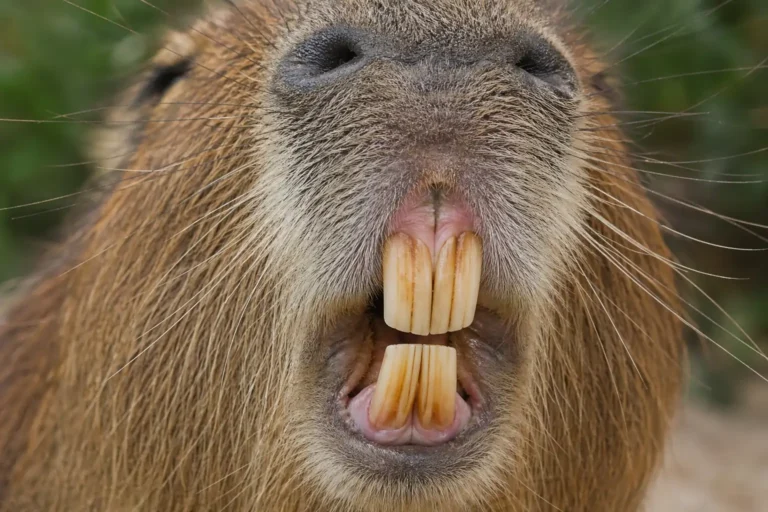
Anatomy of a Gnawing Giant: Incisors, Cheek Teeth & Their Roles
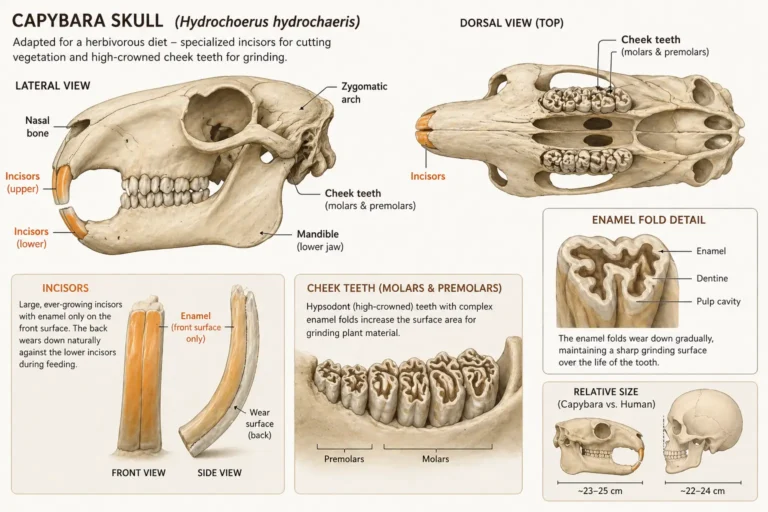
The teeth of the Capybara are highly specialized tools designed for a life centered around grazing and chewing tough plants. Each type of tooth plays a specific role in helping capybaras efficiently process large amounts of fibrous vegetation. Understanding their dental anatomy reveals how these animals are perfectly adapted to their herbivorous lifestyle.
| Tooth Type | Location/Appearance | Primary Function | Unique Characteristic |
|---|---|---|---|
|
Incisors
|
Front of mouth, chisel-shaped, orange enamel
|
Shearing vegetation, gnawing on tough materials
|
Continuously grow, self-sharpening due to differential wear
|
|
Cheek Teeth (Molars & Premolars)
|
Back of mouth, complex folded enamel patterns
|
Grinding coarse plant material into digestible pulp
|
Highly efficient for abrasive diets, wear down continuously
|
Why does Capybara Teeth Never Stop Growing?
One of the most remarkable features of the Capybara is that its teeth continue to grow throughout its entire life. This biological trait is essential for the animal’s survival because capybaras spend much of their day chewing tough plant material. Without continuous tooth growth, their teeth would wear down too quickly and eventually become unusable.
Scientists describe this condition as hypsodonty, a dental adaptation commonly found in herbivorous animals that regularly chew abrasive vegetation.
The Connection Between Diet and Tooth Wear
The continuous growth of capybara teeth is closely linked to their diet. In the wild, capybaras feed on:
- Coarse grasses
- Aquatic plants
- Reeds and stems
- Occasionally bark and shrubs
Many of these plants contain silica, a naturally occurring mineral that makes vegetation more abrasive. When capybaras chew these plants for long periods, the teeth gradually wear down.
If their teeth did not grow continuously, this constant grinding would eventually reduce them to unusable stubs. Hypsodont teeth solve this problem by replacing worn tooth material with new growth, allowing capybaras to keep grazing effectively throughout their lives.
A Day in the Life: Natural Tooth Maintenance in the Wild
In the wild, capybaras rarely suffer from severe dental overgrowth because their daily habits naturally maintain their teeth.
A typical day for a wild capybara involves hours of grazing. Living near wetlands and grasslands in South America, capybaras constantly feed on coarse grasses and aquatic plants. As they cut and grind this vegetation, their teeth gradually wear down.
During the day, a capybara may:
- Graze on thick grasses along riverbanks
- Chew on plant stems and reeds
- Strip bark from branches
- Occasionally gnaw on wood or tough plant roots
All of these activities act like a natural filing system for their teeth. The constant chewing creates the perfect balance between tooth growth and tooth wear.
This natural cycle is essential for maintaining healthy dentition in capybaras and explains why proper diet and chewing opportunities are so important when these animals are kept in captivity.
Diet as Destiny: Fueling Capybara Dental Health
For the Capybara, diet plays a much larger role than simply providing nutrition. It is also the main mechanism that keeps their teeth healthy. Because capybara teeth grow continuously, they must be worn down naturally through constant chewing. The right foods provide the abrasion needed to maintain a healthy balance between tooth growth and tooth wear.
Without a proper diet, capybaras can quickly develop dental problems such as overgrown teeth, malocclusion, and difficulty eating.
The Natural Diet: Nature’s Toothbrush
In the wild, capybaras primarily feed on coarse, fibrous vegetation. Their natural habitat wetlands, riverbanks, and grasslands provides large amounts of tough plant material that requires extensive chewing.
Typical foods in a wild capybara’s diet include:
- Grasses
- Reeds
- Aquatic plants
- Plant stems and leaves
- Occasionally tree bark
These plants are naturally abrasive, meaning they create friction when chewed.
How Abrasive Foods Wear Down Teeth
When capybaras chew fibrous plants, the grinding motion of their molars slowly wears down the surface of their teeth. This abrasion acts like a natural filing system, keeping the teeth at the proper length.
Because capybaras graze for many hours each day, their teeth are constantly being worn down at a rate that matches their natural growth. This balance is essential for maintaining healthy dentition.
Wildlife researchers and veterinarians often describe grass and hay as a “natural toothbrush” for herbivorous animals like capybaras because of the way these foods maintain dental structure through mechanical wear.
Foods to Avoid for Optimal Dental Health
Some foods may be appealing treats but provide little or no dental benefit for capybaras.
Sugary Treats and Soft Foods
Soft or sugary foods do not create the abrasion needed to wear down teeth. Feeding too many of these foods can lead to dental problems and other health concerns.
Examples of foods that should be limited or avoided include:
- Sugary fruits in large amounts
- Processed animal feeds not designed for herbivores
- Soft commercial treats
- Human snack foods
These foods can also contribute to weight gain and digestive problems.
How Diet Affects Capybara Teeth
| Dietary Component | Benefit for Teeth | Examples | Consequences of Deficiency |
|---|---|---|---|
|
Coarse, fibrous plants
|
Natural abrasion and constant grinding that keeps teeth at proper length
|
Timothy hay, orchard grass, fresh grasses, willow or applewood branches
|
Tooth overgrowth, malocclusion, dental disease, pain, difficulty eating
|
|
Aquatic vegetation
|
Supports natural chewing behavior in semi-aquatic environments
|
Water hyacinth, reeds, aquatic plants
|
Reduced natural wear and possible behavioral issues
|
Key Takeaway
For capybaras, diet directly determines dental health. Unlimited access to fibrous plants, safe browse, and natural chewing materials ensures that their continuously growing teeth remain balanced and functional. Without this natural abrasion, dental problems can develop quickly and affect the animal’s overall well-being.
Navigating Dental Challenges: Common Problems & Symptoms
Although the teeth of the Capybara are naturally adapted for constant growth and wear, dental problems can still occur especially in captivity. If their diet lacks enough abrasive material or if their teeth do not align properly, the balance between tooth growth and tooth wear can quickly be disrupted.
Because dental issues can worsen rapidly in animals with continuously growing teeth, early recognition of symptoms is essential for protecting a capybara’s health and comfort.
Recognizing Signs of Dental Distress
Capybaras usually show subtle behavioral changes when dental problems begin to develop. Careful observation of their eating habits and daily behavior can help identify issues early.
Common warning signs include:
- Excessive drooling (also known as ptyalism)
- Difficulty chewing food
- Dropping food from the mouth while eating
- Reduced appetite or refusal to eat certain foods
- Weight loss
- Facial swelling or lumps around the jaw
- Changes in normal eating habits
- Sensitivity or pain when the jaw is touched
These symptoms often appear gradually, which is why routine observation is important.
Expert Tip:
Regularly observe your capybara’s eating habits, chewing behavior, and jaw alignment for any signs of discomfort or difficulty chewing.Expert Tip:
Watch for signs of dental overgrowth such as drooling, difficulty eating, weight loss, or swelling around the face or jaw.
Veterinary professionals who work with exotic mammals frequently emphasize that early intervention greatly improves treatment outcomes for dental problems.
Understanding Malocclusion and Overgrowth
Two of the most common dental conditions seen in capybaras are tooth overgrowth and malocclusion.
Causes
These conditions may occur due to several factors, including:
- Diet lacking enough coarse, fibrous vegetation
- Limited opportunities for natural chewing
- Genetic or congenital dental abnormalities
- Injuries to the jaw or teeth
Among these, improper diet is one of the most frequent causes in captive animals.
Impact on Health
When teeth become misaligned, they cannot grind against each other properly. This prevents natural wear and allows some teeth to grow longer than others.
As the problem worsens, several complications can occur:
- Teeth may form sharp edges or abnormal angles
- The capybara may struggle to close its mouth properly
- Eating becomes painful and inefficient
If untreated, severe dental problems can eventually lead to malnutrition or starvation, since the animal is unable to chew food properly.
Beyond Overgrowth: Spurs, Root Elongation, and Abscesses
In more advanced cases, dental problems can lead to additional complications that require veterinary treatment.
Dental Spurs
Dental spurs are sharp points of enamel that develop when teeth wear unevenly. These spurs often form on the molars and can cut into the tongue or inner cheek lining.
This condition can cause:
- Mouth pain
- Difficulty chewing
- Bleeding or irritation inside the mouth
Root Elongation
Another serious issue is root elongation, where the root of a tooth grows excessively long beneath the gum line. Because capybara teeth grow continuously, the root may extend deeper into surrounding structures.
This can lead to:
- Pressure within the jawbone
- Facial swelling
- Pain while chewing
- In severe cases, pressure near the eye socket
Dental Abscesses
Dental abscesses occur when bacteria infect damaged teeth or surrounding tissues. These infections often develop as a complication of untreated dental overgrowth or root problems.
Symptoms of an abscess may include:
- Swelling around the jaw or face
- Pus-filled lumps
- Pain and reduced appetite
- Lethargy or behavioral changes
Abscesses are painful and require prompt veterinary care to prevent the infection from spreading.
Myth vs. Fact: Capybara Dental Care
Because capybaras are rodents with continuously growing teeth, several misconceptions about their dental health are common.
Myth: Capybaras only need hard foods to keep their teeth healthy.
Fact: Hard foods alone are not enough. Capybaras need fibrous, abrasive vegetation like hay and grasses to create the proper grinding action that wears down teeth naturally.Myth: Capybara teeth take care of themselves completely.
Fact: While natural chewing helps maintain tooth length, dental problems can still occur—especially in captivity—if diet and environment are not appropriate.Myth: All rodents have the same dental problems.
Fact: Different rodents have different diets and tooth structures, which means their dental issues can vary. Large grazing rodents like capybaras face different challenges than smaller rodents that eat seeds or nuts
| Problem | Symptoms | Causes | Potential Solutions/Treatment |
|---|---|---|---|
|
Dental Overgrowth
|
Drooling, difficulty eating, weight loss, facial swelling, reduced appetite
|
Insufficient wear from diet, genetics, trauma
|
Trimming/burring by exotic vet, dietary changes, environmental enrichment
|
|
Malocclusion
|
Misalignment of teeth, inefficient chewing, abnormal wear patterns
|
Genetics, trauma, improper dietary wear
|
Corrective procedures (e.g., trimming, orthodontic appliances), ongoing management
|
|
Dental Spurs
|
Sharp points on teeth, oral lesions, reluctance to chew
|
Uneven wear, malocclusion
|
Filing/burring by exotic vet
|
|
Root Elongation
|
Eye bulging, facial swelling, pain, reduced appetite
|
Chronic malocclusion, genetics
|
Surgical intervention, pain management, ongoing dental care
|
|
Abscesses
|
Swelling, pain, pus, reluctance to eat, fever
|
Infection from trauma, root elongation, severe dental disease
|
Antibiotics, drainage, surgical intervention, tooth extraction (rare)
|
Proactive Care: Ensuring Optimal Dental Health for Capybaras
Because the teeth of the Capybara grow continuously, preventive care is essential. Proper diet, environmental enrichment, and regular veterinary monitoring all work together to maintain healthy teeth. Without proactive care, dental problems can develop quickly and affect the capybara’s ability to eat and stay healthy.
For owners and caregivers, creating the right environment and seeking professional veterinary guidance are the most effective ways to prevent serious dental complications.
The Role of Environmental Enrichment and Chew Items
In the wild, capybaras spend many hours each day grazing, chewing plant stems, and occasionally gnawing on wood. These natural activities help keep their teeth worn down. In captivity, providing appropriate chew items can help replicate this natural behavior.
Common options include:
- Untreated willow branches
- Applewood branches
- Large, durable chew toys designed for large rodents
- Natural wooden enrichment items
It is important that any wood or chew item is free from pesticides, chemicals, paints, or preservatives, as capybaras may ingest small pieces while chewing.
Expert Tip:
Provide safe, non-toxic chew toys or branches such as willow or applewood to encourage natural gnawing behavior.
Veterinary Care: Regular Check-ups and Specialist Expertise
Even with proper diet and enrichment, capybaras still require regular veterinary care to monitor their dental health.
Specialized veterinarians understand the unique characteristics of rodent teeth and have the proper tools to examine and treat dental problems safely.
Expert Tip:
Schedule routine veterinary check-ups with an exotic animal veterinarian who specializes in rodent dental health.
Routine Dental Check-ups
Veterinary professionals typically recommend annual or biannual dental examinations, even if the capybara appears healthy. These routine check-ups allow veterinarians to detect early signs of dental problems before they become severe.
Conclusion
The remarkable, continuously growing teeth of the capybara are a testament to nature’s ingenuity, perfectly suited for their herbivorous lifestyle. However, this unique adaptation places a significant responsibility on their caregivers. Understanding the intricacies of their dentition is not merely an academic exercise; it is fundamental to ensuring their long-term health and well-being
Expert Insights: Q&A with an Exotic Animal Veterinarian on Capybara Dental Health
To provide authoritative guidance on capybara dental care, we consulted an exotic animal veterinarian with extensive experience working with large rodents. Their clinical insights help pet owners and wildlife enthusiasts understand the best practices for maintaining healthy teeth in capybaras.
Common Questions on Capybara Dental Health
Q: How often should a capybara’s teeth be checked?
A: “Ideally, pet capybaras should have their teeth checked at least once a year during their annual wellness exam. If there are any signs of dental problems, more frequent checks or immediate veterinary attention are necessary.”
Q: What are the emergency signs of severe dental problems that require immediate veterinary attention?
A: “Seek immediate veterinary care if your capybara:
- Stops eating completely
- Shows severe facial swelling
- Has persistent drooling
- Appears in significant pain (e.g., hunched posture, lethargy)
These symptoms may indicate severe overgrowth, abscesses, or other critical dental issues.”
Q: Can dental issues in capybaras be completely prevented?
A: “While a proper diet, environmental enrichment, and safe chewing materials can significantly reduce the risk of dental problems,. Regular veterinary check-ups remain crucial for early detection and management.”
Q: What kind of veterinarian should I seek for capybara dental care?
A: “It’s essential to find a veterinarian who specializes in exotic animals, particularly rodents or zoological medicine.
Q: Are there any at-home remedies for mild overgrowth?
A: “Absolutely not. There are no safe or effective at-home remedies for capybara dental overgrowth. Professional veterinary intervention is always required.”