
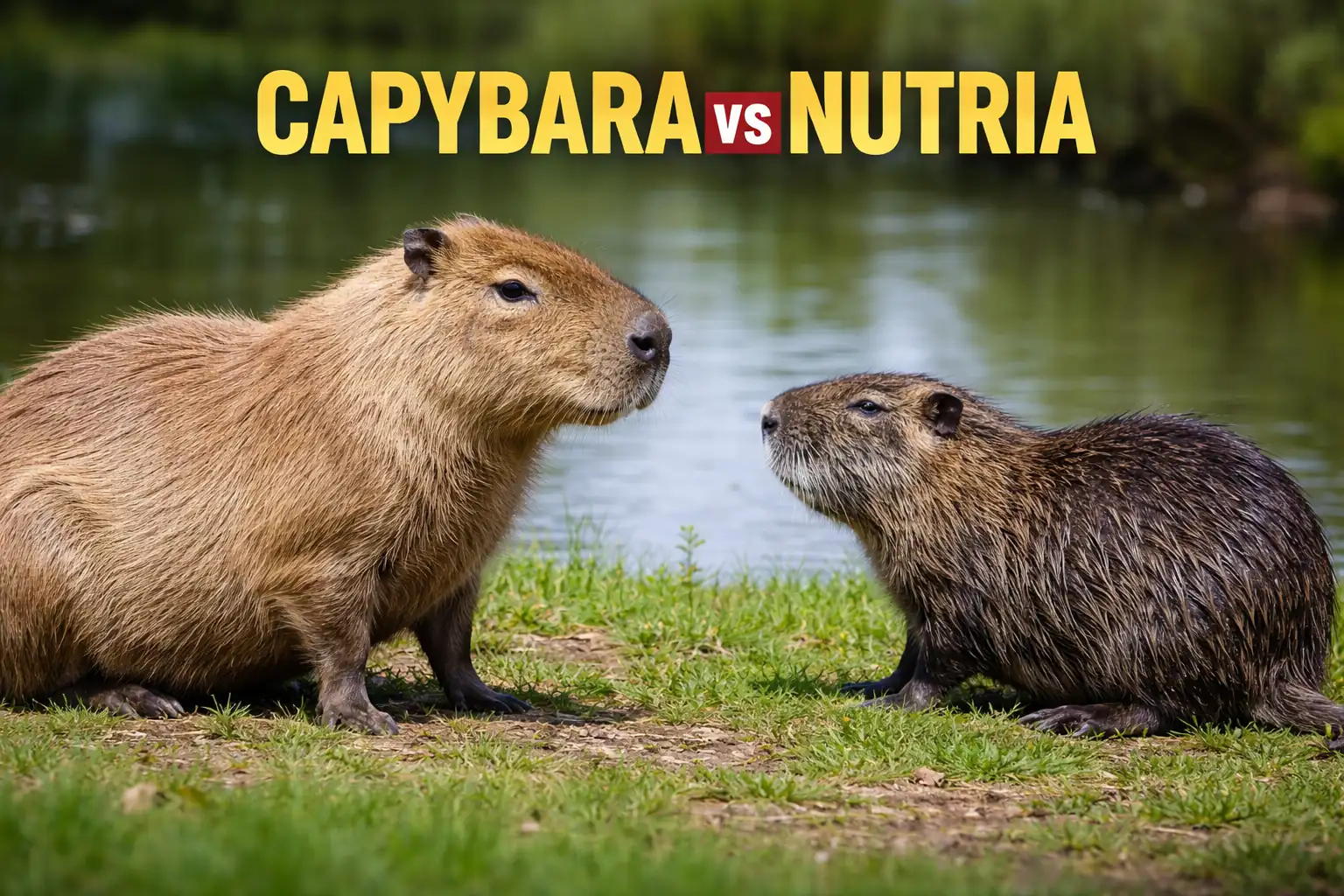
Have you ever spotted a large, furry creature resting near a riverbank and thought, Was that a giant rat… or something more exotic? If so, you’re not alone. The confusion between nutria and capybara is surprisingly common.
This guide will help you tell them apart with confidence. You’ll learn about their size, appearance, habits, and habitats.
Capybara: The Gentle Giant of South American Wetlands
The capybara (Hydrochoerus hydrochaeris) is the largest rodent on Earth. It is a semi-aquatic mammal native to South America. Known for its calm nature and unique appearance, the capybara plays a key role in its ecosystem.
Appearance: Capybaras have a blocky head, short stubby tail, and partially webbed feet.
Size: Much larger than nutria. They can weigh up to 150 lbs (68 kg) and stand about 2 feet tall at the shoulder.
Coat: Their fur is coarse and ranges from reddish-brown to grayish.
Native Habitat and Range:
- Geography: Found mainly in tropical and subtropical regions of South America.
- Preferred Environments: Wetlands, swamps, marshes, rivers, and lakes. They always stay near water.
Behavior and Social Structure:
- Social Animals: Capybaras live in groups, often family units, which can range from a few individuals to large herds.
- Daily Routine: Highly aquatic, they spend much time in water to cool down and avoid predators. Mostly active during dawn and dusk (crepuscular).
- Diet: Herbivores that mainly graze on grasses and aquatic plants.
Conservation Status and Cultural Significance:
- Conservation: The species is generally of Least Concern. Local populations may face threats from habitat loss and hunting. (Source: IUCN Red List)
- Cultural Role: Capybaras are important in South American ecosystems. In some regions, they are a food source and appear in local folklore.
Practical Tip: For the latest conservation status and distribution details, visit IUCN Red List.
Nutria: The Global Aquatic Invader
Overview: The nutria (Myocastor coypus), also called the coypu, is a large semi-aquatic rodent. It is native to South America but has been introduced to North America, Europe, Asia, and Africa. Outside its native range, it is known for its destructive ecological impact.
Appearance: Nutrias look like a large rat or small beaver. They have a long, rounded, rat-like tail and a pointed snout.
Size: Smaller than capybaras, usually weighing up to 20 lbs (9 kg).
Coat: Dense brown fur, often lighter on the belly. They have distinctive bright orange incisors.
Native and Introduced Populations:
- Native Range: Subtropical and temperate South America.
- Global Spread: Brought worldwide for fur farming in the early 20th century. Many escaped or were released, creating feral populations.
Behavior and Dietary Habits:
- Activity: Mostly nocturnal or crepuscular, but sometimes active during the day.
- Burrowing: Build extensive burrows along riverbanks. This can destabilize the soil and cause erosion.
- Diet: Herbivores that eat a wide range of vegetation, including roots, tubers, and crops.
Ecological Impact as an Invasive Species:
- Habitat Destruction: Burrowing and feeding habits damage wetlands, reduce biodiversity, and cause erosion.
- Economic Costs: Can harm crops, levees, and other infrastructure.
- Disease Risk: May carry parasites and diseases affecting wildlife and humans.
Transparency: Nutrients’ invasive behavior is a serious environmental issue. Management programs exist in many countries to control their populations.
The Definitive Showdown: Nutria vs. Capybara (Side-by-Side)
This section provides a crucial, direct comparison of nutria and capybara across various key characteristics for easy understanding and identification.
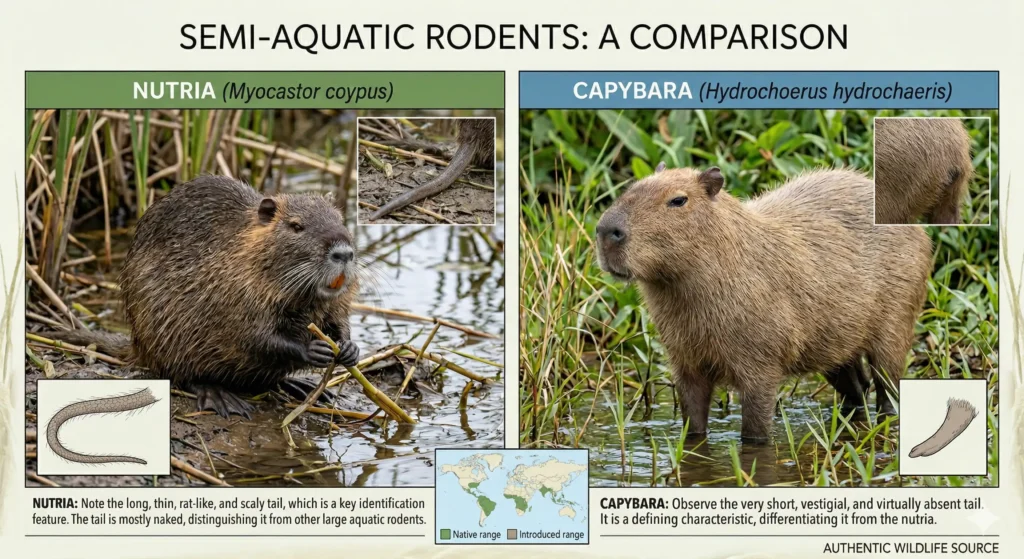
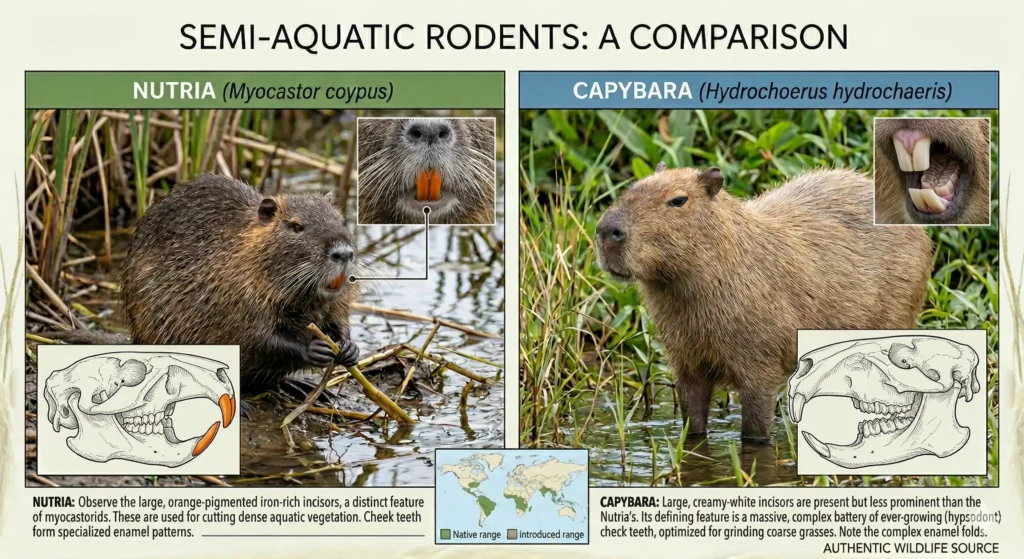
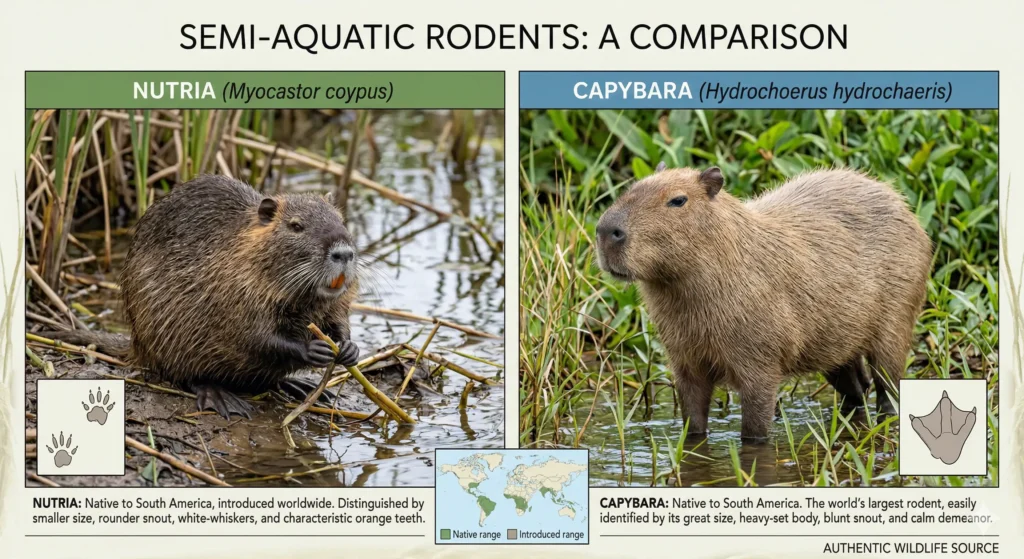
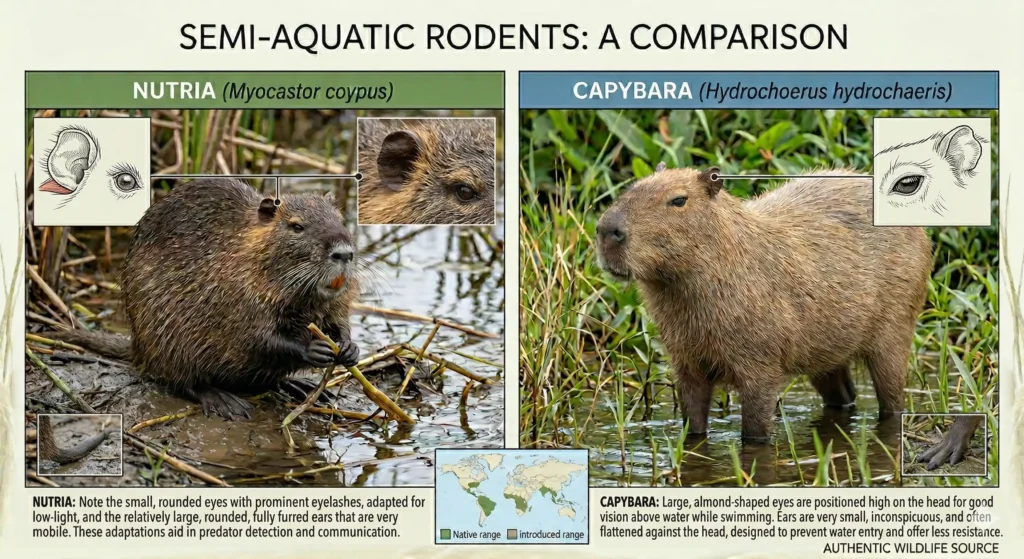
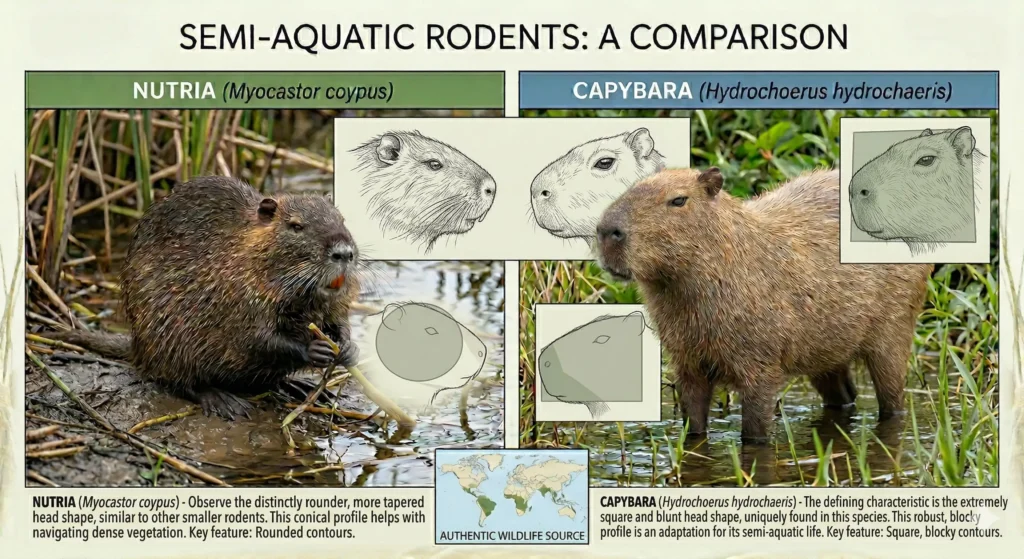
| Feature | Capybara (Hydrochoerus hydrochaeris) | Nutria (Myocastor coypus) |
|---|---|---|
|
Average Size
|
Largest rodent: Up to 150 lbs (68 kg), 2 ft tall, 4 ft long.
|
Smaller: Up to 20 lbs (9 kg), 1.5 ft tall, 2 ft long (excluding tail).
|
|
Tail
|
Very short, stubby, almost imperceptible.
|
Long (12-18 inches), rounded, rat-like, often hairless.
|
|
Head Shape
|
Blocky, broad, squarish snout. |
Pointed snout. |
|
Eyes & Ears
|
Small, positioned high on the head, adapted for swimming with most of body submerged.
|
More typically placed on the side of the head.
|
|
Teeth
|
Prominent, light yellow to white incisors.
|
Distinctive, bright orange-red incisors.
|
|
Hind Feet
|
Partially webbed, four front toes and three hind toes visible in tracks. |
Webbed, five toes on hind feet, tracks show webbing.
|
|
Coat Color/Texture
|
Coarse, shaggy, reddish-brown to grayish fur.
|
Dense, glossy brown fur, often lighter belly.
|
|
Swimming Style
|
Often swims with only eyes, nose, and ears above water (like a hippopotamus). Graceful.
|
ContentSwims lower in the water, often dives more frequently.
|
|
Native Geographic Range |
ContSouth America (tropical and subtropical wetlands).
ent |
South America (subtropical and temperate wetlands).
|
|
Global Distribution |
Primarily confined to native South American range.
|
Widespread invasive populations across North America, Europe, Asia, Africa (introduced).
|
|
Ecological Role
|
Native keystone species, grazer, food source for predators, ecosystem engineer. |
Invasive pests cause significant wetland degradation, erosion, and agricultural damage.
|
|
Social Structure
|
Highly social, live in groups/herds.
|
Can be social, often found in smaller groups or solitary.
|
Rapid Identification: Visual Cues and Behavioral Tells (Expanded Version)
Spotting a capybara versus a nutria in the wild can be tricky. Here are the most reliable ways to tell them apart quickly.
Size Matters
- Capybara: Much larger, about the size of a medium dog, weighing up to 150 lbs (68 kg). Adult capybaras are long and sturdy, making them hard to miss.
- Nutria: Smaller, like a large house cat or small beaver, usually up to 20 lbs (9 kg). Their compact size makes them more agile and harder to spot in dense vegetation.
The Tail Tale
- Capybara: Very short, stubby tail, almost hidden by the body. Rarely visible when moving.
- Nutria: Long, rounded, rat-like tail. Often hairless and used for balance while swimming.
Head Shape and Facial Features
- Capybara: Blocky, square head. Eyes, ears, and nostrils sit high, allowing most of the body to stay submerged in water.
Nutria: Pointed snout. Eyes and ears more on the sides. Bright orange incisors are always visible and a clear sign of nutria.
Extra Tip: Capybaras have a calmer expression and larger, rounder cheeks. Nutrias have sharper facial angles.
Swimming Style
- Capybara: Swims like a small hippo, with only eyes, nose, and ears above water. Often floats slowly and gracefully.
- Nutria: Swims lower in the water and dives more frequently. Moves faster and more erratically when disturbed.
- Extra Tip: Watch how they enter the water. Capybaras slide in smoothly; nutria often dive suddenly.
Tracks and Footprints
- Capybara Tracks: Four toes on front feet, three on hind feet. Webbing may leave a “spoon-like” impression.
- Nutria Tracks: Five toes on hind feet with webbing. Front feet show smaller, clawed toes.
- Expert Tip: Track size is a strong clue. Capybara tracks are much larger and rounder than nutria tracks.
Vocalizations
- Capybara: Bark, whistle, purr, and whistle to communicate with the group. Very social and expressive.
Nutria: Squeaks, grunts, and hissing. Less studied, more subtle than capybaras.
- Extra Tip: Listening for these sounds at dawn or dusk can help identify which species is nearby.
Behavioral Tells
- Capybara: Gentle and social. Often seen in large groups. Tolerant of other species around them.
- Nutria: More solitary or in small groups. Territorial. May hiss or show aggression if approached.
Observation Tip: Capybaras are easier to approach and watch. Nutria are skittish and may flee quickly.
Worlds Apart: Habitat, Distribution, and Adaptation
Capybaras and nutrias may look similar, but their habitats and adaptations reveal very different lifestyles.
Native vs. Capybara
- Capybara: Found only in tropical and subtropical wetlands of South America. Their presence indicates a healthy, balanced ecosystem.
- Nutria: Native to temperate South America but introduced worldwide for fur farming. Now feral populations exist in North America, Europe, Asia, and Africa.
Implications of Geographic Distribution
- Capybara: Being native, it supports natural biodiversity and coexists with local predators and plants.
- Nutria: Presence outside South America is a warning sign for environmental managers. These rodents can disrupt wetland ecosystems and harm local wildlife.
Expert Tip: In areas with invasive nutria, report sightings to local wildlife authorities. Early detection helps control population growth and prevent environmental damage.
Worlds Apart: Habitat, Distribution, and Adaptation
Capybaras and nutrias may look similar, but their habitats and adaptations reveal very different lifestyles.
Native vs. Capybara
- Capybara: Found only in tropical and subtropical wetlands of South America. Their presence indicates a healthy, balanced ecosystem.
- Nutria: Native to temperate South America but introduced worldwide for fur farming. Now feral populations exist in North America, Europe, Asia, and Africa.
Implications of Geographic Distribution
- Capybara: Being native, it supports natural biodiversity and coexists with local predators and plants.
- Nutria: Presence outside South America is a warning sign for environmental managers. These rodents can disrupt wetland ecosystems and harm local wildlife.
Adaptations for Aquatic Life
Both rodents are semi-aquatic, but each has evolved unique ways to thrive in water.
Shared Adaptations:
- Webbed feet for swimming.
- Ability to forage underwater for plants.
Capybara Unique Adaptations:
- Eyes, ears, and nostrils on top of the head.
- Can see, hear, and breathe while mostly submerged.
- A strong, heavy body helps in slow, graceful swimming.
Nutria Unique Adaptations:
- Valvular nostrils to keep water out while submerged.
- Lips positioned behind incisors, allowing them to gnaw underwater without swallowing water.
- A smaller, lighter body enables quick dives and escape.
Evolutionary Split: Why They Differ
Although both are large, semi-aquatic rodents, capybaras and nutrias evolved on separate paths:
- Capybara: Adapted to stable, tropical wetlands with strong social groups.
- Nutria: Adapted to variable temperate wetlands and opportunistic feeding.Their distinct adaptations reflect different ecological niches and survival strategies.
Observation Tip: Knowing these differences helps you predict behavior in the wild. For example, capybaras float calmly, while nutria dive and move quickly when threatened.
Conclusion: Unraveling the Aquatic Rodent Mystery
Capybaras and nutrias look alike, but they are different. Capybaras are much bigger, have almost no tail, and are native to South America. Nutrias are smaller, have long rat-like tails, and are often invasive in many places.
Capybaras are social and important for wetland ecosystems. Nutrias can damage habitats and harm native wildlife. Knowing the difference helps people protect nature and report invasive animals.
By learning and sharing this knowledge, we can help protect wetlands and the animals that live there.
Frequently Asked Questions
What is the difference between capybaras and nutria?
Capybaras are the world’s largest rodents, while nutria (coypu) are smaller semi-aquatic rodents with long orange teeth and rat-like tails.
Which is bigger, a capybara or a nutria?
Capybaras are much larger, often weighing up to 60 kg, while nutria usually weigh around 5–10 kg.
Do capybaras and nutria live in the same habitat?
Yes, both live near rivers, lakes, and wetlands, but capybaras are native to South America, while nutria are originally from South America but are now found in many countries.
How can you identify a capybara vs. a nutria?
Capybaras have round bodies, short legs, and blunt faces, while nutria have long tails, orange teeth, and a more rat-like appearance.
Are capybaras friendlier than nutria?
Capybaras are generally calm and social, while nutria are more shy and less commonly kept around humans.
What do capybaras and nutria eat?
Both eat plants, grasses, and aquatic vegetation, but capybaras prefer to graze on land, while nutria often feed near the water’s edge.
Can capybaras and nutria live together?
In the wild, they may share habitats, but they do not form social groups together or interact closely.
Which is more common, capybara or nutria?
Nutria are more widely spread globally due to their introduction in many countries, while capybaras are mostly found in South America.

Carly
Exotic Pet Research Specialist
Hi, I’m Carly, and I’m the heart behind CapybaraTalks.com. My journey with capybaras began when I met my first pet, and I was instantly fascinated by her calm, social, and endlessly curious nature. Capybaras are gentle, playful, and love to swim and explore—each one has a unique personality that makes them such special companions.