
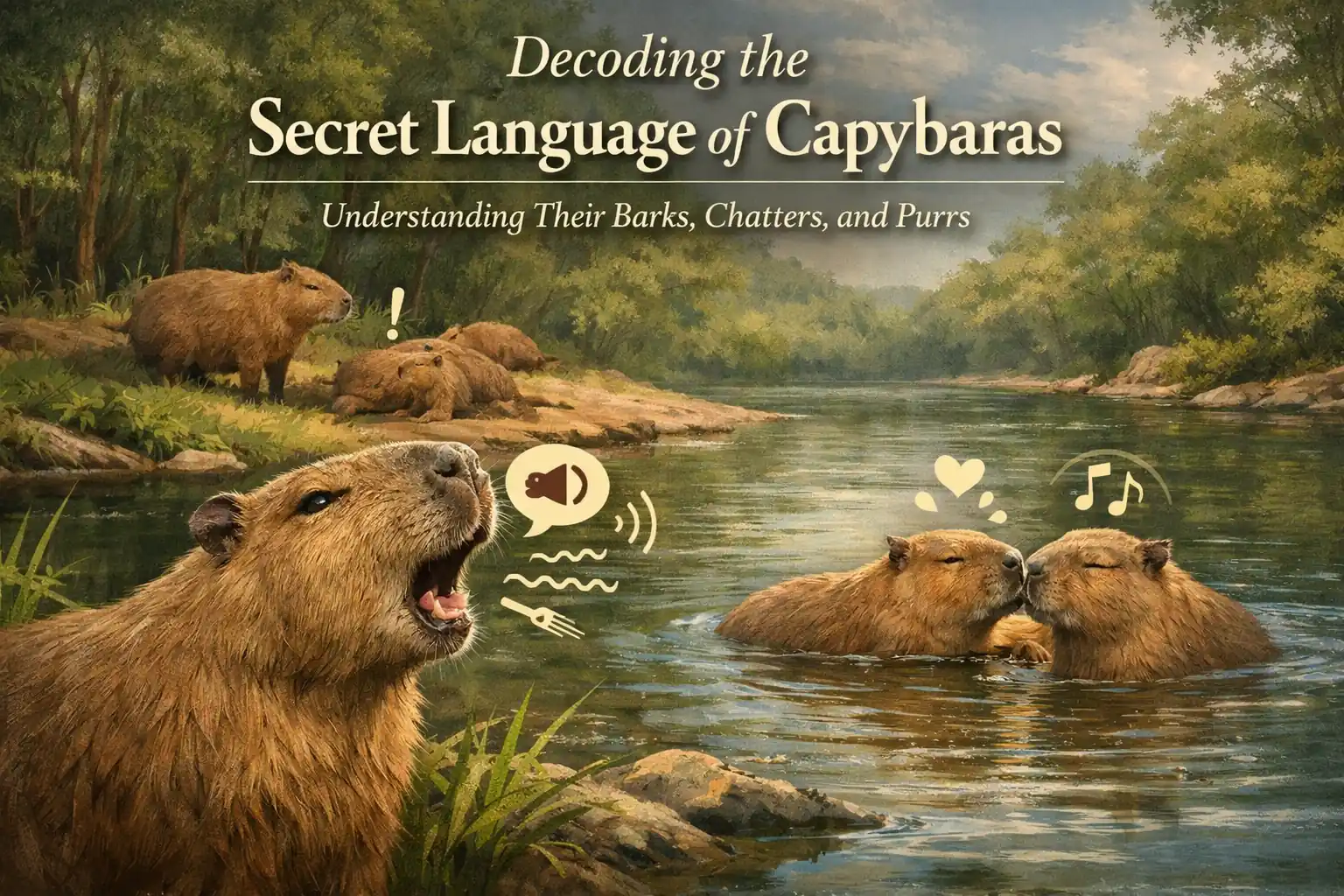
Have you ever heard an animal sound and wondered what it meant? The same happens with Capybara sounds—their unique language needs a little decoding, and we’re here to help you understand what their signals mean.
Capybaras are not limited to sharp alarm barks. They also use soft purrs, whistles, clicks, grunts, and even tooth chattering. Each sound has a purpose.
In this guide, you will learn what each capybara sound means, when it is used, and why it matters. By the end, you will not just hear capybara noises — you will understand them.
Decoding the Capybara's Lexicon: Primary Sounds Explained
Chattering: The Sound of Alertness and Social Signals
How it sounds
Chattering is a fast, high-pitched series of short sounds. It often resembles a quick “ch-ch-ch-ch.” The rhythm is sharp and repeated.
What it usually means
Chattering often signals alertness. It can act as a mild warning. It may also serve as a simple social signal between group members.
Listening carefully to tone and intensity makes a difference. The same sound can signal safety, caution, or mild tension. Understanding this helps you interpret their behavior more accurately instead of guessing.
Purring / Whirring: The Sound of Contentment and Affiliation
How it sounds
Capybara purring is a low, steady rumble. It is deeper than a cat’s purr. Some people describe it as a soft “whirring” or gentle vibration. The sound is smooth and continuous.
What it usually means
Purring signals comfort and trust. It shows that the capybara feels safe. It is often linked to bonding within the group.
Barking: The Distinct Alarm Call
How it sounds
A capybara bark is loud and sharp. It can sound like a deep “honk” or a rough growl mixed with a bark. Some people compare it to a dog, but it is usually deeper and more resonant.
What it usually means
This is the main alarm call. It clearly signals danger. When one capybara barks, the group reacts quickly. Most will move toward water, which is their safest escape route.
Whistling / Squealing: High-Pitched Communication
How it sounds
This sound is high and sharp. It can range from a soft whistle to a loud, piercing squeal. The louder versions are easy to notice, even from a distance.
What it usually means
High-pitched sounds often signal strong emotion. This can include distress, excitement, or a call for attention. Young capybaras use these sounds more often than adults.
Important clarification
Not every high-pitched sound means danger. This is a common misunderstanding. The key is to observe body language and surroundings. Is the capybara relaxed? Is it playing? Or does it appear tense and trying to escape?
When you combine sound with context, you avoid misreading the signal. That leads to a more accurate and responsible understanding of capybara behavior.
Grunting / Growling: Low-Frequency Signals
How it sounds
These are low, deep sounds. A grunt is short and muted. A growl is longer, rougher, and more intense. Both are lower in pitch than whistles or barks.
What it usually means
Grunts often signal mild irritation or close-range communication. Growls are more serious. They warn of aggression, dominance, or a stronger boundary.
Low-frequency sounds may seem subtle, but they play an important role in maintaining order within the group. They help prevent conflict before it escalates.
Beyond the Sound: Context, Body Language, and Meaning
Capybara communication is not based on sound alone. To understand what they mean, you must also observe posture, movement, and environment. Wildlife researchers stress that behavior and context work together. A sound without context can be misleading.
The Power of Context: When and Why Capybaras Make Sounds
Capybara sounds reveal different meanings depending on the situation.
Soft chattering or purring usually happens during grooming, resting, or group bonding and signals comfort.
Loud barks or sharp chatter warn the group about danger, often with an alert posture and movement toward water.
During the mating period, some vocal sounds appear along with scent marking and body positioning.
Calm purring shows relaxation, while high-pitched squeals or deep growls signal fear or distress.
Grunts and growls may also occur when a capybara is guarding food, space, or a resting spot.
Expert Tip
Always assess the environment. When you combine vocal cues with physical signals, you move from simply hearing capybara sounds to accurately interpreting their behavior.
Body Language and Vocalizations: A Combined Language
Capybaras communicate using both sound and body signals. Observing posture, facial expression, and movement helps you understand the meaning behind each vocalization.
Key Body Language Signals
- Alertness: When a capybara is on guard, chattering often comes with an upright posture, ears swiveled forward, and a direct gaze toward the perceived threat. This combination warns the group and signals vigilance.
- Submission or fear: Submissive capybaras lower their heads, flatten their ears, or try to retreat. Soft squeals may accompany these actions, especially in young or cornered animals.
- Aggression or dominance: Growls and barks are often paired with raised heads, gaping mouths showing teeth, or charging. These signals help establish hierarchy or defend territory.
- Contentment: Purring usually occurs with relaxed posture, half-closed eyes, and often during mutual grooming sessions. This shows comfort and social bonding.
Expert Tip
Combining sound with body language allows you to interpret capybara communication accurately. For example, a soft squeal with relaxed posture may indicate playfulness, while the same squeal with stiff body and wide eyes signals distress.
Capybara Communication in Society: Social Dynamics and Vocal Roles
Wildlife studies show that vocal communication in capybaras is both adaptive and socially functional. Researchers observe that these sounds are not random; they are context-driven signals shaped by herd dynamics. For example, the frequency and type of vocalization often correspond to the capybara’s role in the group (dominant male, mother, or juvenile), which highlights the biological and social importance of each call.

Capybara Sounds in Perspective: Comparisons and Misconceptions
How Capybara Sounds Compare to Other Animals
- Capybara barks vs nutria: Both serve as alarm calls, but capybara barks are deeper, more resonant, and usually less varied in pitch.
- Capybara purrs vs. cat purrs: Capybara purrs are lower in frequency and sound more like a continuous rumble.
Capybara sounds vs. guinea pig sounds:Capybaras have a wider range, including deep barks, growls, and purrs not seen in guinea pigs. This makes their vocal communication more complex and socially nuanced.
Why This Matters
Comparing capybara sounds to familiar animals helps readers recognize the purpose and meaning behind each vocalization.
Common Misconceptions About Capybara Sounds
Capybaras are often misunderstood because of their unusual vocalizations. Here are some common myths and the facts behind them:
Myth: Capybaras are mostly silent.
Reality: Capybaras are actually quite vocal. They use a variety of sounds for social interaction, bonding, and alerting the herd to danger.
Myth: All barks mean aggression.
Reality: Barks are primarily alarm signals, not always aggressive. Context and body language matter.
Experiencing Capybara Sounds: Where to Listen and Learn
Capybaras are often misunderstood because of their unusual vocalizations. Here are some common myths and the facts behind them:
Myth: Capybaras are mostly silent.
Reality: Capybaras are actually quite vocal. They use a variety of sounds for social interaction, bonding, and alerting the herd to danger.
Myth: All barks mean aggression.
Reality: Barks are primarily alarm signals, not always aggressive. Context and body language matter.
Conclusion: The Importance of Understanding Capybara Sounds
Capybara are far from silent animals. They use a variety of sounds, from gentle purrs and soft chatters to loud barks and squeals, to communicate emotions, social signals, and warnings. When these sounds are understood along with body language and context, they reveal important insights into capybara behavior, social bonds, and their interaction with the environment, helping us better appreciate and protect these gentle animals.
Frequently Asked Questions About communication
Do capybaras have a language?
Capybaras do not have a language like humans, but they use a complex system of communication that includes sounds, body movements, and scent signals to interact with each other.
What sounds do capybaras make?
Capybaras produce a variety of sounds such as barks, whistles, purrs, clicks, and grunts. Each sound serves a different purpose depending on the situation, like warning others or expressing comfort.
How do capybaras warn each other of danger?
When they detect danger, capybaras make loud barking noises to alert the group. This warning usually causes others to quickly move toward water or a safer area.
Do baby capybaras communicate differently?
Baby capybaras often use higher-pitched sounds like whistles and squeaks to communicate with their mothers, especially when they need attention or feel threatened.
How important is body language in capybara communication?
Body language plays a major role in capybara communication. They use posture, movement, and positioning to show dominance, submission, or social bonding within the group.
Do capybaras use scent to communicate?
Yes, capybaras use scent glands to mark their territory and communicate with others. These scent signals can indicate identity, status, or boundaries.
Can humans understand capybara sounds?
Humans can understand general meanings behind capybara sounds, such as recognizing alarm calls or relaxed noises, but they cannot fully interpret them like a structured language.
Do capybaras communicate differently in groups compared to being alone?
Capybaras communicate more actively in groups, using frequent sounds and signals to stay connected and maintain social harmony, whereas solitary communication is much less active.